中国:消费疲软与投资大跌致四季度增长放缓
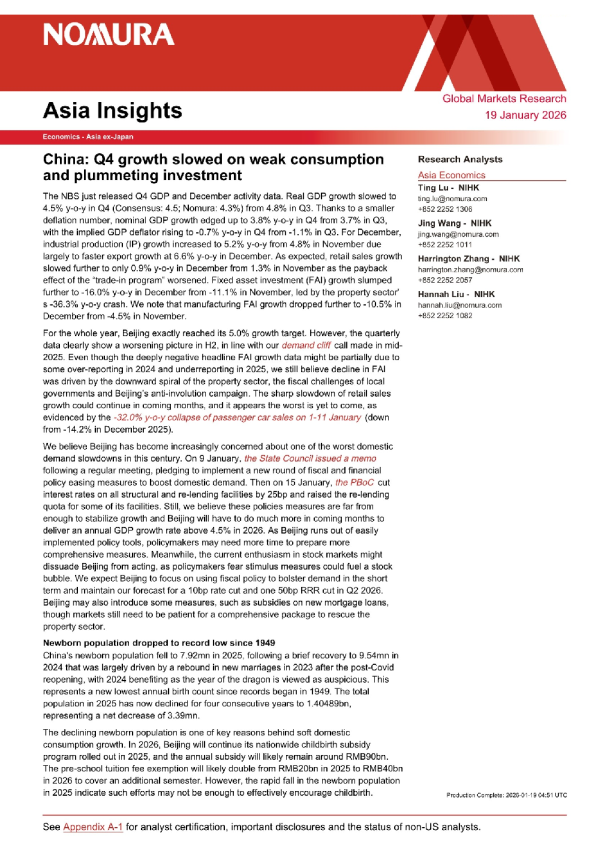
China:Q4growthslowed onweak consumptionandplummeting investment Research Analysts Asia Economics Ting Lu - NIHKting.lu@normura.com+852 2252 1306 The NBS just released Q4 GDP and December activity data. Real GDP growth slowed to4.5% y-0-y in Q4 (Consensus: 4.5; Nomura: 4.3%) from 4.8% in Q3. Thanks to a smallerdeflation numiber, nominal GDP growth edged up to 3.8% y-o-y in Q4 from 3.7% in Q3,with the implied GDP deflator rising to -0.7% y-0-y in Q4 frorn -1.1% in Q3. For December,industrial production (IP) growth increased to 5.2% y-o-y from 4.8% in November duelargoly to faster export growih at 6.6% y-o-y in Decomber. As expocted, retail sales growthslowed further to only O.9% y-o-y in December from 1.3% in November as the paybackeffect of the “trade-in program" worsened. Fixed asset investment (FAl) growth slumpedfurther to -16.0% y-o-y in December from -11.1% in November, led by the property sectors -36.3% y-0-y crash. We note that manufacturing FAl growth dropped further to -10.5% inDecember from -4.5% in November. Jing Wang - NIHK[Iing-wang@ncmura.com+852 2252 1011 Harrington Zhang - NIHKharrington.zheng@rnomur9.com+852 2252 2057 Hannah Liu - NIHKhanrah.lu@ncmuna.com+882 2252 1082 For the whole year, Beijing exactly reached its 5.0% growth target. However, the quarterly2025. Even though the deeply negative headline FAl growth data might be partially due tosome over-reporting in 2024 and underreporting in 2025, w still believe decline in FAlwas driven by the dowward spiral of the property sector, the fiscal challenges of localgrowth could continue in coming months, and it appears the worst is yet to come, asfrom -14.2% in Docomber 2025).evidenced by the -32. 0% y-0-y collapse of passonger car sales on f-1f January (down We believe Bejing has bocome incroasingly concornod about one of the worst domesticdemand slowdowns in this century. On 9 January, the Stafe Counci issued a momofollowing a regular meeting. pledging to implement a new round of fiscal and financialinterest rates on all structural and re-lending faciities by 25bp and raisec the re-lendingquota for some of its faiities. Still, we believe these policies measures are far fromenough to stabilize growth and Beijing vill have to do much more in coming months todeliver an annual GDP growth rate above 4.5% in 2025. As Beijing runs out of εasilyimplemented policy tools, policymakers may need more time to prepare morecomprehensive measures. Meanwhile, the current enthusiasm in stock markets mightdissuade Beijing from acting, as policymakers fear stimulus measures could fuel a stockbubble. We expect Bejing to focus on using fiscal policy to bolster demand in the shortterm and maintain our forecast for a 10bp rate cut and one 50bp RRR cut in Q2 2026.Bejing may also introduce some measures, such as subsicies on new mortgage loans,though rmarkets sill need to be patient for a comprehensive package to rescue theproperty sector. Newborn population dropped to record low since 1949 China's newbom population fell to 7.92mn in 2025, following a brief recovery to 9.54mn inreoponing, with 2024 benefiting as the yesr of the dragon is vicwec as auspicious. Thispogulation in 2025 has now declined for four consecutive years to 1.40489bn,representing a net decrease of 3.39mn. The declining newborn populaftion is one of key reasons behind soft comesticconsumption growth. In 2026, Beijing vill continue its nationwide childbirth subsidyprogram rolled out in 2025, and the annual subsidy will likely remain around RMB90bn.The pre-school tuition fee exemption will likely double from RMB20bn in 2025 to RMB40bnin 2026 to cover an additional semester. However, the rapid fall in the newborn population Frd.rlon Gorrplsls: 2325-0-: P 04 51 UTC Household savings rate increased in 2025 on the property drag According to the NBS housahold survey, the household savings rate increased to 32.0%in 2025 from 31.7% in both 2024 and 2023, as household income growth outpacedexpenditure growth. Spending on residences, including actual rents paid by renters,imputed rents for owner-occupied cvellings and expenditure on household utilities andmaintenance of dvellings contributed 21.7% of overall household spencling, the lowesthistorical high of 24.6% in 2020. Clearly, the property collapse since mid-2021 has beenthe major driver of weaker household spending and a rising household saving ratio. Details of the industrial production data Headline IP growth increased modestly to 5.2% y-o-y in December from 4.8% inNovember, slightly above market expectations (Consensus: 5.0%; Nomura: 4.0%). Thegrowth increase was msinly a function of befter-than-expected exports, as growth ofsxport-delivered value incroased to 3.2% y-o-y in December from -0.1% in November. Inquarterly terms, IP growth slowed to 5.0% y-0-y in Q4 from 5.8% in Q3. In sequential,seasonslly adjustec terms, month-over-month IP growth incressed to 0.49% in Decemberfrom 0.44% in November (December 2024: 0.60%). By major sec