基于证据的矿业新技术影响研究报告
 AI智能总结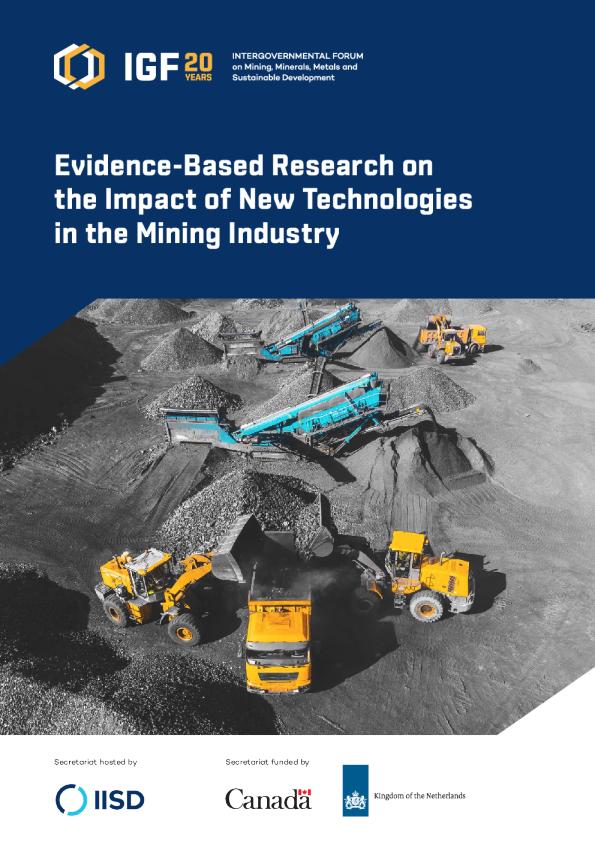
© 2025 International Institute for Sustainable Development This publication is licensed under aCreative Commons Attribution-NonCommercial-ShareAlike 4.0 International License. The International Institute for Sustainable Development (IISD)is an IISD HEAD OFFICE award-winning independent think tank working to accelerate solutions fora stable climate, sustainable resource management, and fair economies.Our work inspires better decisions and sparks meaningful action to helppeople and the planet thrive. We shine a light on what can be achieved 111 Lombard AvenueSuite 325Winnipeg, Manitoba IISD.orgX-TWITTER@IISD_news IISD is a registered charitable organization in Canada and has 501(c)(3)status in the United States. IISD receives core operating support from theProvince of Manitoba and project funding from governments inside and The Intergovernmental Forum on Mining, Minerals, Metals and SustainableDevelopment (IGF)supports its more than 80 member countries inadvancing their sustainable development goals through effective laws,policies, and regulations for the mining sector. We help governments takeaction to develop inclusive and gender-equitable practices, optimizefinancial benefits, support livelihoods, and safeguard the environment. IGFMining.orgX-TWITTER linkedin facebook@IGFMining Evidence-Based Research on the Impact of New Technologiesin the Mining Industry December 2025Written by the IGF Secretariat.Photo: iStock ACKNOWLEDGEMENTS Lead authors of this publication are Sidi Younga, Ege Tekinbas,Grégoire Bellois, and Isabelle Ramdoo. Executive Summary The global mining sector is experiencing a profound transformation driven by the increasingdemand for critical minerals essential to the energy and digital transitions, alongsidemounting pressures from investors, consumers, and civil society for more sustainableand equitable mining practices. Accompanying and supporting this transformation, new Key Findings The findings outlined here come from both qualitative information and quantitative data •accelerated technological adoption: Mining companies are increasingly integratingadvanced technologies such as artificial intelligence (AI), autonomous machinery, and •disparities between economies: Advanced mining economies like Australia and SouthAfrica are leading in technology adoption due to better financial and infrastructuralresources. In contrast, emerging mining economies, including Burkina Faso and the •labour market shifts: Adoption of new technologies is reshaping the labour market byreducing demand for low-skilled jobs and increasing the need for specialized skills ininformation technologies (IT), data management, and engineering. While automation •varied impacts on job: The effect of technological adoption on employment varieswidely across countries examined in this report. Some companies have reducedtheir workforces, while others have redeployed or retrained employees to minimize •gendered job opportunities: Technologies are opening up job opportunities for women,but their uptake is limited by the underrepresentation of women in science, technology, •indirect and local benefits: Technology adoption is generating indirect jobopportunities and new business ventures, particularly in digital services. However, •need for proactive measures: Both mining companies and governments are takingsteps to address the challenges posed by the deployment of new technologies, but Policy Recommendations To navigate the ongoing transformation in the mining sector and ensure that its benefitsare broadly shared, governments and companies must adopt forward-looking, data-driven •monitor labour dynamics: implement systems to track the impact of technologies onjobs and skills, and the skills requirements of the mining sector, allowing for timelysupport and adaptation;•adapt training programs: align educational and vocational training with the emerging This report underscores the need for a collaborative approach between governments, industry,and communities to manage the complex dynamics of technological change in the mining Table of Contents 1.0 Background, Purpose, and Scope of the Study..........................................................................1 1.1 Introduction.......................................................................................................................................................................................................11.2 Background and Purpose of the Study................................................................................................................................21.3 Countries and Operations Selection.....................................................................................................................................2 2.0 Overview of Technological Landscape...........................................................................................5 2.1 Taxonomy of Disruptive Technologies.......................