您的浏览器禁用了JavaScript(一种计算机语言,用以实现您与网页的交互),请解除该禁用,或者联系我们。[摩根士丹利&OpenAI]:2025年人工智能趋势:AI智能体跨越鸿沟 - 发现报告

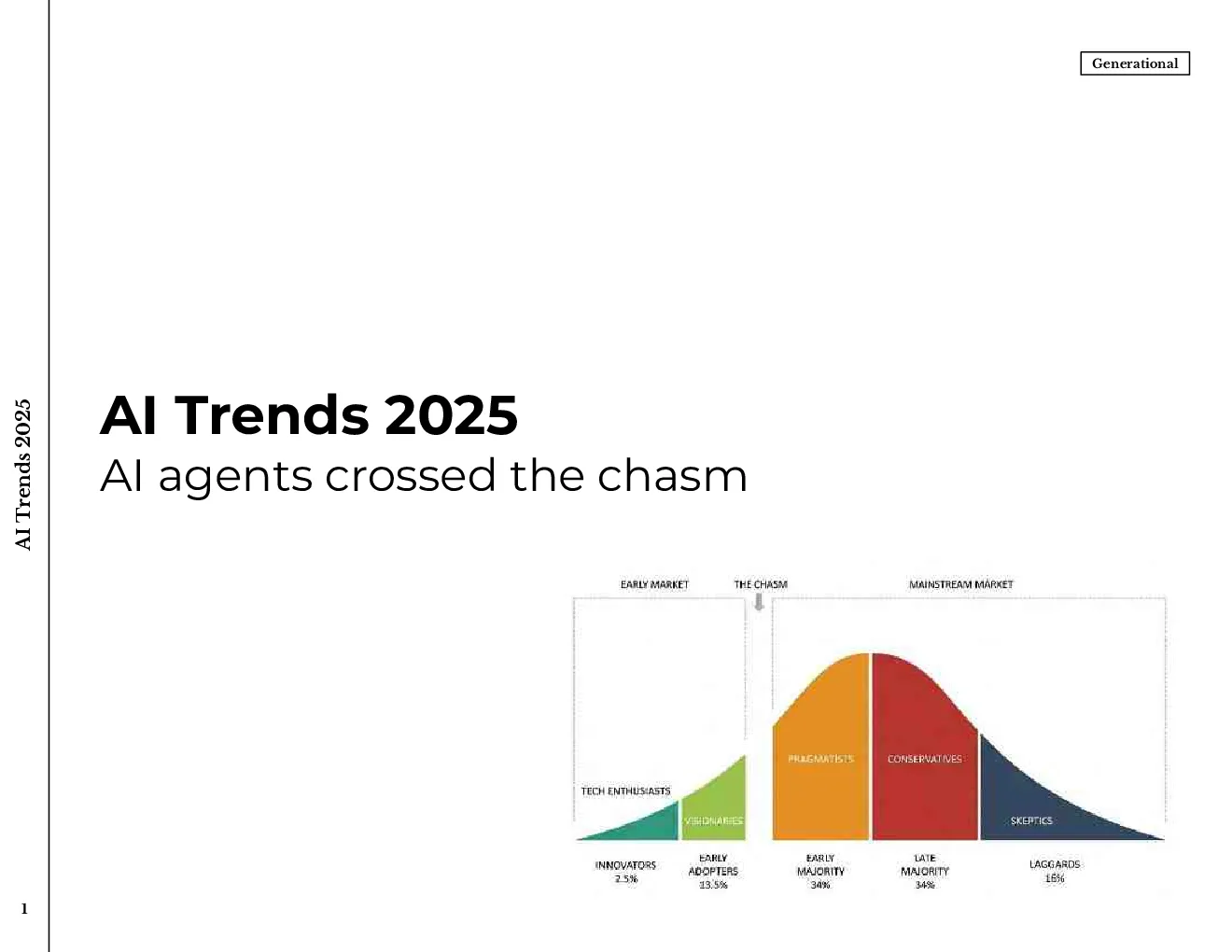
2025年人工智能趋势:AI智能体跨越鸿沟

2025年人工智能趋势:AI智能体跨越鸿沟

What is Generational? Table of Contents AI Trends 2025Section 1: MacroeconomicsSection 2: Public MarketsSection 3: Industry Deep DivesSection 4: Are we in an AI Bubble?Section 5: Private MarketsSection 6: AI Startup BenchmarksSection 7: Scaling Laws & ModelsSection 8: Products & ProtocolsSection 9: AI Agent OpportunitySection 10: 2026 Outlook Section 1: Macroeconomics Rapid adoption of generative AI Foundation models are the fastest-adopted general-purpose technology (GPT) in history. A GPT refers to a foundational innovationthat has broad applications across industries, significantly transforming how we work and live. In just two years, >50% of the U.S.population has used a generative AI product. Each wave of GPT has historically created opportunities for companies to buildtransformative products, leading to the emergence of iconic businesses. Interestingly, these waves tend to produce two distinctcohorts of leading companies:●Desktops: Adobe, Blizzard, NVIDIA ●Internet: Amazon, Google, Facebook●Smartphones: Uber, Doordash, Tiktok AI macro impact mostly in jobs so far Deep dive in the following slides Inflation –limited nationaleffect, local variation Employment –young AI-exposed workers impacted Gross Domestic Product –AIcontributions are overstated Employment by Age Group (Normalized) AI Trends 2025AI is often cited as driving most of USGDP growth in 2025—approximately1.0–1.2% of 1.6% total growth. However,when accounting for import leakage toTaiwan and other chip-manufacturingcountries, domestic impact is smaller. Broad labor displacement has notmaterialized. However, evidencesuggests young workers in highlyautomatable roles are affected. The main drivers of consumer priceincreases remain non-AI related:housing, transportation, food, andhealthcare. Employment among young workers hasdeclined post-ChatGPT, diverging fromhistorical patterns where employmentrises with population and graduationgrowth. The most AI-relevant CPI component ishousehold energy, which represents only3% of the index. Household energyprices increased 7.5% since late 2022,but given its small weight, aggregateimpact is limited. That said, regions withdata center construction—such as theDistrict of Columbia and Virginia—haveseen 10–30% year-over-year increases. GDP contribution of AI-related industrieshas hovered around 8–10% over recentyears. While elevated from pre-ChatGPTlevels, it remains a modest share ofoverall GDP. Additional studies show job postings forAI-exposed roles are down 12% relativeto less exposed roles. Young workers face steepest AI-drivenemployment declines Payroll data shows that the impact of generative AI is not spread evenly across the workforce. Since late 2022, employment for 22-to 25-year-olds in highly exposed occupations—most notably software development and customer service—has fallen sharply,even as overall job growth continues. By mid-2025, early-career software developers saw employment drop nearly 20% from itspeak, while their older peers held steady or grew. A similar divergence is visible in customer service roles. AI agents are >20 times cheaper for basictasks and >3x cheaper for advanced tasks The low cost of AI tools compared to human labor makes them an easy choice for many. This drives adoption, reshapingindustries and how work is done. A common rule is that for companies to adopt a new product, it must be 10x better or 10xcheaper. Leading AI products can already do basic knowledge work tasks for over 20x cheaper with more advanced work at over3x chapear. AI agents product work better thanprofessionals w/ 14 years of experience AI quality now matches professional human output for many tasks. This matters because companies won't adopt AI that producesinferior work, regardless of cost savings. The GDPVal benchmark tests whether AI can create complete professionaldeliverables—like 3D engineering models, financial analyses, and customer service responses—that match work from experts with14 years of experience. GPT-5.2 matches or beats human experts 70.9% of the time across these tasks, showing AI can replacerather than just assist human workers for specific work outputs. AI agents can work faster and longerthan most humans AI can now autonomously complete tasks that take human professionals 30 minutes with 80% reliability—the success rateexpected of professional workers. The METR benchmark measures task length by how long human experts need to completesoftware engineering work, then tests whether AI can finish autonomously. Leading models like Claude Opus 4.5 handle 30-minutetasks reliably, compared to near-zero capability just 2-3 years ago. Section 2: Public Markets AI is driving the stock market The AI boom kicked off in January 2023, after people had some time over the holidays to process ChatGPT’s launch in lateNovember 2022. Since then, AI has fueled stock market gains, with the NASDAQ and S&P 500 returning 124% and 89%,respectively. Meanwhile, the AI Index—a colle