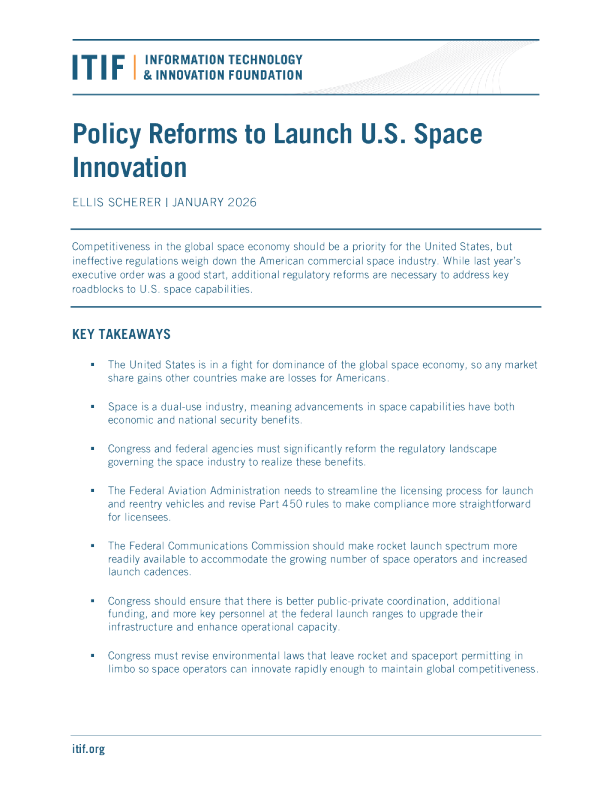
政策改革推动美国航天创新(英)
 AI智能总结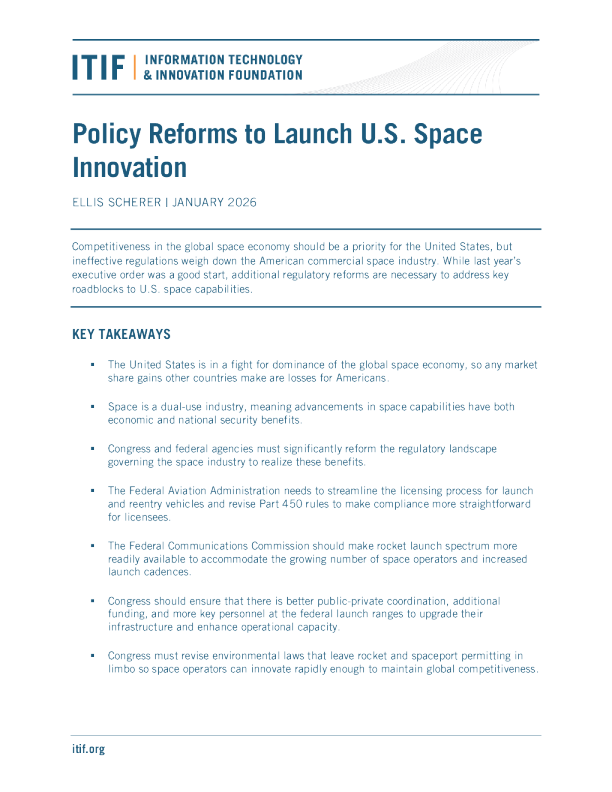
ELLIS SCHERER| JANUARY 2026 Competitiveness in the global space economy should be a priority for the United States, butineffective regulations weigh down the American commercial space industry. While last year’sexecutive order was a good start, additional regulatory reforms are necessary to address key KEY TAKEAWAYS The United States is in a fight for dominance of the global space economy, so any market Space is a dual-use industry, meaning advancements in space capabilities have both Congress and federal agencies must significantly reform the regulatory landscape The Federal Aviation Administration needs to streamline the licensing process for launchand reentry vehicles and revise Part 450 rules to make compliance more straightforward The Federal Communications Commission should make rocket launch spectrum morereadily available to accommodate the growing number of space operators and increased Congress should ensure that there is better public-private coordination, additionalfunding, and more key personnel at the federal launch ranges to upgrade their Congress must revise environmental laws that leave rocket and spaceport permitting inlimbo so space operators can innovate rapidly enough to maintain global competitiveness. CONTENTS Key Takeaways................................................................................................................... 1Introduction....................................................................................................................... 3Why the United States Needs a Competitive Space Industry ................................................... 4Space Industry Contributions to the U.S. Economy............................................................. 4Space Capabilities Lead to Innovation and Growth in Other Industries.................................. 5Communications.......................................................................................................... 5Precision Agriculture.................................................................................................... 5Disaster Prevention and Response ................................................................................. 5Positioning, Navigation, and Timing............................................................................... 5Healthcare Science on the International Space Station.................................................... 6Space Capabilities Are Dual Use....................................................................................... 6The Space Industry’s Greatest Regulatory Challenges............................................................. 6Permitting for Launch and Reentry Vehicles ...................................................................... 6 INTRODUCTION Today, the United States faces fierce competition for a fixed market share of globally tradedadvanced industries, including space industries. This competition is win-lose, meaning any market share that another country gains is lost from the U.S. economy.1For example, if anothercountry develops better rocket launch capabilities than that of the United States, then the U.S. American market share is important because space is a dual-use industry, meaning that advancing America’s space capabilities has both economic and national security benefits.2Manycommercial space operators use federal infrastructure for launches, and the military often usescommercial launch vehicles and payloads for national security missions. Space-based defense capabilities are important as adversary nations develop offensive space technologies.3Furtherdeveloping the commercial space industry is critical for protecting the homeland. A robust space industry will enhance American economic welfare and defense capabilities bycreating new industries, spurring economic growth, supporting national security missions, andenabling innovation, all of which lead to key developments in related industries such astelecommunications, agriculture, precision navigation, and healthcare. As such, the United Regulatory modernization can help unleash America’s innovative potential, but without morecomprehensive reform, the United States risks falling behind in the global race to lead in space President Trump’s executive order (EO) 14335 on Enabling Competition In The CommercialSpace Industry aims to modernize key space policy regulations, including licensing for launchand reentry vehicles, the development of spaceports, and environmental reviews for spaceoperations and infrastructure.4The EO represents an important step toward remaining However, significant challenges remain. This report outlines why U.S. competitiveness in spaceis important, discusses the state of the U.S. space industry, highlights the effective reforms inthe EO, and suggests further steps lawmakers should take to support U.S. competitiveness in WHY THE UNITED STATES NEEDS A COMPETITIVE SPACE INDUSTRY A competitive space industr