您的浏览器禁用了JavaScript(一种计算机语言,用以实现您与网页的交互),请解除该禁用,或者联系我们。[联合国]:受教育权:过去、现在与未来方向 - 发现报告

受教育权:过去、现在与未来方向

文化传媒2025-12-04联合国木***
AI智能总结
查看更多
受教育权:过去、现在与未来方向

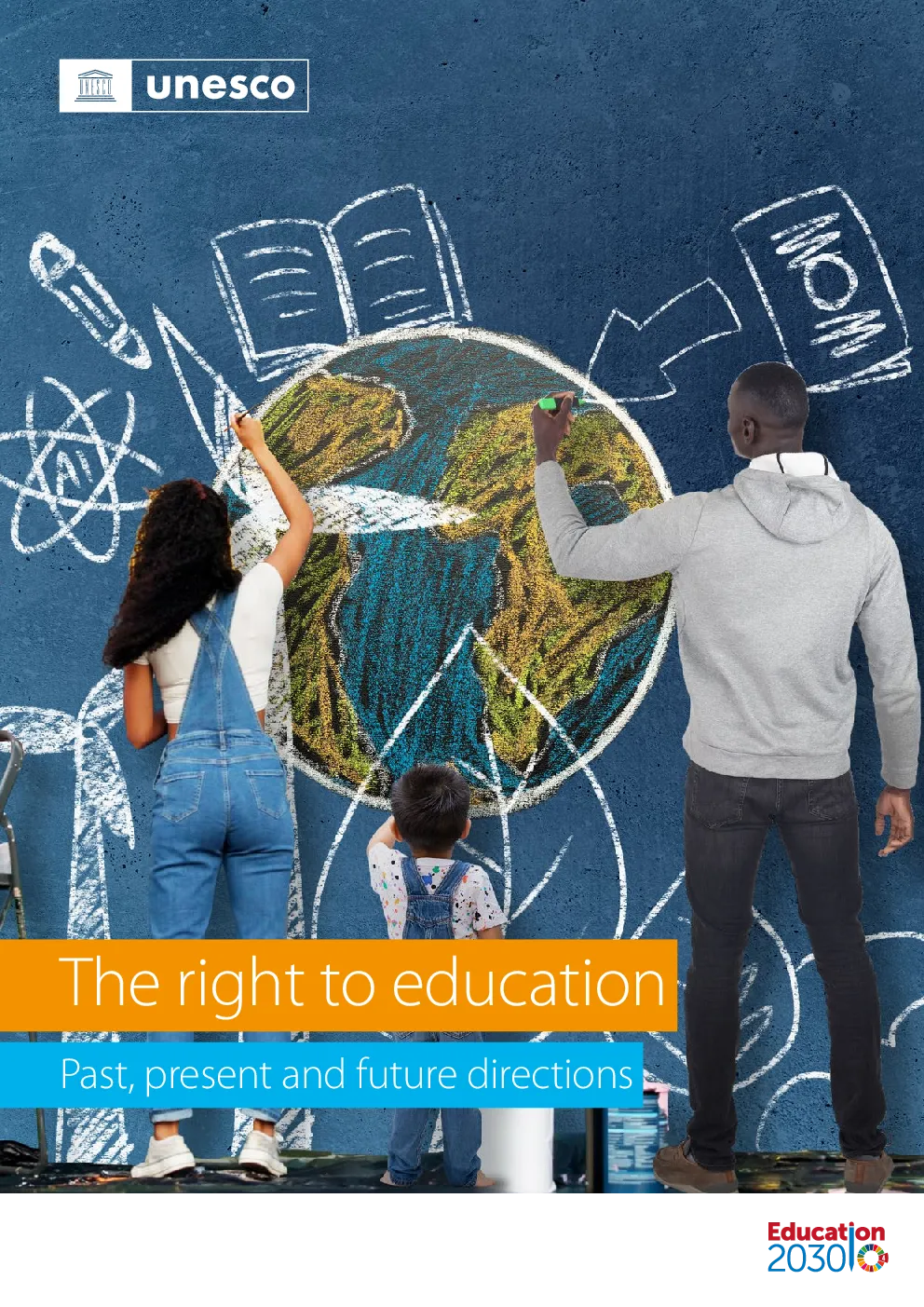
Past, present and future directions UNESCO – a global leader in education The Global Education 2030 Agenda UNESCO, as the United Nations’ specialized agency foreducation, is entrusted to lead and coordinate theEducation 2030 Agenda, which is part of a globalmovement to eradicate poverty through 17 SustainableDevelopment Goals by 2030. Education, essential toachieve all of these goals, has its own dedicated Goal 4,which aims to“ensure inclusive and equitable qualityeducation and promote lifelong learning opportunitiesfor all.”The Education 2030 Framework for Actionprovides guidance for the implementation of thisambitious goal and commitments. Education is UNESCO’s top priority because it is abasic human right and the foundation for peaceand sustainable development. UNESCO is theUnited Nations’ specialized agency for education,providing global and regional leadership to driveprogress, strengthening the resilience and capacityof national systems to serve all learners. UNESCOalso leads efforts to respond to contemporaryglobal challenges through transformative learning,with special focus on gender equality and Africaacross all actions. Published in 2025 by the United Nations Educational, Scientific and Cultural Organization,7, place de Fontenoy, 75352 Paris 07 SP, France © UNESCO 2025 ISBN 978-92-3-100836-8DOIhttps://doi.org/10.54675/GONT9347 This publication is available in Open Access under the Attribution-ShareAlike 3.0 IGO (CC-BY-SA 3.0 IGO) license (http://creativecommons.org/licenses/by-sa/3.0/igo/). By using the content of this document, the users accept to be bound by the terms of use of the UNESCO Open AccessRepository (https://www.unesco.org/en/open-access/cc-sa). Images marked with an asterisk (*) do not fall under theCC-BY-SAlicense and may not be used or reproduced without the prior permission ofthe copyright holders. The designations employed and the presentation of material throughout this publication do not imply the expression of any opinionwhatsoever on the part of UNESCO concerning the legal status of any country, territory, city or area or of its authorities, or concerning thedelimitation of its frontiers or boundaries. The ideas and opinions expressed in this publication are those of the authors; they are not necessarily those of UNESCO and do not committhe Organization. Cover credits:© UNESCO/Weiwei Kang; Josep Curto/Shutterstock.com*; Anton27/Shutterstock.com*; PeopleImages/Shutterstock.com*;SUKJAI PHOTO/Shutterstock.com*; STILLFX/Shutterstock.com* Securing the right to educationin a transforming world Education remains the most critical means to accelerate societal progress, strengthensocial cohesion and foster individual growth – but the right to education stands at acritical juncture. This report reviews 25 years of progress on the right to education, highlighting majorgains such as near universal access to primary education, expansion of formal learningfrom early childhood through to higher education, and the growing recognition oflifelong learning as a cornerstone of human and social development. At the same time, radical shifts in the ways that we live, work and learn, have placededucation systems under unprecedented pressure to adapt in a remarkably shortperiod of time. The report explores the impact ofdigitalization, conflict, migration anddemographic change on the right toeducation, in particular for vulnerablegroups. It underscores the urgent need forrenewed global commitments to strengthenthe legal and institutional foundations of theright to education, close persistent equitygaps, and adapt to emerging demographic,technological, and societal realities.Reinforcing these dimensions is essentialto ensure that education remains both aprotective and transformative force for all. “Since wars begin in the minds of men andwomen, it is in the minds of men and womenthat the defences of peace must beconstructed” The right to education Past, present and future directions The right to education is at a pivotal moment as the world approaches thetarget year of the Education 2030 Agenda. Multiple forces are reshaping thefoundations of this right: rapid advances in artificial intelligence, intensifyingclimate change, demographic shifts and rising human displacement. At thesame time, strains on multilateral cooperation, declining international aid anderoding trust in democratic institutions are deepening the global learning crisis. These new realities require stronger normative frameworks to ensure that theright to education remains both relevant and resilient amid accelerating change. This report marks a significant milestone within UNESCO’s Initiative on theEvolving Right to Education, launched in 2021 to explore how internationalhuman rights instruments can be reinforced to address today’s needs andchallenges. It reflects the important progress made so far and draws fromextensive analytical work, expert perspectives and broad consultations withMember States and partners