您的浏览器禁用了JavaScript(一种计算机语言,用以实现您与网页的交互),请解除该禁用,或者联系我们。[德意志银行]:趋势通胀:以基点衡量的进展 - 发现报告

趋势通胀:以基点衡量的进展

2025-12-11-德意志银行邓***
AI智能总结
查看更多
趋势通胀:以基点衡量的进展

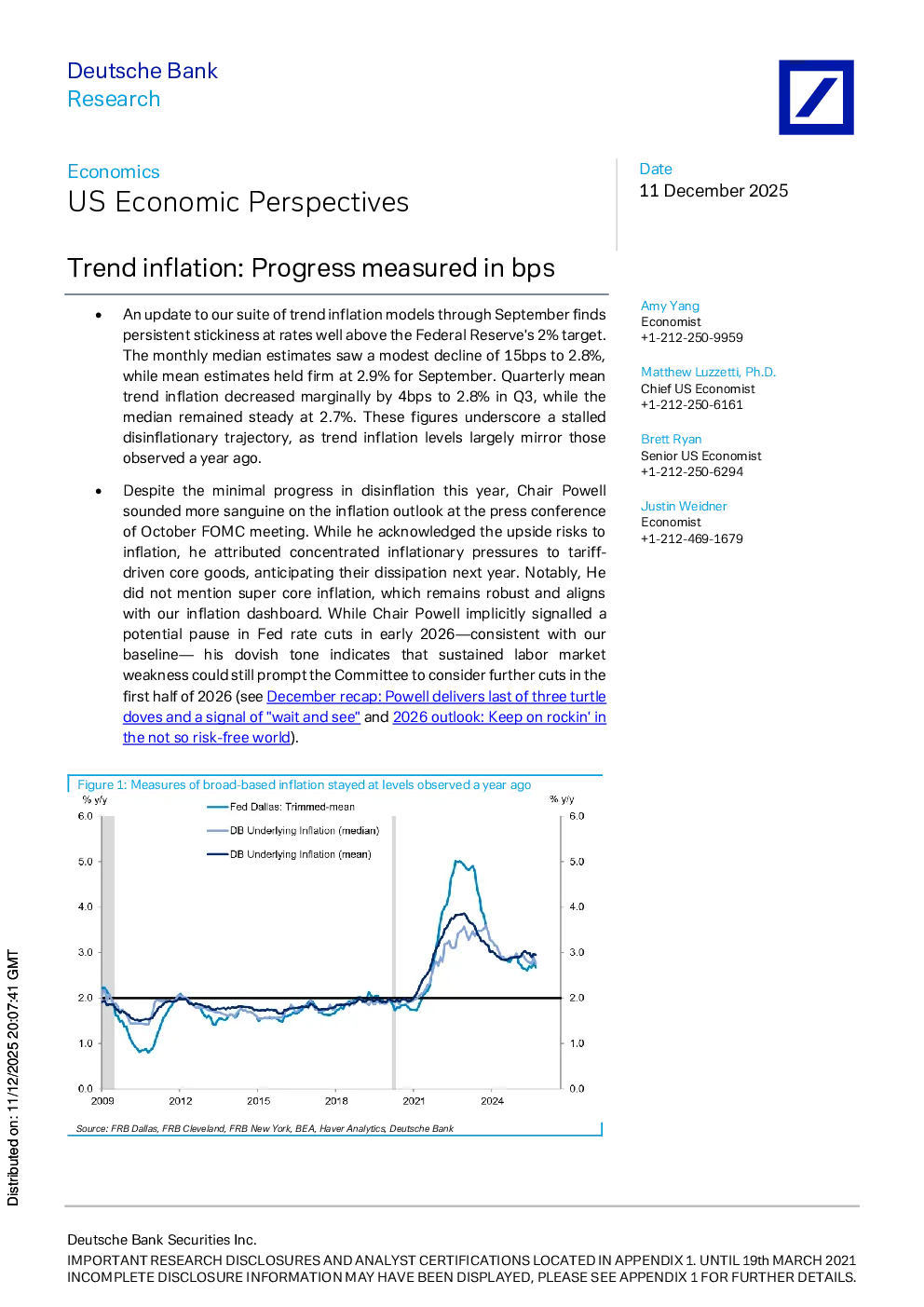
Economics US Economic Perspectives Trend inflation: Progress measured in bps Amy YangEconomist+1-212-250-9959 •An update to our suite of trend inflation models through September findspersistent stickiness at rates well above the Federal Reserve's 2% target.The monthly medianestimates saw a modest decline of 15bps to 2.8%,while mean estimates held firm at 2.9% for September. Quarterly meantrend inflation decreased marginally by 4bps to 2.8% in Q3, while themedian remained steady at 2.7%. These figures underscore a stalleddisinflationary trajectory, as trend inflation levels largely mirror thoseobserved a year ago. Matthew Luzzetti, Ph.D.Chief US Economist+1-212-250-6161 Brett RyanSenior US Economist+1-212-250-6294 •Despite the minimal progress in disinflation this year, Chair Powellsounded more sanguine on the inflation outlook at the press conferenceof October FOMC meeting. While he acknowledged the upside risks toinflation, he attributed concentrated inflationary pressures to tariff-driven core goods, anticipating their dissipation next year. Notably, Hedid not mention super core inflation, which remains robust and alignswith our inflation dashboard. While Chair Powell implicitlysignalledapotential pause inFed rate cuts in early 2026—consistent with ourbaseline—his dovish tone indicates that sustained labor marketweakness could still prompt the Committee to consider further cuts in thefirst half of 2026 (seeDecember recap: Powell delivers last of three turtledoves and a signal of "wait and see"and2026 outlook: Keep on rockin' inthe not so risk-free world). Justin WeidnerEconomist+1-212-469-1679 Trend Inflation Update Core PCE inflation remained strong in September, with the monthly rate seeing aslight deceleration to 20bps and the annual rate edging down by 7bps to 2.83%.Within the components, the persistence and duration of tariff-induced inflationremain key considerations. Durable goods prices continued their monthly decline,falling by 6bps, with certain tariff-sensitive categories showing evidence of pass-through. Outside of the furnishing and equipment category (+0.45% month-over-month), the monthly inflation for motor vehicles and parts slowed considerably by56bps to 12bps, while recreational goods and other durable goods experiencedprice reductions in September (-0.36% and-0.66%, respectively). However, thenon-durable goods prices surged by 0.73% month-over-month, driven by take-home food and beverage (+0.45%), energy goods (+3.61%), clothing and footwear(+0.8%) and other non-durable goods (+0.29%). The inflation strength in the lattertwo categories likely stemmed from tariffs and sustained core goods inflation at18bps. Theservice sector contributed 13bps to monthly core inflation,roughlyconsistent with its contribution during the pre-pandemic period. Within services,inflationary pressures from housing and utilities were subdued (+0.08% month-over-month), while othercategories showed average to stronger inflation prints:healthcare(+0.14%),transportation(+0.97%),foodservicesandaccommodations (+0.29%). Notably, monthly inflation for shelter plummeted to15bps, reaching its lowest level since the pandemic. “Super-core” inflationdecreased by 10bps to 22bps in September, though the 3-month annualized rateedged 7bps up to 3.54% and 6-month annualized rates increased by 12bps to2.8%. With these data, we updated our trend inflation dashboard, which replicates avariety of measures from the Fed staff's past work (see “Transient or persistent?A trend inflation dashboard for decoding monthly data” for details about thedashboard components). Our preferred approach for interpreting these data is toaverage across the ten models that we track. Our monthly mean and medianestimates edged down by 2bps and 15bps to 2.9% and 2.8%, respectively. Thispersistence suggests a stalling of disinflation progress, with trend inflationremaining at elevated levels observed a year prior. Within the individual measures, trimmed mean PCE inflation dropped by 9bps to2.7% in year-over-year terms while the Cleveland Fed’s median PCE inflationgauge felled 18bps to 3.2%. The NY Fed’s multivariate core trend measuredeclined by 15bps to 2.8% inSeptember. The rest of our individual measures sawlittle changefrom August,except for one. Inflation expectations from theUniversity of Michigan survey ticked up by 20bps to 3.7% in September, whichhad the effect of raising the Phillips curve model-based estimates by a similarmagnitude to 4.3%. Incorporating the latest data, our quarterly median trendinflation measure remained at 2.7% in Q3, while the mean estimate declined by4bps to 2.8%. Despite the minimal progress in disinflation this year, Chair Powell sounded moresanguine on the inflation outlook at the press conference of October FOMCmeeting. While he acknowledged the upside risks to inflation, he attributedconcentrated inflationary pressures to tariff-driven core goods, anticipating theirdissipation next year. Notably, He did not m