您的浏览器禁用了JavaScript(一种计算机语言,用以实现您与网页的交互),请解除该禁用,或者联系我们。[亚开行]:制定促进孟加拉国地方一级适应投资的国家框架(英)2025 - 发现报告

制定促进孟加拉国地方一级适应投资的国家框架(英)2025

建筑建材2026-01-06亚开行还***
AI智能总结
查看更多
制定促进孟加拉国地方一级适应投资的国家框架(英)2025

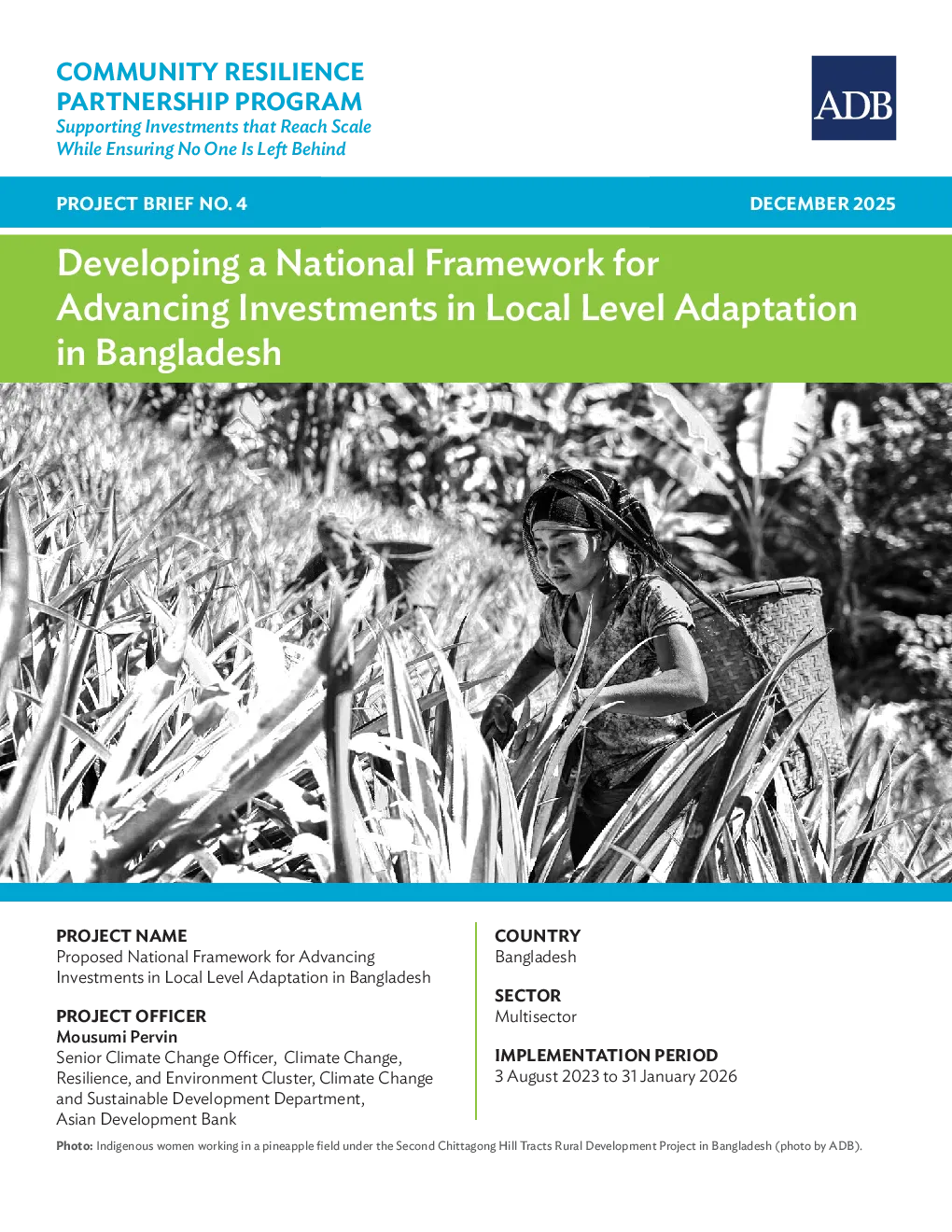
While Ensuring No One Is Left Behind Developing a National Framework forAdvancing Investments in Local Level Adaptationin Bangladesh COUNTRYBangladesh PROJECT NAMEProposed National Framework for Advancing Investments in Local Level Adaptation in Bangladesh SECTORMultisector PROJECT OFFICERMousumi PervinSenior Climate Change Officer, Climate Change, IMPLEMENTATION PERIOD3 August 2023 to 31 January 2026 Resilience, and Environment Cluster, Climate Changeand Sustainable Development Department,Asian Development Bank CLIMATE RISK AND RESILIENCE PROFILE Bangladesh faces severe climate vulnerability, ranking 46th in the 2022 Climate Risk Indexaand 173rd in the ND-GAINCountry Index,bindicating high exposure to climate impacts with limited adaptive capacity. Multiple climate and weather-related hazards—such as tropical cyclones and storm surges, floods, droughts,sea-level rise, and associated salinity intrusion—are severely impacting the country’s development and hamperingsocioeconomic progress and well-being.c Climate change poses substantial economic risks to Bangladesh, with estimated losses at 1.3% of the annual grossdomestic product,dpossibly escalating to 2% by 2050, and potentially exceeding 9% by 2100 under extreme scenarios.e High population density, widespread poverty, and heavy reliance on climate-sensitive sectors such as agriculture,fisheries, and livestock for water and food security, significantly increase the country’s vulnerability to climate change. aClimate Risk Index: The annual Climate Risk Index analyses to what extent countries have been affected by the impacts of weather-related loss events (storms,floods, heat waves, etc.).bTheND-GAIN Country Indexsummarizes a country’s vulnerability to climate change and other global challenges in combination with its readiness to improveresilience, with higher rankings signifying greater vulnerabilities (i.e., 192 is the most vulnerable and 1 as the least vulnerable). A total of 192 countries were rankedfrom low vulnerability and high readiness to high vulnerability and low readiness. (Updated August 2024).cGovernment of Bangladesh, Ministry of Environment, Forest and Climate Change. 2022.National Adaptation Plan of Bangladesh, 2023–2050.dGovernment of Bangladesh, General Economics Division, Bangladesh Planning Commission Ministry of Planning. 2020.Making Vision 2041 a Reality –Perspective Plan of Bangladesh, 2021–2041.eM. Lee, M. Villaruel, and R. Gasper. 2016. Effects of Temperature Shocks on Economic Growth and Welfare in Asia.ADB Economics Working Paper Series. SeriesNo. 501. (Goals 1–3) through systems development (Goals 4–5)to transformative capacity building (Goal 6), all contributingto the overarching NAP vision (Figure). This strategic sequenceensures that basic resilience measures are establishedbefore advancing to more complex, systemic, and innovativeapproaches to climate adaptation. CLIMATE CHANGE ADAPTATIONIN BANGLADESH The Government of Bangladesh has long identified climatechange as one of the major challenges to achieving itsdevelopment goals. It has integrated adaptation actionsinto a wide range of policies, strategies, and programs,such as the National Adaptation Plan (NAP) 2023–2050,the Mujib Climate Prosperity Plan (MCPP) 2022–2041,and the Bangladesh Climate Change Strategy and ActionPlan. These policies aim to build a climate-resilient nationby reducing risks, fostering robust societies and ecosystems,and stimulating sustainable economic growth. As part of implementing its vision for the NAP, theGovernment of Bangladesh has expressed interest indeveloping a framework for LLA and requested support fromthe Asian Development Bank (ADB). The country’s NAPrecognizes that LLA can unlock the enormous potential andcreativity of communities to develop and implement solutionsby shifting power to local stakeholders without expectingthem to shoulder the burdens of adaptation. This frameworkwill be one of the first of its kind globally, intended to provideguidance to all ministries and local private sector in designing,financing, and executing adaptation investments, to catalyzeadaptation that is effective, equitable, and transparent. The country has a strong legacy on locally led adaptation(LLA). Both the NAP and MCPP have identified LLA asa priority. The NAP has established six interconnectedadaptation goals that progress from foundational protection CRPP TRUST FUND SUPPORT coordination across ministries, development partners,and communities—a complex undertaking that benefitedfrom CRPP’s focus on locally led, participatory approaches toclimate adaptation. The support from the Community Resilience PartnershipProgram (CRPP) was critical to the development of thenational framework for locally led adaptation (LLA) of theGovernment of Bangladesh. It enabled comprehensivemulti-stakeholder consultations and provided technicalexpertise that would not have been possible through regulargovernment channels alone. In partnership with