您的浏览器禁用了JavaScript(一种计算机语言,用以实现您与网页的交互),请解除该禁用,或者联系我们。[亚开行]:亚行资助项目的环境流量评估和管理:良好做法说明(英) - 发现报告

亚行资助项目的环境流量评估和管理:良好做法说明(英)

公用事业2025-12-01亚开行d***
AI智能总结
查看更多
亚行资助项目的环境流量评估和管理:良好做法说明(英)

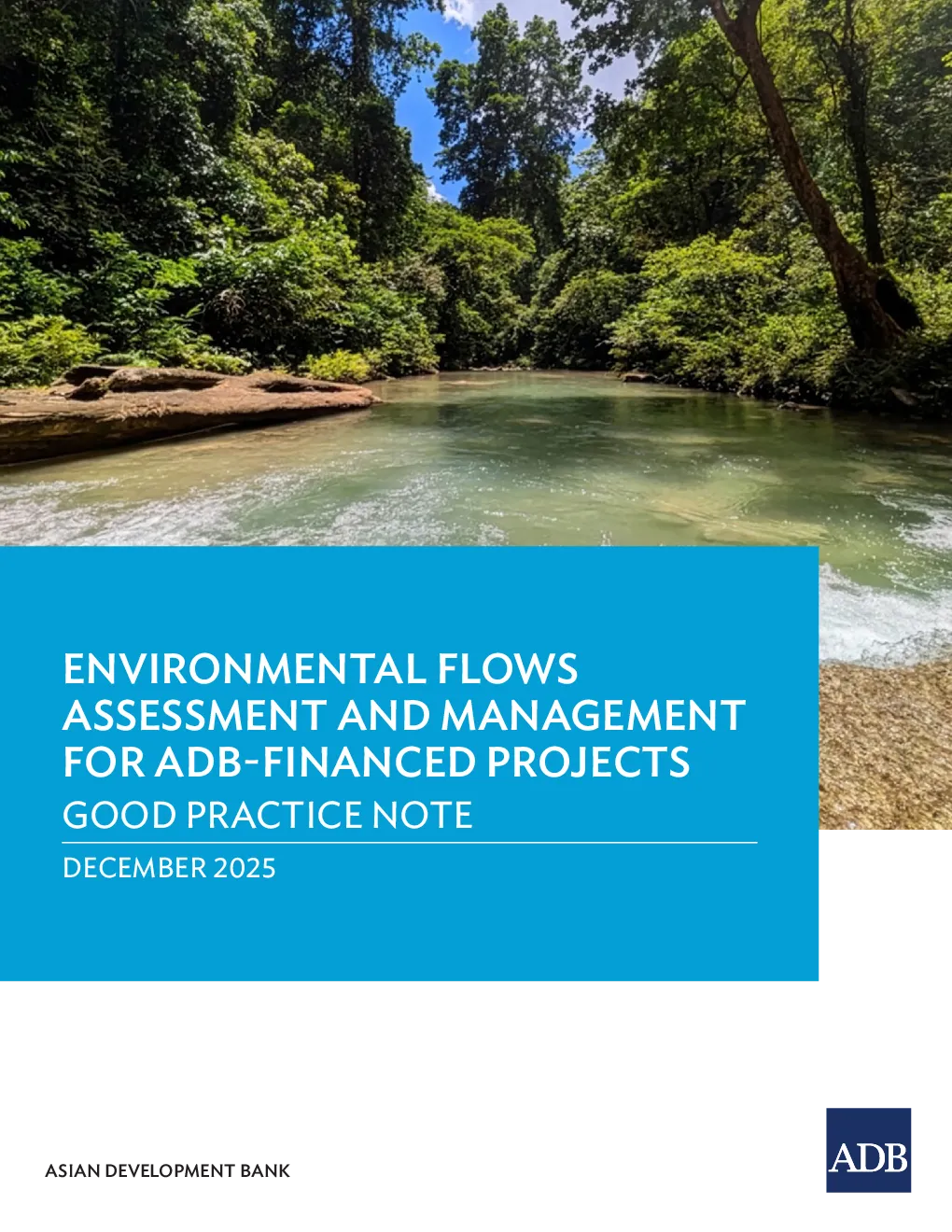
DECEMBER 2025 ENVIRONMENTAL FLOWSASSESSMENT AND MANAGEMENTFOR ADB-FINANCED PROJECTS GOOD PRACTICE NOTE DECEMBER 2025 Creative Commons Attribution 3.0 IGO license (CC BY 3.0 IGO) © 2025 Asian Development Bank6 ADB Avenue, Mandaluyong City, 1550 Metro Manila, PhilippinesTel +63 2 8632 4444; Fax +63 2 8636 2444www.adb.org Some rights reserved. Published in 2025. ISBN 978-92-9277-623-7 (print); 978-92-9277-624-4 (PDF); 978-92-9277-625-1 (e-book)Publication Stock No. TIM250548-2DOI: http://dx.doi.org/10.22617/TIM250548-2 The views expressed in this publication are those of the authors and do not necessarily reflect the views and policiesof the Asian Development Bank (ADB) or its Board of Governors or the governments they represent. ADB does not guarantee the accuracy of the data included in this publication and accepts no responsibility for anyconsequence of their use. The mention of specific companies or products of manufacturers does not imply that theyare endorsed or recommended by ADB in preference to others of a similar nature that are not mentioned. By making any designation of or reference to a particular territory or geographic area in this document, ADB does notintend to make any judgments as to the legal or other status of any territory or area. This publication is available under the Creative Commons Attribution 3.0 IGO license (CC BY 3.0 IGO)https://creativecommons.org/licenses/by/3.0/igo/. By using the content of this publication, you agree to be boundby the terms of this license. For attribution, translations, adaptations, and permissions, please read the provisionsand terms of use at https://www.adb.org/terms-use#openaccess. This CC license does not apply to non-ADB copyright materials in this publication. If the material is attributedto another source, please contact the copyright owner or publisher of that source for permission to reproduce it.ADB cannot be held liable for any claims that arise as a result of your use of the material. Please contact pubsmarketing@adb.org if you have questions or comments with respect to content, or if you wishto obtain copyright permission for your intended use that does not fall within these terms, or for permission to usethe ADB logo. Corrigenda to ADB publications may be found at http://www.adb.org/publications/corrigenda. Note:In this publication, “$” refers to United States dollars. TABLES AND FIGURESACKNOWLEDGMENTSABBREVIATIONSEXECUTIVE SUMMARY 1INTRODUCTION1 1.1Background and Rationale11.2Purpose of the Guidance Note11.3Definition of Environmental Flows11.4Importance of Environmental Flows1 2KEY ASPECTS OF AN ENVIRONMENTAL FLOWS ASSESSMENT 2.1Hydrology and Hydraulics2.2Sediment2.3Water quality2.4Connectivity2.5Human Resource Use 35666 3INTEGRATION OF ENVIRONMENTAL FLOWS ASSESSMENTS7INTO THE PROJECT CYCLE 3.1ADB Projects Requiring an Environmental Flows Assessment73.2The Relationship Between Environmental Flows Assessments and Other ADB Assessment Types83.3Contribution of Environmental Flows Assessments to ADB Safeguards10 4KEY FEATURES OF AN EFFECTIVE ENVIRONMENTAL FLOWS ASSESSMENT12 4.1Scope of Assessment124.2Methods134.3Factors Influencing the Recommended Resolution of An Environmental Flows Assessment174.4Dealing with Data Limitations214.5Staffing for environmental flows assessments234.6Assessment Process234.7Construction and commissioning impacts32 APPENDIXES 1Case Studies and Best Practices332Generic Templates for Terms of Reference38 REFERENCES46 TABLES 1Direct Impacts of ADB-Funded Developments on River Ecosystems72Contribution of Environmental Flows Assessments to ADB Safeguards113Examples of Environmental Flows Assessment Methods, Scope, Resolution, and Applications15in ADB Projects4Guidance on Team Composition for Different Environmental Flows Assessment Resolution Levels245Parties Responsible for Each Step in an Environmental Flows Assessment256Types of Datasets Required for Different Environmental Flows Assessment Methods277Outline of an Environmental Flows Monitoring Program30A1Tennant Method: Percentage of Average Annual Flow Required to Achieve Different Objectives34A2Examples of Where Environmental Flows Are Being Implemented36 FIGURES 1Example of Changes in Timing and Volumes of the Flow of Water with an In-Channel Dam and Reservoir42Lane’s Balance, Showing the Interrelationship Between Sediment Loads, Median Sediment Size,5Water Discharge, and Channel Slope3Recommended Alignment of Project Planning with an Environmental and Social Impact Assessment9and Environmental Flows Assessment4Flowchart for Determining the Resolution of an Environmental Flows Assessment17A1Location of Examples of Where EFlows Are Being Implemented37 This Good Practice Note—Environmental Flows Assessment and Management for ADB-financed projects—was developed with leadership and technical guidance from Cate Brown (ADB Consultant at Southern WatersEcological Research and Consulting, South Africa) and Lois Koehnken (ADB Consultant from