未来的大趋势
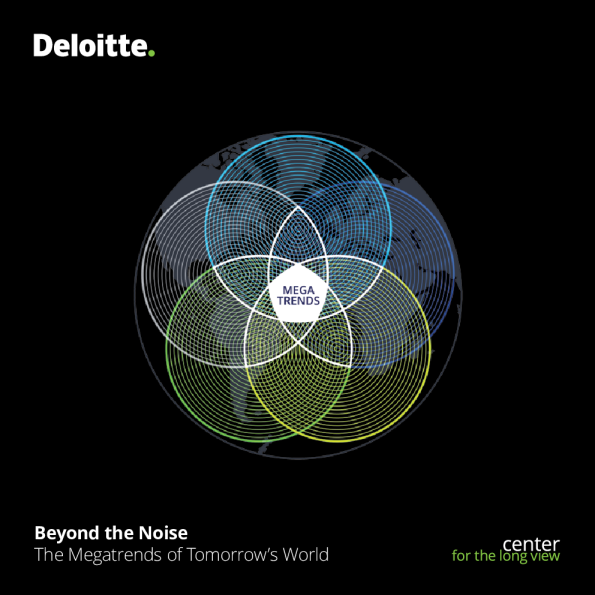
Die Deutsche Bibliothek verzeichnet diese Publikation in derDeutschen Nationalbibliografie. Detaillierte bibliografischeDaten sind im Internet über http://dnb.ddb.de abrufbar. Content Introduction04Drivers08Megatrends82Empowerment84Polarization90Hyperconnectivity96Disengagement102Aging108Dematerialization114Scarcity120Blurring Boundaries126Erosion of Governance132Displacement138Concluding Words144Sources148About the Authors164Contact165 Herausgeber: Deloitte Consulting GmbH 2. Auflage, Juli 2017 Alle Rechte vorbehalten.Nachdruck, auch auszugsweise, verboten.Kein Teil dieses Werkes darf ohne schriftliche Einwilligung des Verlagesin irgendeiner Form (Fotografie, Mikrofilm oder ein anderes Verfahren),reproduziert oder unter Verwendung elektronischer Systemeverarbeitet, vervielfältigt oder verbreitet werden. © Deloitte Consulting GmbH, München 2017 LOGOPUBLIX Fachbuch Verlag, München Satz: Deloitte Design StudiosDruck: LOGOPRINT GmbH, München ISBN 978-3-927985-50-6 Take a step back and consider this: isit easier to make assumptions aboutthe future today, or some years backin the last millennium? Most peoplewould agree that it is harder to makesense of “it all” today, compared to themore clear-cut and bipolar world inwhich we grew up. We all have to makedecisions in spite ofan uncertain future.Imagining the futurethrough scenariosenables us to identifyrobust strategic choicesthat would fit to anyplausible future, and tokeep strategies flexiblein case the futuresurprises us. keep in mind two more points. First,this book can be read from front toback, but you don’t have to stick toconvention. Feel free to jump fromdriver to driver, go back and forth andexplore the points that capture yourimagination. economy. To illustrate this, we providefive “stories of the future” for eachmegatrend, to give you examples ofhow the megatrend might impact thefuture across STEEP categories. each other is never the same, and isextremely specific to the focus of thescenario at hand. In other words, drawing up a sensiblelist of factors that can explain the pro-verbial first 80 percent of our futureis the easy bit of scenario thinking.Selecting the relevant drivers for yourspecific focal question, country orindustry, and combining the overallset into plausible, balanced and chal-lenging stories, on the other hand, isan art. Enjoy the ride. Second, there are two parts to thisbook, and that structure needs a bitof explanation. The first section de-scribes 35 drivers of the future, whichare social or political tendencies,economic or environment-relatedprocesses, or technological develop-ments we often rank as relevant whencompiling our trend analyses. Thesedrivers certainly make an interestingread on their own, but they are stillrather discrete and unrelated obser-vations between themselves. We live in a world of ever faster tech-nology cycles, hyperconnected andnervously flickering financial markets,and post-factual politics. No wonderthat the gentle art of perceiving, asscenario-pioneer Pierre Wack oncefamously described it, has becomean increasingly critical skill when far-ranging decisions are to be taken. The objective of this book is two-fold.We would like to give you a sense ofstructure when thinking about driversof the future. By clustering driversinto buckets such as societal, tech-nology-related, environment-related,economic, and political (which is oftenreferred to as the STEEP categoriza-tion), you are off to a good start. With this book, we would like to drawyour attention to a number of trendsthat, in our current view, might welldrive the future. To do this, we willdescribe a selection of the social, tech-nology-related, environment-related,economic, and political drivers ofchange that we encounter again andagain in our daily work at the Centerfor the Long View. By contrast, the second sectionhighlights megatrends, which is amore abstract concept. Megatrendsemerge at the intersection of two orthree STEEP categories. For example,hyperconnectivity is a phenomenonthat stems from both technology andsociety, and therefore qualifies as amegatrend. Yet, even more important-ly, megatrends will have an impact onall aspects of our life in the future. Tostick with our example, that mega-trend hyperconnectivity not only de-termines further future technologiesand trigger new social trends, but alsoleaves its mark in politics, the envi-ronmental debate, and of course the We would also like to open your eyesto the fact that the future is alreadyhere, you just need to perceive it.After absorbing the list of drivers, youmight start to read or watch the newsdifferently. If you start to feel thatmost of the news we are bombardedwith on a daily basis actually tie inneatly with one or several of thetrends described in this book, youhave started to think like a futurist. There is one striking insight fromyears of scenario work: the set of driv-ers that form the general backgroundto the scenarios we draw is surpris-ingly sta