权力的未来:大趋势和超权力
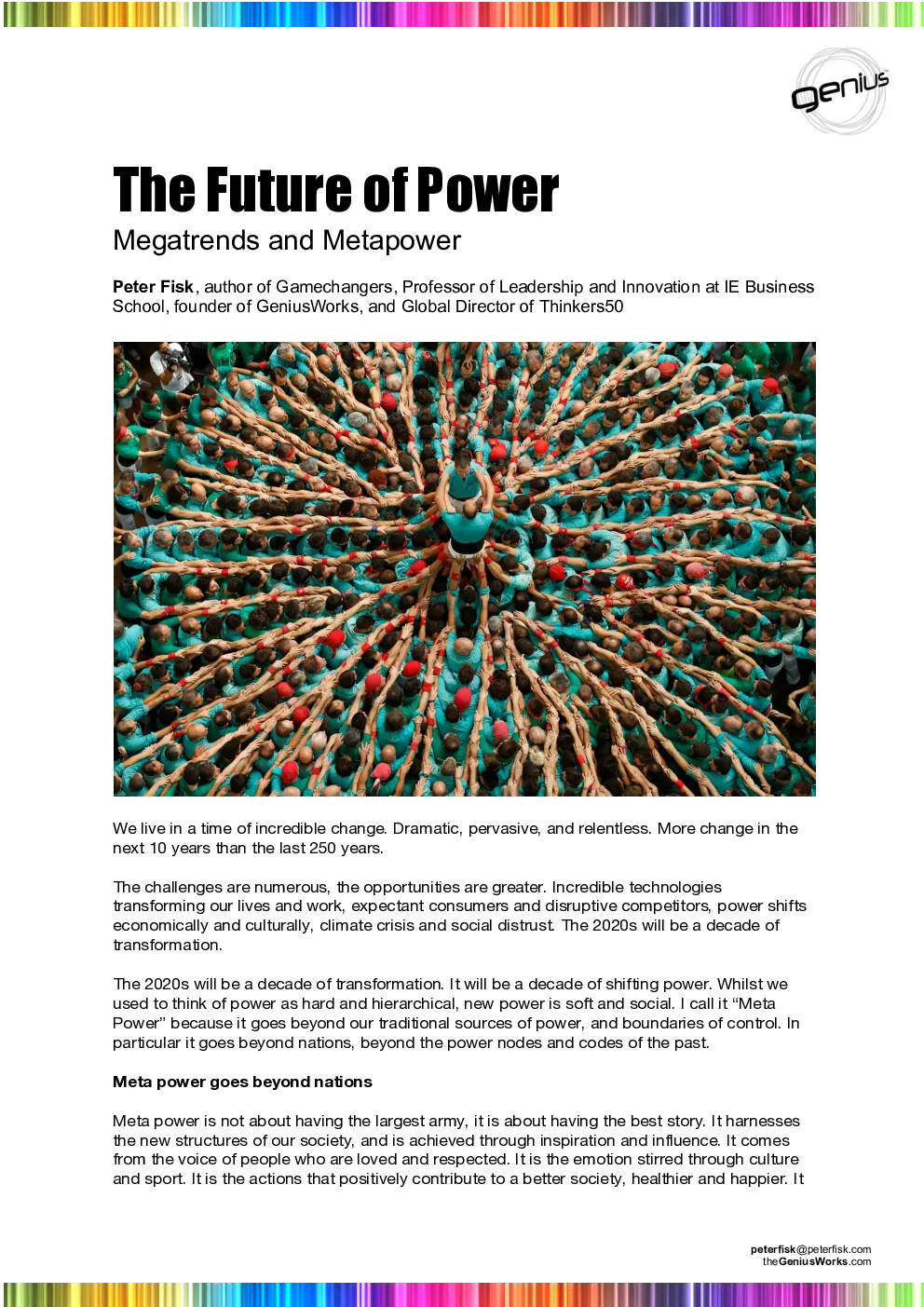
Megatrends and Metapower Peter Fisk,author of Gamechangers,ProfessorofLeadership and Innovationat IE BusinessSchool, founder ofGeniusWorks, and Global Director of Thinkers50 We live in a time of incredible change. Dramatic, pervasive, and relentless. More change in thenext 10 years than the last 250 years. The challenges are numerous, the opportunities are greater. Incredible technologiestransforming our lives and work, expectant consumers and disruptive competitors, power shiftseconomically and culturally, climate crisis and social distrust. The 2020s will be a decade oftransformation. The 2020s will be a decade of transformation. It will be a decade of shifting power. Whilst weused to think of power as hard and hierarchical, new power is soft and social. I call it “MetaPower” because itgoes beyond our traditional sources of power, and boundaries of control.Inparticular it goesbeyondnations, beyondthe powernodes andcodes of the past. Meta powergoes beyond nations Meta poweris not about having the largest army, it is about having the best story. Itharnessesthe new structures of our society, andis achieved through inspiration and influence. Itcomesfromthe voice of people who are loved and respected. It is the emotion stirred through cultureand sport.It is the actions that positively contribute to a better society, healthierand happier.It is less tangible and less structural, more human and collaborative. It isa pull not a push,acarrotnot a stick. Thunberg is more respected than Trump,U2 has more influence than the UN,Messi is morefollowedthan Macron.Leadersrealise thatsocial mediais more effective thanpress releases,nations realise that culture is more potent than politics, media realise that people love stories ofreal people beyond celebrity. Thebest brands win through word of mouth rather thanadvertising, music and movies are promoted through immersive experiences. Think of the power of social media in driving the Arab Spring,which no nation was able toinfluence or contain. Think about reality television which immerse peoplein trivial yeteverydaylives. Think about the most memorable Olympic stories:Jesse Owensas he underminded Hitlerin Berlin, Eric “the Eel” Moussambani who have never swum in a pool before Sydney, or SarahAttar, who ran in London in a headscarf, and inspired the liberation of women in Saudi Arabia. We are only starting to appreciate the seismicnature ofchange in ourworld, technologically andsocially, and how it is changing the very concepts of power. We are all familiar with how thesmartphonehastransformedthe waywelive, how weshop andconnect, how wework andlearn, how we voteand identify ourselves.The rising economies ofAsia, its new brands and new middle class, transform business, but also the power behindmovies, fashion, and sports.Jurassic Park to Harvey Nichols, Volvo Cars to Weetabix.We mightbe concerned about Huawei, we shouldprobablybe more concerned about TikTok, and itsdisruptive impact on our children. Indeed, artificial intelligence will be the most powerfultransformative force of all, with its applications from genetic recoding to self-learning machines. Take a look at three megatrends shaping our decade ahead, and the consequences for power,be it for nations,and also forentities thatexistbeyond or across nations: 1.Citiesare the new the power nodes Rapid urbanisation is redefining our world, the nature of markets and nations. 1.5million morepeople live in cities every week. By2025,Asiawillbehometo33oftheworld’s49megacities,of over 10 million people.In factChina expects to have 200 cities with a population of over onemillion people by 2025. To tackle overcrowding in Beijing, China is building a new city–XionganNew Area–from scratch 100km southwest of the capital. Delhi will replace Tokyo as the world’slargest city, whilst all 10 of the world’s fastest growing cities will be in India, with the port ofSurat growing fastest of all. Economicgrowth is driving the rise of a new global middle class, 3.2 billion people today,growing across Asia to 5.3 billion by 2030, the world’s fastest growing market.At the same time,people have migrated across the world. Nations are increasingly heterogeneous, multi-culturaland diverse. Over 350 million people live in a different country from their birth, a number that willtriple in 10 years. Diasporas and tribes, driven by culture or religion, a love of hip hop or runningwill spread across the world, dispersed but connected.“Meta power”lies in thenewcommunities ofcities,andthe global tribes of the future. 2.Social issues are the new power drivers Environmentalthreatsareintensifying,challenging our desire for industrialisation and progress,demanding anew balance between short-andlong-term impacts. As individualsandbrandsembracemoreresource-efficient behaviours,from bike-sharingto material recycling, social andenvironmental issues have become critical drivers of decision making. 66% of consumers,including 73% of millennials, say they