赋予可持续未来权力:阿拉伯地区的绿色就业
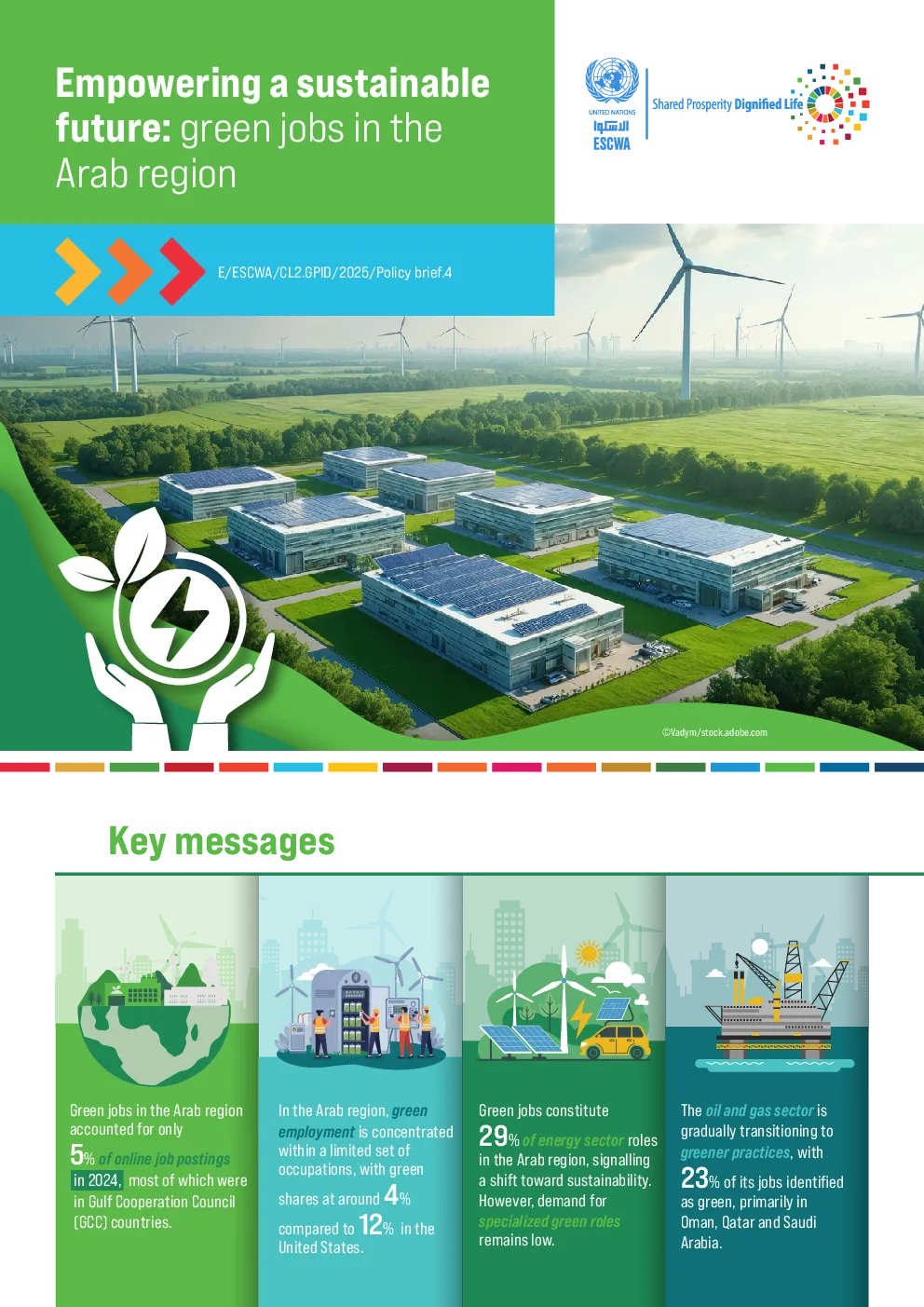
E/ESCWA/CL2.GPID/2025/Policy brief.4 Key messages In the Arab region,greenemploymentis concentratedwithin a limited set ofoccupations, with greenshares at around4%compared to12%in theUnited States. Theoil and gas sectorisgradually transitioning togreener practices, with23% of its jobs identifiedas green, primarily inOman, Qatar and SaudiArabia. Green jobs constitute29%of energy sectorrolesin the Arab region, signallinga shift toward sustainability.However, demand forspecialized green rolesremains low. Green jobs in the Arab regionaccounted for only5%ofonline job postingsin 2024,most of whichwerein GulfCooperation Council(GCC) countries. Green jobs as a catalyst for sustainableeconomic transformation1 While green jobs are now central to policy discussions,the concept itself is not new. Debates on the greeneconomy and green workforce transitions have longfocused on making jobs more sustainable and managingthe employment shifts that follow.1This transition requiresdefining green jobs so as to drive environmental progress.The approach in this policy brief integrates frameworksfrom the United Nations Educational, Scientific andCultural Organization (UNESCO), the International LabourOrganization (ILO) and the United States Bureau of LaborStatistics. Whether the job is rooted in a traditional sectorlike manufacturing and construction or belongs to emerginggreen sectors such as renewable energy and energyefficiency, a green job is characterized by: Output approach:Jobs that produce goods,services or technologies benefiting the environmentby protecting, preserving or restoring naturalresources, even if their production methods are notentirely green. Process approach:Jobs that make productionprocesses more resource-efficient andenvironmentally friendly, even if they do notdirectly produce green goods or services. Adopting this dual approach ensures a clear, structuredframework for identifying green versus non-green jobs,guiding labour market assessments and policy interventions.2 Biodegradable Green jobs in the Arab region:growth, gaps and trends2 A.Green jobs on the rise: Saudi Arabia leads the Arab region’s sustainability shift investment in economic diversification and green initiatives.Qatar (4.59percent) and Oman (3.53percent), thoughsmaller in absolute size, also dominate the green job marketthrough their substantial investment in sustainability andenergy transitions efforts. Economies such as Kuwait(2.17percent) and Lebanon (1.52percent), contributeless but remain engaged in green initiatives. By contrast,the total share of green jobs in the United States stands at11.40percent,4significantly higher than in any country inthe Arab region and well above the Arab region average of3.85percent. The status of green jobs in the Arab region have been analysedto evaluate the growth of green jobs over the years and toidentify emerging trends. According to primary data from theESCWA Skills Monitor, a steady upward trajectory in the totalshare of green jobs as part of the overall online job marketin the region is evident.3While green jobs still represent asmall proportion of total online postings – accounting forapproximately 5.06percent as of 2024 – this percentage hasshown consistent growth since 2021 (figure1). In the Arab region, Saudi Arabia has the highest total shareof green jobs (6.22percent), reflecting its significant Note:The total share of green jobs was calculated by standardizing the number of green jobs over the total number of scraped jobs peryear. Data from 2020 wereexcluded as its collection was incomplete (Q3 and Q4 only), which could distort the results if discussing year on year growth. The 20 occupations in the Arab region with the highest greenshares are shown in figure3.5A higher green share indicatesthat when this occupation appears in online job postings, it ismore likely to be classified as green. The results demonstratealmost total alignment with green practices for roles such asforestry technician and environmental engineer. The inclusion ofspecialized roles like starch extraction operator and geothermalengineer demonstrates the region’s progress towardsdiversifying green job opportunities across different sectors. By comparison, the average green share peroccupation in the UnitedStates stands at 11.48percent,6significantly higher than the Arabregion average (3.76percent), highlighting a broader diffusion ofgreen shares across occupations in the United States comparedto more concentrated shares in specific occupations within theArab region. While the green share peroccupation varies in theUnited States, it remains far higher, reflecting stronger industrialinnovation and sustainability policies (figure5). This gap highlightsstructural differences; in the United States, green jobs are embeddedin technology and industry, whereas in the Arab region, they areconcentrated in policy, conservation and resource management. While the average green share peroccupation in the region is3