您的浏览器禁用了JavaScript(一种计算机语言,用以实现您与网页的交互),请解除该禁用,或者联系我们。 [世界银行]:开发住宅建筑节能潜力 - 发现报告

开发住宅建筑节能潜力

建筑建材 2025-11-04 世界银行 绿毛水怪
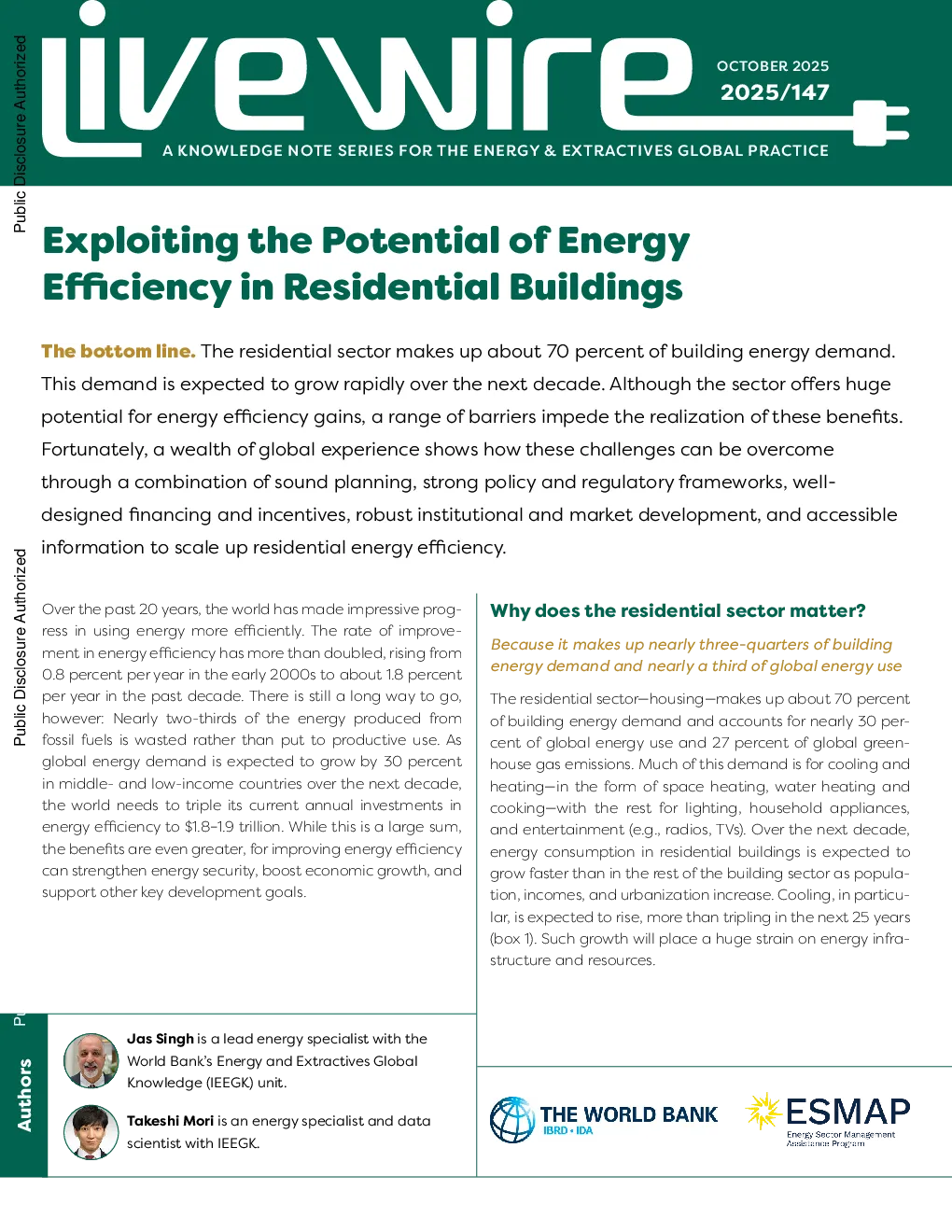
报告封面

The bottom line.The residential sector makes up about 70 percent of building energy demand.This demand is expected to grow rapidly over the next decade. Although the sector offers hugepotential for energy efficiency gains, a range of barriers impede the realization of these benefits.Fortunately, a wealth of global experience shows how these challenges can be overcomethrough a combination of sound planning, strong policy and regulatory frameworks, well-designed financing and incentives, robust institutional and market development, and accessibleinformation to scale up residential energy efficiency.Public Disclosure Authorized Over the past 20 years, the world has made impressive prog-ress in using energy more efficiently. The rate of improve-ment in energy efficiency has more than doubled, rising from0.8 percent per year in the early 2000s to about 1.8 percentper year in the past decade. There is still a long way to go,however: Nearly two-thirds of the energy produced fromfossil fuels is wasted rather than put to productive use. Asglobal energy demand is expected to grow by 30 percentin middle- and low-income countries over the next decade,the world needs to triple its current annual investments inenergy efficiency to $1.8–1.9 trillion. While this is a large sum,the benefits are even greater, for improving energy efficiencycan strengthen energy security, boost economic growth, andsupport other key development goals.Public Disclosure Authorized Why does the residential sector matter? Because it makes up nearly three-quarters of buildingenergy demand and nearly a third of global energy use The residential sector—housing—makes up about 70 percentof building energy demand and accounts for nearly 30 per-cent of global energy use and 27 percent of global green-house gas emissions. Much of this demand is for cooling andheating—in the form of space heating, water heating andcooking—with the rest for lighting, household appliances,and entertainment (e.g., radios, TVs). Over the next decade,energy consumption in residential buildings is expected togrow faster than in the rest of the building sector as popula-tion, incomes, and urbanization increase. Cooling, in particu-lar, is expected to rise, more than tripling in the next 25 years(box 1). Such growth will place a huge strain on energy infra-structure and resources. Jas Singhis a lead energy specialist with theWorld Bank’s Energy and Extractives GlobalKnowledge (IEEGK) unit. Takeshi Moriis an energy specialist and datascientist with IEEGK. Box 1. Sustainable cooling and heating Sustainable coolingwill be critical in the next decade to meet growing energy demand. Technologies and strat-egies exist that can deliver today’s space cooling needs with less than half the energy use at a lower lifecyclecost to users and consumers. A recommended approach to sustainable cooling involves (i) reducing cooling loadsthrough passive building designs (e.g., wall/roof insulation, efficient windows, reflective roofs, shading); (ii) ensuringefficient cooling appliances (e.g., high-efficiency fans, air conditioners, chillers); and (iii) optimizing cooling sys-tems and user behaviors to minimize loads. Supportive policies and regulations (e.g., building codes, equipmentstandards), accessible and innovative financing (such as cooling as a service), consumer awareness, and enhancedprofessional capabilities can all help drive this important transition. Today’sspace heatingpractices not sustainable. Fossil fuels and unsustainable biomass (mostly firewood) haveoverwhelmingly met this energy need, leading to air pollution, particularly in urban areas, which causes 302,000deaths and incurs a welfare cost of 7 percent of GDP annually. Governments are advised to developsustainableheatingstrategies to include (i) reducing heating demand through efficient building designs and retrofits andchanging user behaviors; (ii) bolstering and decarbonizing centralized district heating where possible; and (iii)promoting clean building-level heating systems, such as heat pumps or biomass pellet boilers, where centralizedheating is not economic. Public sector planning and regulations, new programs that include incentives andfinancing (notably for poorer households), inclusive communications and outreach, and training are all importantelements of a holistic government response. Source: World Bank 2020, 2023. Investments in energy efficiency (EE) can help householdslower their energy costs, while improving their overall comfortand enhancing property values. A household that invests incommon EE measures—insulation, better windows, efficientlighting and appliances—can save 10–50 percent or more onits energy bills. Where energy prices are below their supplycosts, EE can lower fiscal outlays for energy subsidies andfacilitatetariff reforms.Such investments can also easeenergy demand, improve air quality and health benefits,support resilience, and spur economic development. Becausethe residential sector in