远离田地:机械化对农业生产和家庭内部劳动力供给的影响
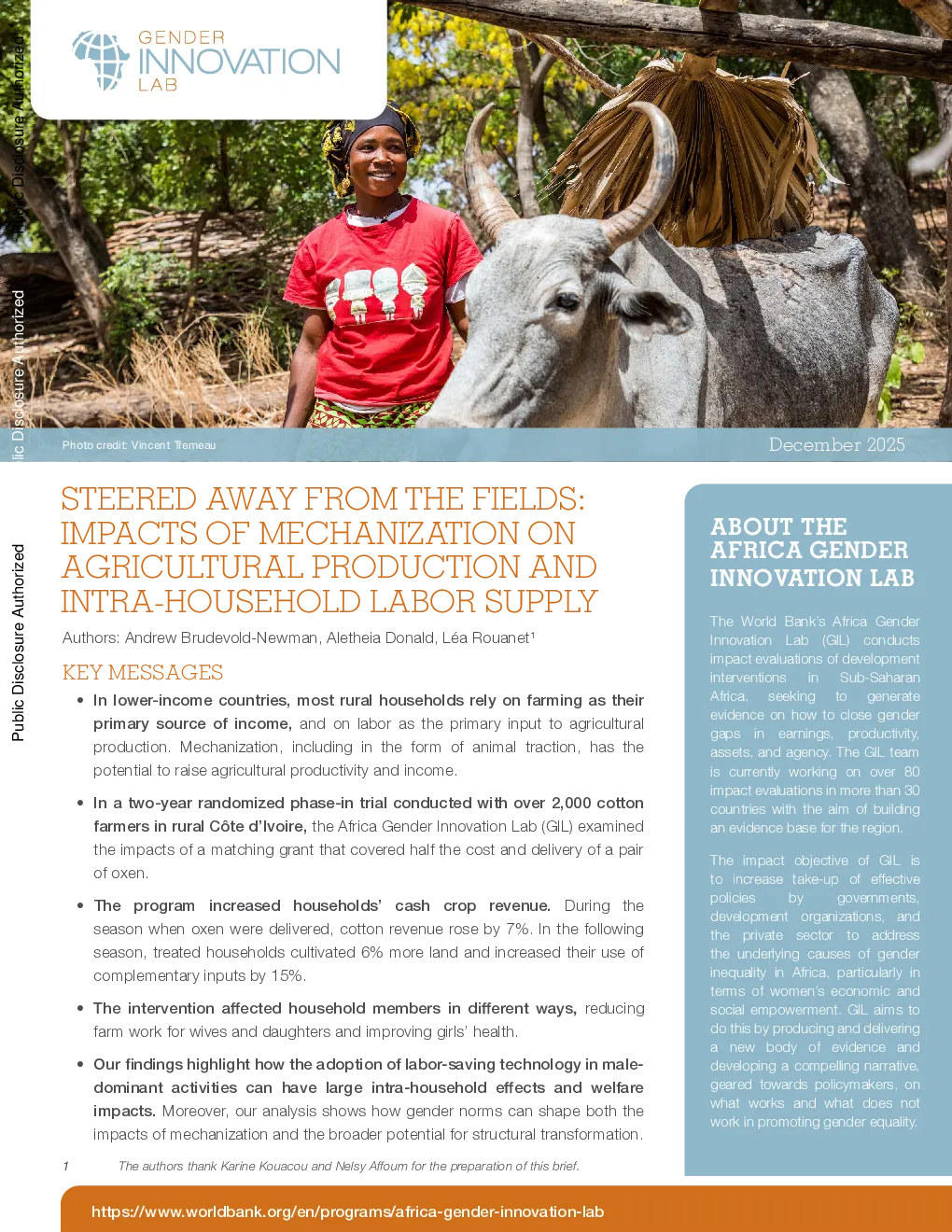
STEERED AWAY FROM THE FIELDS:IMPACTS OF MECHANIZATION ONAGRICULTURAL PRODUCTION ANDINTRA-HOUSEHOLD LABOR SUPPLYPublic Disclosure Authorized ABOUT THEAFRICA GENDERINNOVATION LAB The World Bank’s Africa GenderInnovationLab(GIL)conductsimpact evaluations of developmentinterventionsinSub-SaharanAfrica,seekingtogenerateevidence on how to close gendergapsin earnings,productivity,assets, and agency. The GIL teamiscurrently working on over 80impact evaluations in more than 30countries with the aim of buildingan evidence base for the region. Authors: Andrew Brudevold-Newman, Aletheia Donald, Léa Rouanet1 KEY MESSAGES •In lower-income countries, most rural households rely on farming as theirprimary source of income,and on labor as the primary input to agriculturalproduction. Mechanization, including in the form of animal traction, has thepotential to raise agricultural productivity and income.Public Disclosure Authorized •In a two-year randomized phase-in trial conducted with over 2,000 cottonfarmers in rural Côte d’Ivoire,the Africa Gender Innovation Lab (GIL) examinedthe impacts of a matching grant that covered half the cost and delivery of a pairof oxen. Theimpact objective of GIL istoincrease take-up of effectivepoliciesbygovernments,developmentorganizations,andtheprivate sector to addressthe underlying causes of genderinequality in Africa, particularly interms of women’s economic andsocial empowerment. GIL aims todo this by producing and deliveringanew body of evidence anddeveloping a compelling narrative,geared towards policymakers, onwhatworks and what does notwork in promoting gender equality. •The program increased households’cash crop revenue.During theseason when oxen were delivered, cotton revenue rose by 7%. In the followingseason, treated households cultivated 6% more land and increased their use ofcomplementary inputs by 15%.Public Disclosure Authorized •The intervention affected household members in different ways,reducingfarm work for wives and daughters and improving girls’ health. •Our findings highlight how the adoption of labor-saving technology in male-dominant activities can have large intra-household effects and welfareimpacts.Moreover, our analysis shows how gender norms can shape both theimpacts of mechanization and the broader potential for structural transformation. The authors thank Karine Kouacou and Nelsy Affoum for the preparation of this brief. https://www.worldbank.org/en/programs/africa-gender-innovation-lab TTHE PROGRAM CONTEXT Most rural households in lower-income countries relyon farming as their primary source of income, and onlabor as the primary input to agricultural production.Mechanization, including in the form of animal traction,has the potential to raise agricultural incomes and facilitatethe structural transformation of developing economies.Previous research has identified which conditions favorthe adoption of animal traction, yet observational studieson its potential benefits yield nuanced results. In additionto how mechanization economically influences agriculturalhouseholds, there is limited evidence regarding whether(and why) technology adoption has differential impactson men and women within the household. As part of the World Bank’s Côte d’Ivoire AgriculturalSupport Project (PSAC), we conducted a randomizedevaluation of matching grant that covered 50% of thecost and delivery of a pair of oxen for cotton farmers.The cotton component of PSAC operated in the northernregions of Bere, Poro, Tchologo and Worodougou, andwas implemented by Intercoton—the cotton value-chaininterprofessional organization in Côte d’Ivoire—and itsfive constituent cotton societies (CIDT, COIC, IVOIRECOTON, SECO and URECOSCI), under the broader goalof increasing agricultural productivity in the country. The market value of two traction oxen at the delivery timewas FCFA 480,000, implying a matching grant value ofFCFA 240,000 (US $408). In practice, there were smallvariations in treatment across farmers. While 96% of HERE’S WHAT WE FOUND farmersrequested two oxen,4%instead requestedone ox. Moreover, 7% of farmers in the treatment grouprequested and received a multi-cultivator, 6% a seed drill,5% a plow, and less than 4% received tillers or carts. In the first agricultural season, producers increased theircotton production and cotton revenues by 7%, despiteonlybeing notified about the program and receivingthe oxen after planting decisions were made. Duringthe second agricultural season, households expandedtheir cultivated land area by 6%, accompanied by asimultaneous increase in spending on complementarynon-labor inputs by approximately 15%. HERE’S WHAT WE DID We used a randomized phase-in approach for ourexperiment:from an initial list of 2,546 eligiblefarmers, we randomly assigned 1,273 producers toreceive the oxen matching grant offer in the fall of2016 (treatment group) and 1,273 to receive the offerstarting in April 2018 (control group).We stratifiedthe randomization by c