2025年全球贸易有望创下历史新高,贸易额预计突破35万亿美元
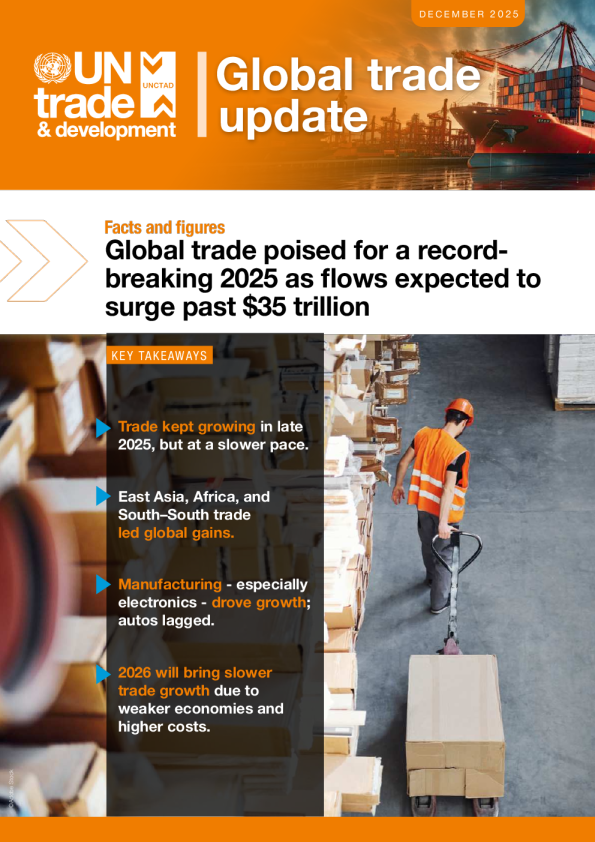
Facts and figures Global trade poised for a record-breaking 2025 as flows expected tosurge past $35 trillion K E Y TA K E AW AY S Trade kept growingin late2025, but at a slower pace. East Asia, Africa, andSouth–South trade Manufacturing- especiallyelectronics -drove growth; 2026 will bring slowertrade growthdue toweaker economies and A record-breaking year: Global trade surges Global trade trends and nowcast Global trade growth slowed in Q3 2025, but remained positive at about 2.5 per centquarter-on-quarter. Both goods and services contributed to this rise: goods trade UNCTAD’s nowcast suggests that this positive trend will continue in the final quarter ofthe year. Trade in goods is expected to grow by 0.5 per cent, and services by 2 per cent. If these projections hold, global trade in 2025 will exceed $35 trillion, an increase ofaround $2.2 trillion—roughly 7 per cent—compared to 2024. Of this total rise: Goods would contribute about $1.5 trillion (approximately 6 per cent growth versus 2024).Services would add around $750 billion (nearly 9 per cent growth versus 2024). Global trade growth remains strong, but slowed in Q3 and Q4 of 2025 Trade value in goods and services: trailing four quarters and quarterly growth After two periods of inflationary trends, prices for traded goods are expected to declinein Q4 2025. This suggests that while the increase in trade value in Q2 and Q3 2025was partly driven by higher prices, the increase in Q4 is expected to be fueled by rising Trade inflation increased in Q2 and Q3 2025, but is set to decrease inQ4 2025 Overall price of traded goods: trailing four quarters and quarterly growth growth (QoQ) is the quarter-over-quarter growth rate of seasonally adjusted values. Figures for Q3-2025 are preliminary. Q4-2025 is anowcastas of 2 December 2025. Data exclude services. Opportunities Outlook: Strong 2025 trade, risingpressures for 2026 Trade growth remained positive in Q3 2025, supported by developing economies,strong South–South trade, and robust performance in Africa and East Asia. UNCTADnowcastfor Q4 2025 indicates continued growth. In 2025, international trade is set togrow faster than the global economy (in real terms), reflecting renewed momentum in In 2026, global trade growth is expected to be more muted as slowing global economicgrowth, geopolitical fragmentation, continued policy uncertainty, and heightenedvulnerability weigh on trade activity. In addition, rising trade costs contribute to anoutlook marked by caution. While import demand in some consumer-driven markets On a more positive note, sentiment toward trade remains broadly supportive in manydeveloping regions, sustaining commitments to increasing openness and investmentin cross-border commerce, which could result in further expansion of intra-regionaland South–South trade. All factors considered, expectations for the next few quarters Positive factors influencing the global trade outlook: Growing South–South trade Expanding trade among developing economies is expected to continue, strengtheningdiversification, resilience, and opportunities to develop intra- and inter-regional trade Increasing demand from emerging economies could help sustain imports of goods and services, supporting global trade flows. Digital, AI, and environmental sectorsRapid growth in technology, digital, and environmental industries could providesome boosts in high-value, knowledge-intensive goods and services trade. Easing interest rates and lower borrowing costsCentral banks are expected to gradually cut interest rates in 2026, sustaining Negative factors hindering the trade outlook: Geopolitical tensions and conflictsPersistent instability and ongoing conflicts continue to disrupt bilateral and regional Tariffs, complex regulations, restructuring of global value chains, and logisticsbottlenecks are raising the cost, complexity, and unpredictability of cross-border Persisting uncertainty in United States trade policy Negotiations between the United States and key partners are likely to continue,leaving room for policy shifts affecting business confidence and investment decisions. Potential increase of restrictive policies due to overcapacityThe surge in industrial policy paired with weaker global demand may result inoversupply and encourage defensive trade measures, with trade in certain strategic Mounting debt pressures, especially in developing countriesHigh public and private debt levels constrain fiscal support, reduce investment, andweaken import demand, limiting trade growth. The new engines:East Asia,Africa, and Regional trade splits,developing regions lead East Asia and Africa drive global trade in 2025 as United Statesimports stay strong and Chinese imports lag Imports and exports growth: percentage-point difference from global average(Jan-Sept 2025) Goods trade growth in Q3 2025 was fairly balanced between developed and developingeconomies, with imports outside East Asia growin