OpenAI、Meta 及其 AI 竞争对手通过三张图表加剧地盘争夺战与合作
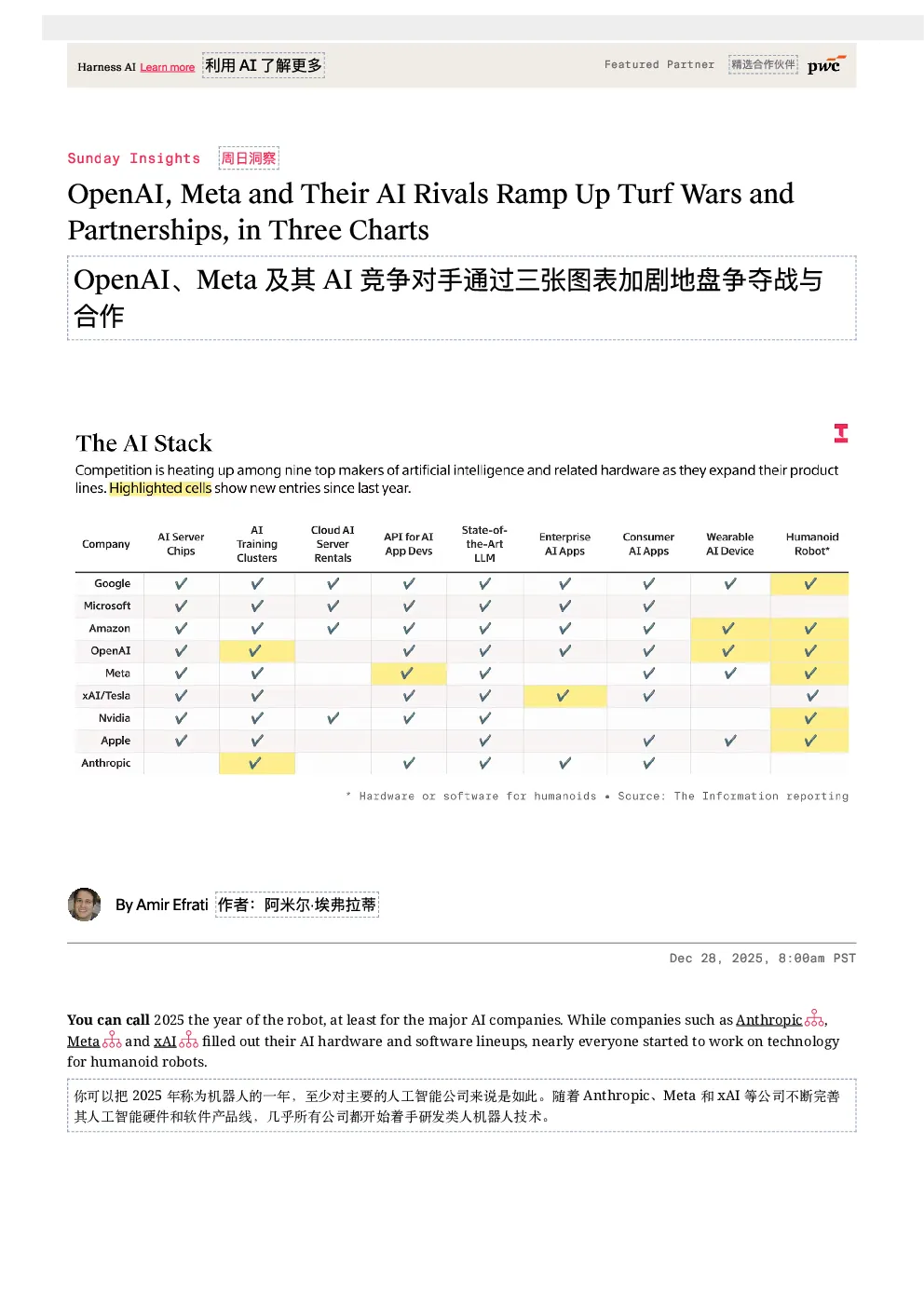
OpenAI、Meta及其AI竞争对⼿通过三张图表加剧地盘争夺战与合作 Dec28,2025,8:00am PST You can call2025 the year of the robot, at least for the major AI companies. While companies such asAnthropic,MetaandxAIfilled out their AI hardware and software lineups, nearly everyone started to work on technologyfor humanoid robots. 你可以把2025年称为机器⼈的⼀年,⾄少对主要的⼈⼯智能公司来说是如此。随着Anthropic、Meta和xAI等公司不断完善其⼈⼯智能硬件和软件产品线,⼏乎所有公司都开始着⼿研发类⼈机器⼈技术。 The shift to robots says as much about the current competitive landscape in AI as it does about the dream of humanoidsrunning around every factory and household. Nearly every major technologyfirm offers or is developing a full slate ofAI hardware and software. 向机器⼈领域的转向,不仅反映了⼈⼯智能当前的竞争格局,也关乎让类⼈机器⼈在⼯⼚和家庭中四处活动的愿景。⼏乎每⼀家⼤型科技公司都在提供或开发⼀整套⼈⼯智能硬件和软件。 For a better picture of how AI companies have evolved over the past year, take a look at the second chart below. Itshows how nearly all of them improved their position in developing a fuller AI “stack” to capture more revenue throughtheir products or potentially saving money in the long run by gaining more control of their AI training servers, as wasthe case withOpenAIand Anthropic. 要更清楚地了解⼈⼯智能公司在过去⼀年中的演变情况,请查看下⾯的第⼆张图表。它显⽰,⼏乎所有公司都在构建更完整的⼈⼯智能“技术栈”⽅⾯提升了⾃⾝位置,以便通过产品获取更多收⼊,或像OpenAI和Anthropic那样,通过更好地掌控⼈⼯智能训练服务器,在长期内节省成本。 T h eT a k e a w a y要点 Meta increased its lead in AI-powered devices but fell behind in AI models. Meta在⼈⼯智能驱动的设备⽅⾯领先优势扩⼤,但在⼈⼯智能模型上却落后了。 xAI made gains in LLM quality, consumer AI apps, and AI training clusters. xAI在LLM质量、消费者级AI应⽤以及AI训练集群⽅⾯取得了进展。 All these AI rivals are more interconnected than ever, due to a string of new alliances. 由于⼀连串新的联盟,这些AI竞争对⼿之间的关联性⽐以往任何时候都更强。 Powered byDeep Research由Deep Research提供⽀持 Yet as our third chart shows, these gambits for more independence have only deepened their entanglements. Ascompanies reduced ties with one partner, they fell into the arms of another, creating an increasingly tangled web ofalliances that have made industry more interdependent than before. 然⽽,正如我们的第三张图表所显⽰的那样,这些旨在获取更多独⽴性的策略却只会加深它们之间的纠缠。企业在减少与某⼀合作伙伴联系的同时,又投⼊了另⼀⽅的怀抱,形成了⼀张⽇益错综复杂的联盟⽹络,使整个⾏业的相互依赖程度⽐以前更⾼。 These nine companies are pushing to get bigger pieces of the fast-growing markets for consumer and enterprise AIservices, including server chips and personal devices. They also want to be there at the creation of new industries, suchas humanoids. Another trend underlying the data is a push to save money by lessening dependence on key supplierslike Nvidia or on cloud providers such as Microsoft. 这九家公司正努⼒在快速增长的消费者和企业级AI服务市场中争夺更⼤的份额,其中包括服务器芯⽚和个⼈设备。它们也希望参与新产业的诞⽣,⽐如⼈形机器⼈。数据背后反映出的另⼀⼤趋势是,通过降低对Nvidia等关键供应商或对微软等云服务提供商的依赖来节省成本。 Imagevia Nano Banana Pro 图⽚来⾃Nano Banana Pro We did a similar chart package this time in 2024.Some of our predictionsfrom then came true: 我们在2024年这个时候也做过⼀组类似的图表。其中⼀些当时的预测已经成为现实: Meta released an application programming interface to sell its Llama models directly tocustomers. Meta发布了⼀个应⽤程序编程接⼜,直接向客户销售其Llama模型。 Companies including Google, Amazon and OpenAItook steps to develop humanoid robotsoftwareor hardware. These are all at a nascent stage, as the challenges are enormous. (Weexpanded the humanoid robot category in this year’s chart to also include software for themachines, not just robot hardware, as Google, Amazon and Nvidia appear to be focused onsoftware for now.) 包括Google、Amazon和OpenAI在内的公司采取了措施,着⼿开发⼈形机器⼈的软件或硬件。这些都还处于⾮常早期的阶段,因为⾯临的挑战巨⼤。(我们在今年的图表中扩⼤了⼈形机器⼈这⼀类别,把机器所需的软件也纳⼊其中,⽽不仅仅是机器⼈硬件,因为Google、Amazon和Nvidia⽬前似乎更专注于软件。) And Amazonmade big moves to develop wearable AI devicesin the form of augmented realityglasses. 此外,Amazon还在以增强现实眼镜的形式,⼤举推进可穿戴AI设备的开发。 Additionally:此外: xAI says it’s developing enterprise AI applications dubbed Macrohard, the semantic inversion ofMicrosoft. xAI表⽰正在开发名为Macrohard的企业级AI应⽤,这是对Microsoft的语义反转。 OpenAI and Anthropic both startedambitious plans to develop or control the server clustersfordeveloping their technology. OpenAI和Anthropic都启动了雄⼼勃勃的计划,旨在开发或掌控⽤于研发其技术的服务器集群。 OpenAI also stepped up to develop wearable AI devices, spending $6.5 billion in stock to acquirea design group overseen by former Apple design chief Jony Ive. While OpenAI’s devices may notarrive in 2027, we’re sure to hear lots about them in 2026. (OpenAI has worked on smart glasses,a smart speaker, a wearable pin and digital voice recorder.) OpenAI也加快了可穿戴AI设备的开发步伐,斥资65亿美元股票收购了⼀个由前苹果⾸席设计官Jony Ive监管的设计团队。尽管OpenAI的设备可能要到2027年才会⾯世,但我们肯定会在2026年听到⼤量相关消息。(OpenAI曾研究过智能眼镜、智能⾳箱、可穿戴徽章以及数字语⾳记录器。) The relatively few gaps left in thefirst chart—namely, cloud-server rentals—are probably not going to befilled anytimesoon. 第⼀张图中剩下的少数空⽩——即云服务器租赁——很可能短期内不会被填补。 Try askingDeep Research to… 不妨试着向“深度研究”提出以下问题…… Whatis next for Apple after the recent executiveexodus? IsGoogle actually a threat to OpenAI and Nvidia? ⾕歌真的会对OpenAI和英伟达构成威胁吗? 近来多名⾼管离职之后,苹果接下来将⾛向何⽅? Whatmajor market shifts will define the AI Agentcompetitive landscape in 2026? Howdoes Broadcom factor into the AI chip race withNvidia, AMD and others? 哪些重⼤的市场变化将定义2026年AI Agent的竞争格局? 博通在与英