您的浏览器禁用了JavaScript(一种计算机语言,用以实现您与网页的交互),请解除该禁用,或者联系我们。[BofA SECURITIES]:全球研究营销10大宏观视角塑造2026-19150498 - 发现报告

全球研究营销10大宏观视角塑造2026-19150498

全球研究营销10大宏观视角塑造2026-19150498

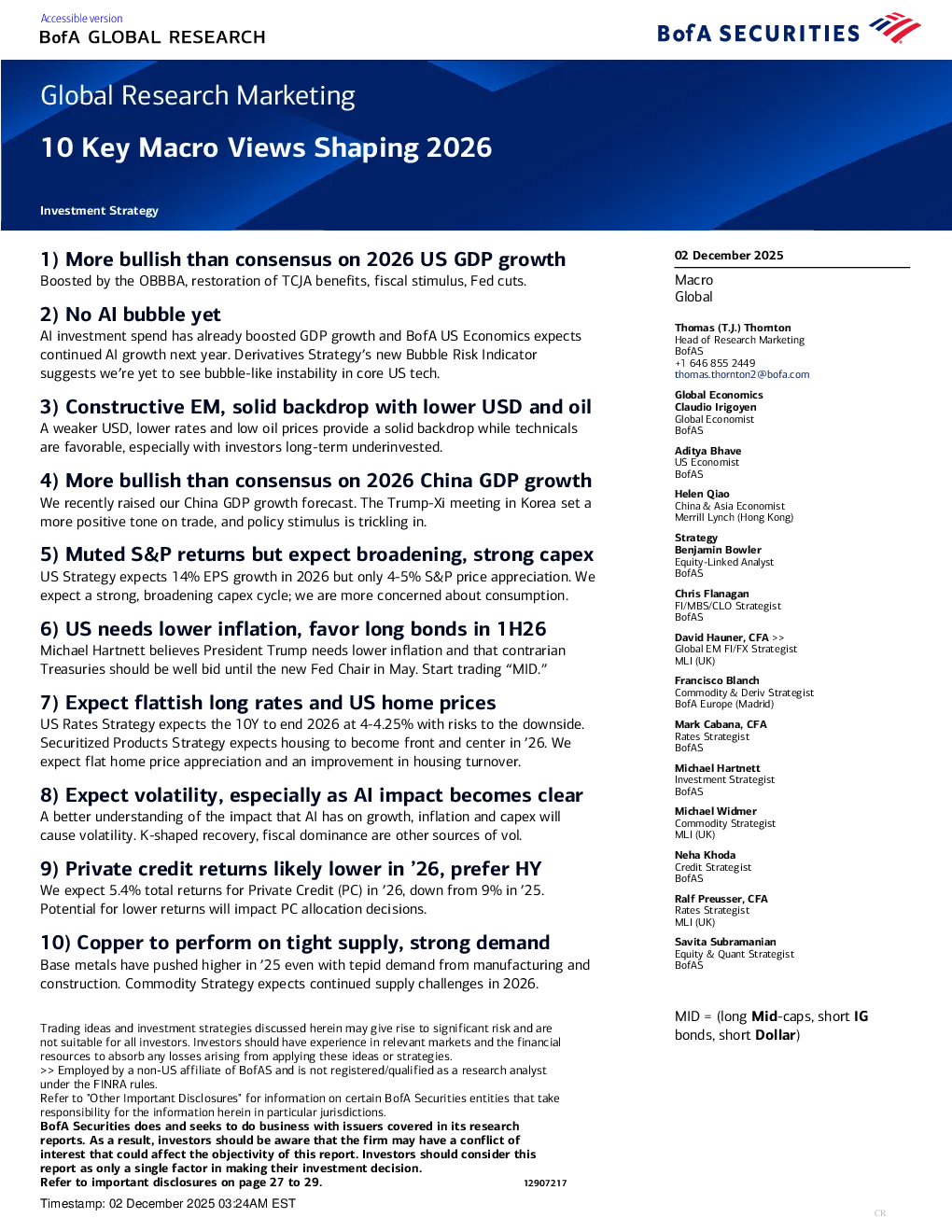
10 Key Macro Views Shaping 2026 Investment Strategy 1) More bullish than consensus on 2026 US GDP growth 02 December 2025 MacroGlobal Boosted by the OBBBA, restoration of TCJA benefits, fiscal stimulus, Fed cuts. 2) No AI bubble yet Thomas (T.J.) ThorntonHead of Research MarketingBofAS+1 646 855 2449thomas.thornton2@bofa.com AI investment spend has already boosted GDP growth andBofA US Economics expectscontinued AI growth next year. Derivatives Strategy’s new Bubble Risk Indicatorsuggests we’re yet to see bubble-like instability in core US tech. Global EconomicsClaudio IrigoyenGlobal EconomistBofAS 3) Constructive EM, solid backdrop with lower USD and oilA weaker USD, lower rates and low oil prices provide a solid backdrop while technicalsare favorable, especially with investors long-term underinvested. Aditya BhaveUS EconomistBofAS 4) More bullish than consensus on2026 China GDP growthWe recently raised our China GDP growth forecast. The Trump-Xi meeting in Korea set amore positive tone on trade, and policy stimulus is trickling in. Helen QiaoChina & Asia EconomistMerrill Lynch (Hong Kong) StrategyBenjamin BowlerEquity-Linked AnalystBofAS 5) Muted S&P returns but expect broadening, strong capexUS Strategy expects 14% EPS growth in 2026 but only 4-5% S&P price appreciation. Weexpect a strong, broadening capex cycle; we are more concerned about consumption. Chris FlanaganFI/MBS/CLO StrategistBofAS 6) US needs lower inflation, favor long bonds in 1H26Michael Hartnett believes President Trump needs lower inflation and that contrarian David Hauner, CFA>>Global EM FI/FX StrategistMLI (UK) Treasuries should be well bid until the new Fed Chair in May. Start trading“MID.” Francisco BlanchCommodity & Deriv StrategistBofA Europe (Madrid) 7)Expect flattish long rates and US home pricesUS Rates Strategy expects the 10Y to end2026 at 4-4.25% with risks to the downside. Securitized Products Strategy expects housing to become front and center in’26. Weexpect flat home price appreciation and an improvement in housing turnover. Mark Cabana, CFARates StrategistBofAS Michael HartnettInvestment StrategistBofAS 8) Expect volatility,especially as AI impact becomes clearA better understanding of the impact that AI has on growth, inflation and capex willcause volatility. K-shaped recovery, fiscal dominance are other sources of vol. Michael WidmerCommodity StrategistMLI (UK) Neha KhodaCredit StrategistBofAS 9) Private credit returns likely lower in ’26, prefer HYWe expect 5.4% total returns for Private Credit (PC) in’26, down from 9% in’25.Potential for lower returns will impact PC allocation decisions. Ralf Preusser, CFARates StrategistMLI (UK) 10)Copper to perform on tight supply, strong demandBase metals have pushed higher in’25 even with tepid demand from manufacturing and Savita SubramanianEquity & Quant StrategistBofAS construction. Commodity Strategy expects continued supply challenges in 2026. MID = (longMid-caps, shortIGbonds, shortDollar) Timestamp: 02 December 2025 03:24AM EST 1) More bullish than consensus on 2026US GDP growth The BofA Global Research US Economics team raised 2026 GDP growth estimates withtheir Year Ahead and they now look for 4Q/4Q growth of 2.4%. In 2026, five factorsshould push growth back to 2.4%. The team expects the One Big Beautiful Bill Act(OBBBA) to add 0.3-0.4pp to GDP growth in FY 26 compared to a roughly flat impulse in2025. Business investment should benefit from the restoration of the Tax Cuts and JobsAct (TCJA) tax benefits that sunsetted a few years ago. And consumers will get around $100B (0.3% of GDP) in fiscal stimulus. Of this, ~$65Bwill be a tax-refund“windfall”due to favorable treatment of tip and overtime income,and a larger standard deduction for seniors. Refunds mostly get paid out in Feb-Apr. Ourforecast assumes that the resulting spending boost will peak in 2Q-3Q 2026. Second, the lagged effect of ongoing Fed cuts is likely to buoy activity in 2H26. In fact,we think the (real) policy rate could be in accommodative territory next year because i)inflation is stuck a few tenths above target, even excluding tariffs, ii) potential growth,and therefore r*, are higher than the Fed thinks and iii) financial conditions suggestpolicy isn’t very restrictive today. Easy financial conditions are likely supportingeconomic activity via the equity wealth effect and we expect that impulse to continuenext year.The US Economics team expects one more rate cut under Chair Powell andsees 50bps of cuts under the new Fed Chair (25bp cuts in Jun, July).This forecast wasrevised on 12/1, after the release of the Year Ahead. Exhibit1: GDP growth, inflation, and policy rate forecastsWe now forecast GDP growth at 3.3% in 2026 and 3.4% in 2027, inflation to remain stable in 2026 We expect growth divergences to persist The third tailwind is related to trade policy. The Supreme Court is likely to rule on theIEEPA tariffs in late 2025 or early 2026. If the tariffs are s