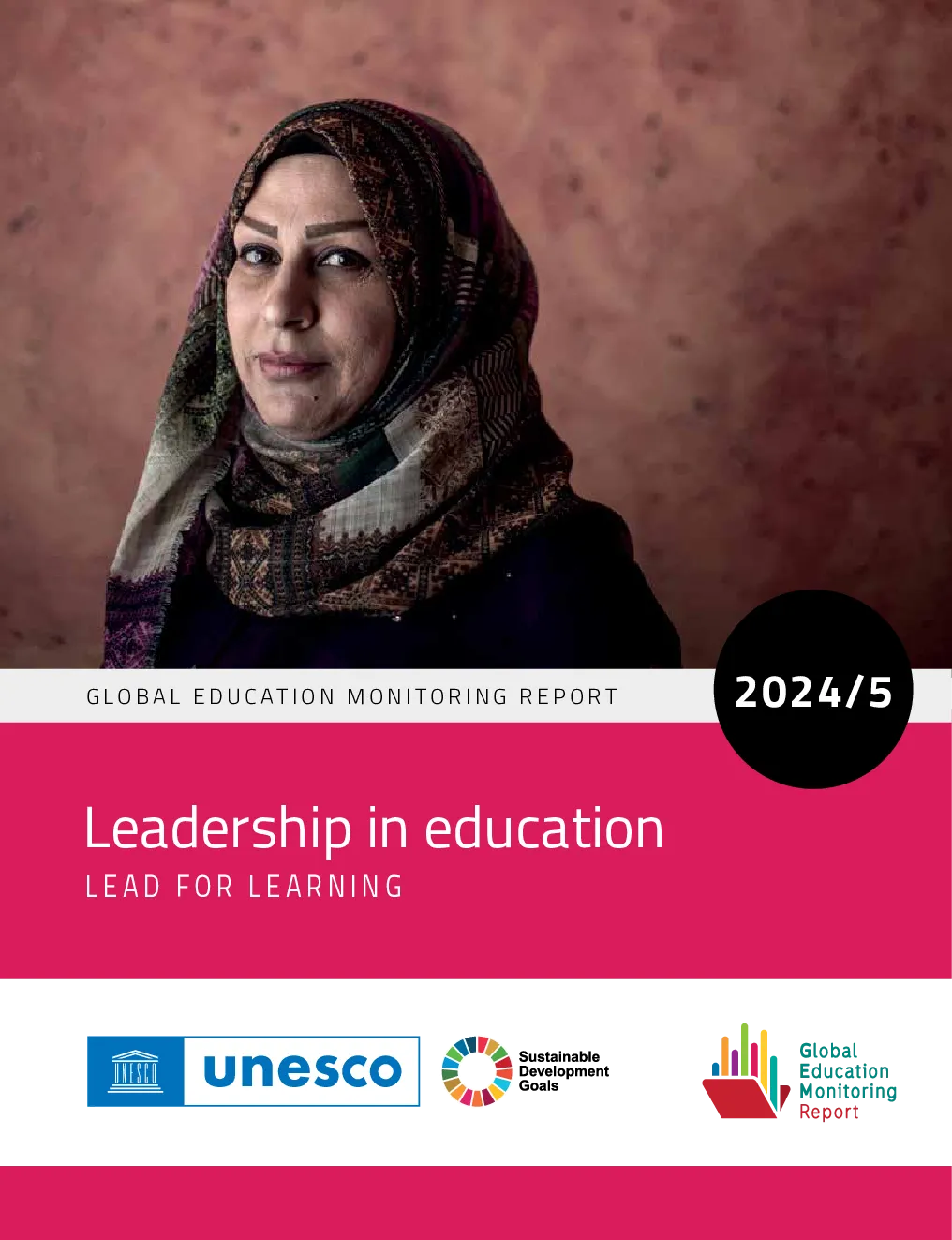
Leadership in education L E A D F O R L E A R N I N G G L O B A LE D U C A T I O N M O N I T O R I N G R E P O R T Leadership in education L E A DF O R L E A R N I N G The Education 2030 Incheon Declaration and Framework for Action specifies that the mandate of theGlobal EducationMonitoring Reportis to be “the mechanism for monitoring and reporting on SDG 4 and on education in the other SDGs”with the responsibility to “report on the implementation of national and international strategies to help hold all relevantpartners to account for their commitments as part of the overall SDG follow-up and review”. It is prepared by anindependent team hosted by UNESCO. The designations employed and the presentation of the material in this publication do not imply the expression of anyopinion whatsoever on the part of UNESCO concerning the legal status of any country, territory, city or area, or of itsauthorities, or concerning the delimitation of its frontiers or boundaries. TheGlobal Education Monitoring Reportteam is responsible for the choice and the presentation of the facts contained inthis book and for the opinions expressed therein, which are not necessarily those of UNESCO nor of its donors and do notcommit the Organization. Overall responsibility for the views and opinions expressed in the Report is taken by its Director. This publication can be referenced as: UNESCO. 2024.Global Education Monitoring Report 2024/5: Leadership in education– Lead for learning. Paris, UNESCO. UNESCO is an Open Access publisher and all publicationsare made available on-line, free of charge throughUNESCO’s documentary repository. Any commercializationof its publications by UNESCO is for cost-recovery ofnominal actual costs for printing or copying content onpaper or CDs, and distribution. There is no profit motive. © UNESCO, 2024First editionPublished in 2024 by the United Nations Educational,Scientific and Cultural Organization7, Place de Fontenoy, 75352 Paris 07 SP, France Typeset by UNESCOGraphic design and layout byOptima Graphic Design Consultants Ltd This publication is available in Open Access under theAttribution-ShareAlike 3.0 IGO (CC-BY-SA 3.0 IGO) license(http://creativecommons.org/licenses/by-sa/3.0/igo/).By using the content of this publication, the users acceptto be bound by the terms of use of the UNESCO OpenAccess Repository (https://www.unesco.org/en/open-access/cc-sa). Photography caption: On 3 March 2022 at Al TasneemSchool in Basra, Iraq, school principal Ansal stands for aportrait in her office. She says,“Poverty, mental health,child labour, child marriage, are some of the main factorsfor our students … Poverty is the main issue that makesthem drop out school”. Images marked with an asterisk (*) do not fall under the"https://creativecommons.org/licenses/by-sa/3.0/igo/"CC-BY-SA license and may not be used or reproducedwithout the prior permission of the copyright holders. Photo credit: © UNICEF/UN0614639/Ibarra Sánchez* ISBN: 9789231007163https://doi.org/10.54676/EFLH5184 How can education systems attract, appointand retain good education leaders? Leadership matters in education. Strong leaders are needed to help institutions,systems and societies change for the better. Strong leaders work in collaborationwith other actors towards the same goals. At the school level, they are the principalsbut also those who surround them, in the school and in the community, in positionsof responsibility. At the system level, they are civil servants working as districtofficers, supervisors or planners. At the societal level, they are politicalleaders, as well as a very broad range of actors who help shape educationgoals, from unions and researchers to civil society and the media.62%of countries use competitivepractices forschool leaders’recruitment Entitled Lead for learning, this report argues that, in pursuing specificgoals, education leaders are more than just managers. They are changeagents, who need the time, trust and support to focus on setting avision and developing the people they serve and work with. The reportcalls for investment in and empowerment of school and system leaders.There should be fair hiring processes and growth opportunities thatrecognize the full scope of leaders’ roles. Moreover, leadership works bestwhen it is shared, empowering others to lead as they can within their roles. There is no one leadership style that works. Different contexts, capacities andpersonalities mean that styles vary, and rightfully so. This, combined with thedifferent goals that each leader is trying to achieve, means that their impact is hardto fully assess. Yet, all research points towards the critical need for strong leaders tocontinuously improve education quality. School leaders are second only to teachers fortransforming student outcomes. Meanwhile, politicians wield huge influence in makingequitable and inclusive education a national priority. Supporting this seventhGlobal Education Monitoring Reportis