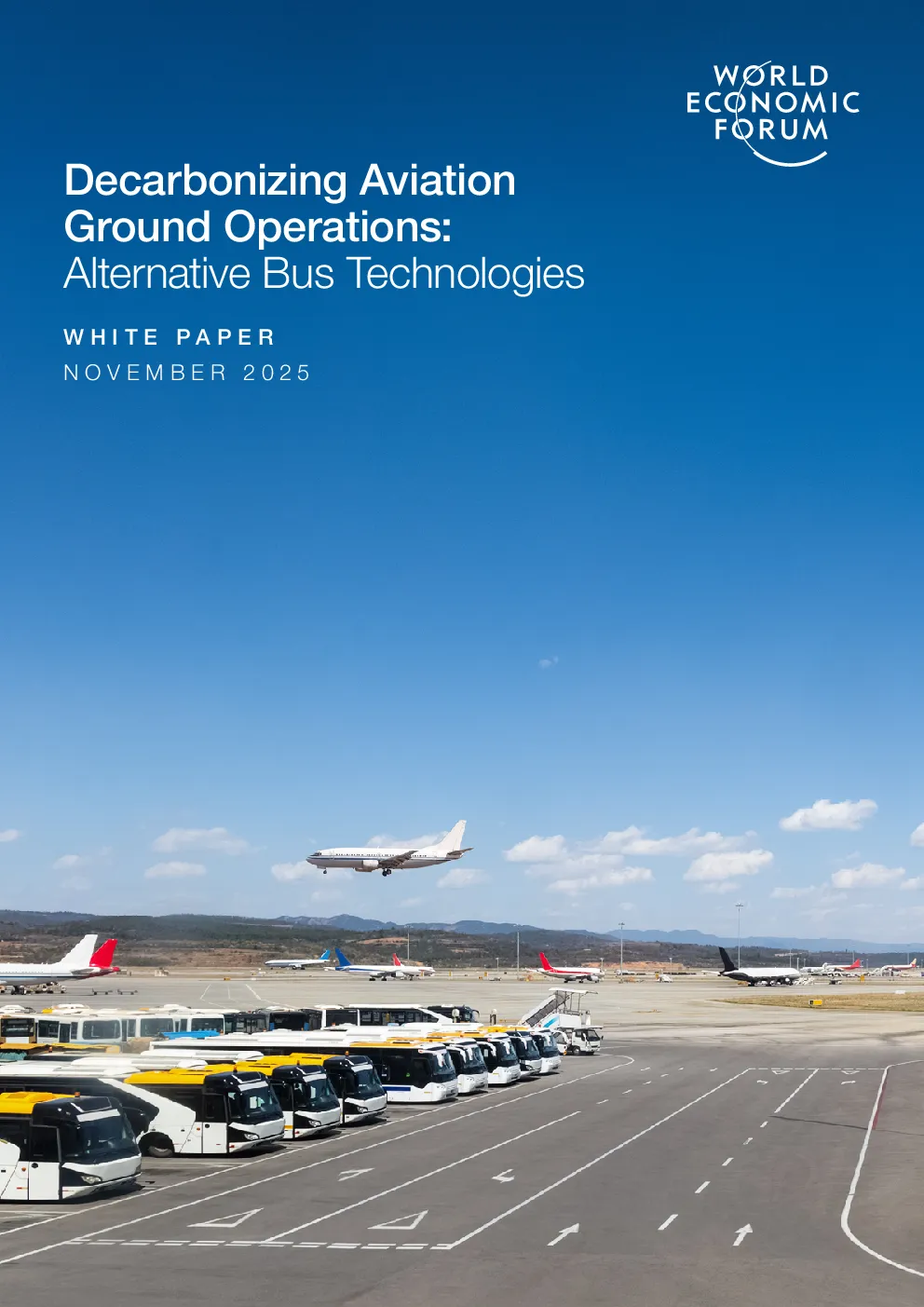
脱碳航空地面运营:替代巴士技术
W H I T EP A P E RN O V E M B E R2 0 2 5 Contents Executive summary3 Introduction4 1 Operating buses at airports5 2 Airport bus solutions: Technology overview and developments9 3 Total cost of ownership (TCO) analysis3.1 Reference case study and scenarios considered3.2 Scenario-based TCO results and insights3.3 Sensitivity analysis14141621 Conclusion25 Appendix 1: Methodology26 Appendix 2: Assumptions details per scenario27 Appendix 3: Subsidies29 Contributors32 Endnotes35 Disclaimer This document is published by theWorld Economic Forum as a contributionto a project, insight area or interaction.The findings, interpretations andconclusions expressed herein are a resultof a collaborative process facilitated andendorsed by the World Economic Forumbut whose results do not necessarilyrepresent the views of the World EconomicForum, nor the entirety of its Members,Partners or other stakeholders. ©2025 World Economic Forum. All rightsreserved. No part of this publication maybe reproduced or transmitted in any formor by any means, including photocopyingand recording, or by any informationstorage and retrieval system. Executive summary Total cost of ownership analysis is apragmatic tool to empower airports toadvance strategic decisions on net-zeroground operations. This paper explores the techno-economic feasibilityof replacing fossil-fuelled airport buses withalternative low-emission technologies such asretrofitted diesel-to-electric, battery-electric andhydrogen buses. The aim is to provide actionableinsights for airports seeking to decarbonize groundoperations and improve local air quality. Usinga robust total cost of ownership (TCO) model –validated through industry research and stakeholderinterviews – the analysis explores how capital,operating, maintenance and infrastructure costsaffect airport bus operations and their costs. Keyfindings include: –Operational and strategic considerations:The choice of technology depends on eachairport’s operational profile, financial capacityand long-term sustainability goals. Sensitivityanalysis highlights that driver salaries, utilizationrates and the availability of subsidies are theparameters that affect TCO the most. While further research is recommended to assessmore detailed airport load profiling, batterydegradation modelling and real-world retrofitperformance data, pragmatic recommendationsfor airports include: –Technology assessment: Retrofitted dieselvehicles with electric powertrains present acost-effective transitional solution that enablesrapid emissions reduction without the needto procure an entire fleet of battery-electricbuses. Battery-electric buses offer zerotailpipe emissions and are increasingly cost-competitive over their life cycle, especially whereairport routes are predictable and charginginfrastructure can be efficiently deployed andoperated alongside flight schedules. Hydrogenbuses (using fuel cell batteries or internalcombustion engines (ICE)) provide greater rangeand faster refuelling, making them suitablefor larger airports with intensive duty cycles,though they currently face higher upfront andinfrastructure costs. –Adopting common electric vehicle (EV) chargingand hydrogen refuelling standards to streamlineinfrastructure deployment and interoperability,including between ground equipment and futureaircraft. –Integrating renewable energy sources to powerelectric fleets and reduce life-cycle emissions,and renewable transport fuels where reliance onnon-electric powertrains is envisaged. –Exploring second-life battery applicationsto maximize asset value, circularity andsustainability. –Leveraging public-private partnerships andgreen bonds to finance large-scale fleettransitions. –TCO: The analysis, based on a referenceEuropean hub airport, reveals that retrofittedelectric buses can offer the lowest TCO perkilometre (km), making them attractive foroperators with budget constraints compared tonewer diesel fleets. New battery-electric busesrequire higher upfront investment but can deliverlower operating costs over time, particularlywhen supported by government incentives.Hydrogen buses, while operationally flexible, areprobably the most expensive option at presentdue to technology and infrastructure costs. –Enhancing collaboration among airports,operators and energy providers to share bestpractices and accelerate innovation. The paper concludes that decarbonizing busoperations is both technically feasible andeconomically advantageous, positioning airportsas enablers in the broader energy transition of theaviation industry. By adopting a tailored, evidence-based approach, airports can also enhanceoperational efficiency while contributing meaningfullyto the aviation industry’s net-zero journey. Introduction The aviation industry is committed to achievingnet-zero emissions by 2050, with every actor –airlines, airports, ground handling companies andpassengers – playing a critical role in this transition.As global air passenger