漂浮式海上风电与渔业共存框架——可行性研究
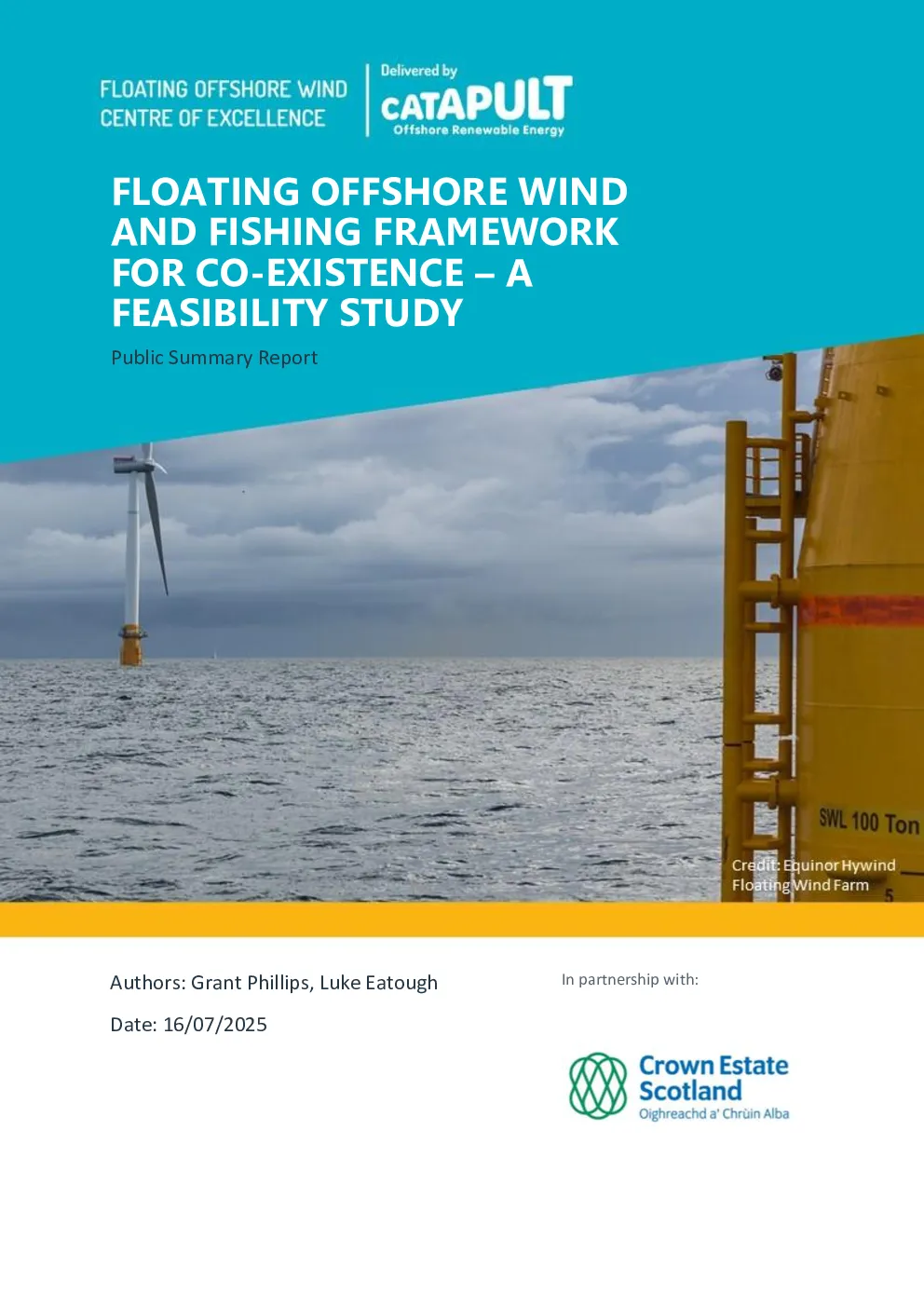
FLOATING OFFSHORE WINDAND FISHING FRAMEWORKFOR CO-EXISTENCE–AFEASIBILITY STUDY PublicSummary Report DISCLAIMER Whilst the information contained in this report has been prepared and collated in good faith,ORECatapult makes no representation or warranty (express or implied) as to the accuracy orcompleteness of the information contained herein nor shall we be liable for any loss or damageresultant from reliance on same. EXECUTIVE SUMMARY In February 2025, the Climate Change Committee published its Seventh Carbon Budget, advising theUK Government that 125 GW of offshore wind capacity,a sevenfold increase upon 2025levels,wouldbe required by 2050 to meet net zero greenhouse emissions targets.According to the latestindustry estimates, it is anticipated that floating offshore wind (FOW) technology will account formore than one third of the UK’s total offshore wind capacity by 2050.Giventhe scale of thisambition, it is important that the potential risks and opportunities associated with the coexistence offuture large scale FOW farms and other sea users are considered early so that the appropriatemeasures and enabling actions can beuntaken. As an established maritime industry, commercial fisheries areconsidereda key stakeholder in theoffshore wind development process.Therefore,in 2021,the Floating Offshore Wind Centre ofExcellence (FOW CoE) launched its FOW and Fishing Interaction Roadmap project which facilitated anextensive cross-industry engagement processto identify potential interactions between the FOWand fishing industries.A principal recommendation from the resulting Roadmap was to assesswhether the FOW array layout design process could play a role in facilitating coexistence betweenfuture large scale FOW farms and commercial fisheries. The FOW CoE thereforesubsequentlyestablished theFloating Offshore Wind and Fishing Frameworkfor Coexistenceprojectin orderto deliver on this recommendation. Although the primacy of marinespatial planningisrecognised as akey method for managingthe requirements of a range of maritimeindustries, the objective of this projectwas to determinethe extent to which decisions made duringthe design of future large-scale FOW farms, post-lease award,might facilitate potential coexistencewith commercialfisheries.A UK remit was adoptedfor this work, with a particular focus on theScottish North Sea and the Celtic Sea. The project was developed with the following core aims: •To undertake targeted engagements with key stakeholders in order to identify andcharacterise potential opportunities to support coexistence between the FOW and fishingindustries, with a focus on the role of FOW farm array layout design. •To deliver a technical feasibility assessment of the identified opportunities and innovationsfor maximising coexistence.•To undertake an economic impact assessment to determine the potential financialimplications of the identified opportunities and innovations, both in respect of a FOWproject’s capital expenditure (CAPEX), operational expenditure (OPEX) and LCoE, as well asthe potential considerations for the fishing industry.•To develop guidance in the form of acoexistence framework for supporting decision makingduring the development process of commercial scale FOW arrays–both at the project-leveland a strategic-level–in respect of maximising coexistence with the fishing industry. This willsummarise both the technicaland economic considerations, and, where relevant, thepotential role of innovations. Technical workshops were convened to facilitate the cross industry-engagement process. Thesewere conducted regionally, with in-person workshops held in Scotland and Cornwall, and includedrepresentatives from the fishing industry (including several withdirect experience of working on orcaptaining commercial fishing vessels) and FOW farm developers (including design engineers,development and consenting specialists, and fisheries engagement managers). The project team also sought the input of other relevant stakeholders, including seabed leasing authorities, regulators, andmaritime navigational and safety bodies. Following the technical engagement process, the identified opportunitiesfor supporting potentialcoexistence were assessed by the project team in respect of their technical and economic feasibility.The opportunities were subsequently scored inthecoexistence framework. The principalinnovationopportunities for supporting potential future coexistence between large-scale FOW farms and commercial fisheries include: larger turbine capacities, and the increasedspacing within arrays that they would enable; taut nylon moorings, and the reduction inmooringfootprints that they could facilitate; the appropriate positioning of substations within FOW arrays;the simplification of FOW farm maritime logistics through the adoption of SOV-led logistic strategiesand the development of in-situ heavy lift solutions;andthe digital mapping of FOW subseainfrastructure. Theseinnovation opportunities