AI智能总结
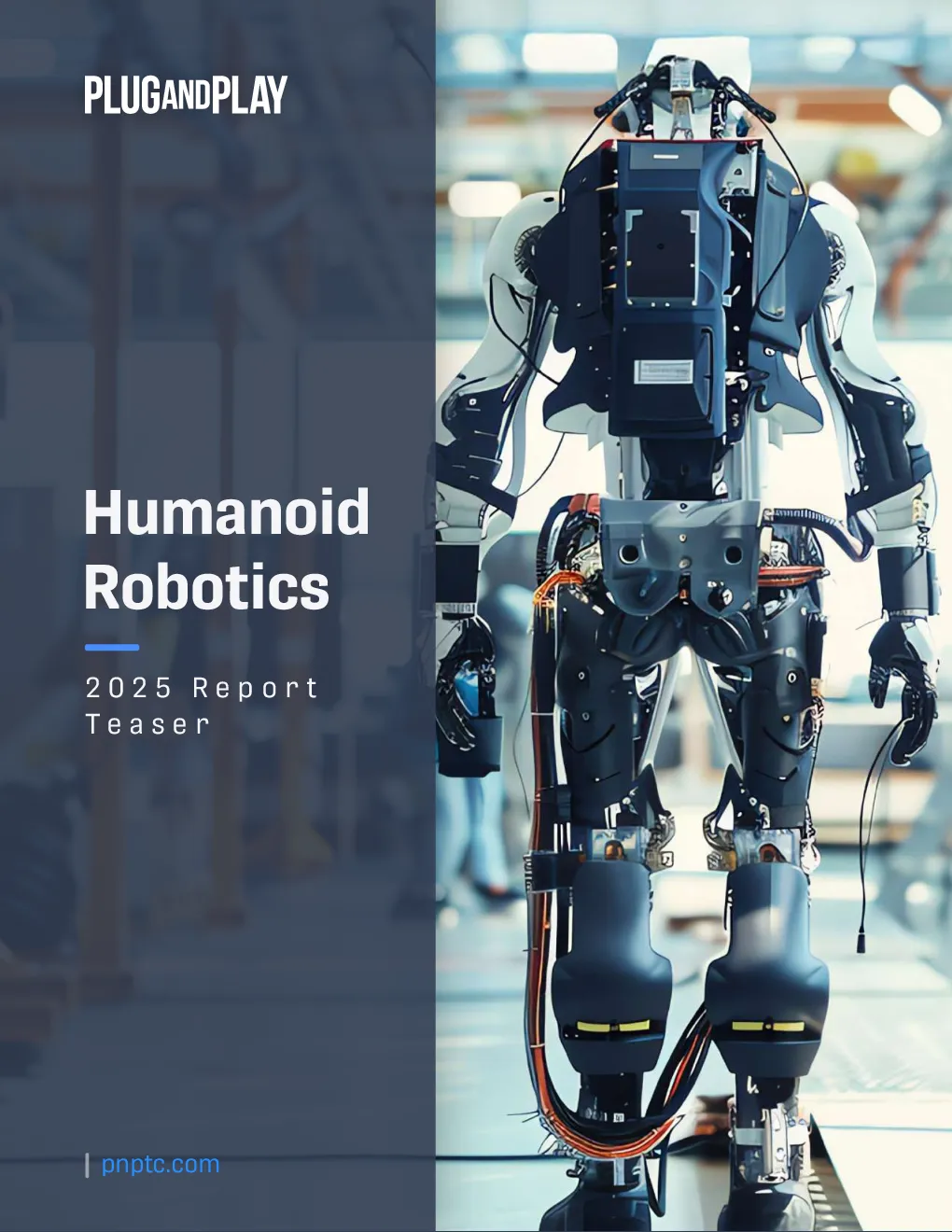
2 0 2 5R e p o r tT e a s e r Executive Summary Table of Contents Page 4Page 5Page 6Page 7Page 8Page 9Page 12Page 13Page 14Page 15Section 1 | Overview•Introduction•Humanoid Categories•FundingSection 2 | Capabilities & Challenges•Software Capabilities & ChallengesSection 3 | Deep Dive•Overview & ComparisonSection 4 | Interview Perspectives•Buyer Perspective Introduction In recent years, the excitement surrounding humanoid robots has reached newheights. From Wall-E-sized robots that can clean up after us to a T800 ArnoldSchwarzenegger that can kick down my door muttering “Hasta La Vista,” sciencefiction has long fueled the belief that robots will one day walk among us. Theexcitement has captured the imagination of investors, technologists, and the publicalike, leading to investments of over $1.5 billion in 2024 to bring these ideas closer toreality. This report is the result of extensive interviews with founders of major startups,robotics experts from top universities, and industry leaders who have piloted thetechnology. It combines extensive research from academic papers and marketanalytics. The Plug and Play 2025 Humanoid Report builds on the 2024 edition and incorporatesnew insights from our team in China, adding coverage of Chinese humanoid startups.It highlights current achievements, explores potential developments, and examinesthe hurdles to broader adoption, offering a nuanced perspective on the evolvingtechnological landscape. Humanoid Categories Full Humanoid The full humanoid form factor refers torobots designed to replicate the humanbody and its capabilities. In general, theyhave: •Two arms•Torso•Two legs•End Manipulators Semi-Humanoid Semi-humanoid robots offer capabilitiescomparable to full humanoids, typicallyfeaturing a humanoid upper body mountedon an autonomous mobile robot (AMR) base.In general, semi-humanoids include: •Torso•Two arms•Wheelbase•End Manipulators Humanoid-Like A humanoid-like form factor refers to arobot that resembles the human form inappearance but lacks human-likecapabilities. These robots are typically builtfor specific, limited tasks — such as actingas a registration assistant — rather thanserving broader functional purposes. PLUG AND PLAY PARTNERS GET FULL ACCESSCONTACT US TO VIEW THE FULL REPORTPNPTC.COM/JOIN Funding Below is the total funding of over 85 startupsand companies within the humanoid androbotic AI sectors, broken down by category. Physical Intelligence and Skild AI raised$400M and $300M, respectively. While funding in 2024 had taken off, it hasexploded even further this year. Landmarkrounds include Field AI raising over $400M,Genesis AI securing $105M, Figure AI closing amassive $1.5B round, Apptronik raising$350M, and Agility Robotics raising over$100M. With momentum still building, whoknows where funding levels will be by year’send?. Aside from the 2021 acquisition of BostonDynamics for $880M, funding in the humanoidand robotic AI space had been relativelymodest until the last two years. In 2024, however, we’ve seen significantfunding rounds, including 1X and Cobotraising $100M each, and Figure AI securing$675M for hardware. On the software side, PLUG AND PLAY PARTNERS GET FULL ACCESSCONTACT US TO VIEW THE FULL REPORTPNPTC.COM/JOIN Capabilities &Challenges Software Capabilities & Challenges In humanoid robotics, the software stack can bebroken down into four main categories: perception,reasoning, locomotion, and manipulation. Each ofthese components play a crucial role in enablingrobots to interact with and navigate theirenvironments, making them more adaptable andcapable of performing complex tasks. In this section,we will explore these components, as well as thedifferences between traditional and modernartificial intelligence, highlighting advancements inAI and how they have influenced the development ofhumanoid robots. Category 1: Perception Perception for humanoid robotics is the ability toidentify and locate objects and obstacles in itssurroundings. This capability is broken down intotwo key aspects: "what" and “where.” Capability 1: What is the Object? Perception for humanoid robotics involvesidentifying objects and obstacles in the robot'senvironment. Object detection, particularlythrough vision, has largely been solved, allowinghumanoid robots to detect and label objects theyhave been trained to recognize. While thetechnology still requires some time for learningnew objects, it is expected to become less of aconcern for humanoid startups in the near futureas AI models continue to improve. PLUG AND PLAY PARTNERS GET FULL ACCESSCONTACT US TO VIEW THE FULL REPORTPNPTC.COM/JOIN Capability 2: Where is the Object? Determining the location of objects in relation to the robot, however, is still a challenge. While visionsensors can identify objects, they do not fully assess their position in 3D space relative to the robot. Toaddress this, humanoid startups are utilizing sensor fusion techniques, which combine vision sensors