摩根士丹利美股招股说明书(2025-12-03版)
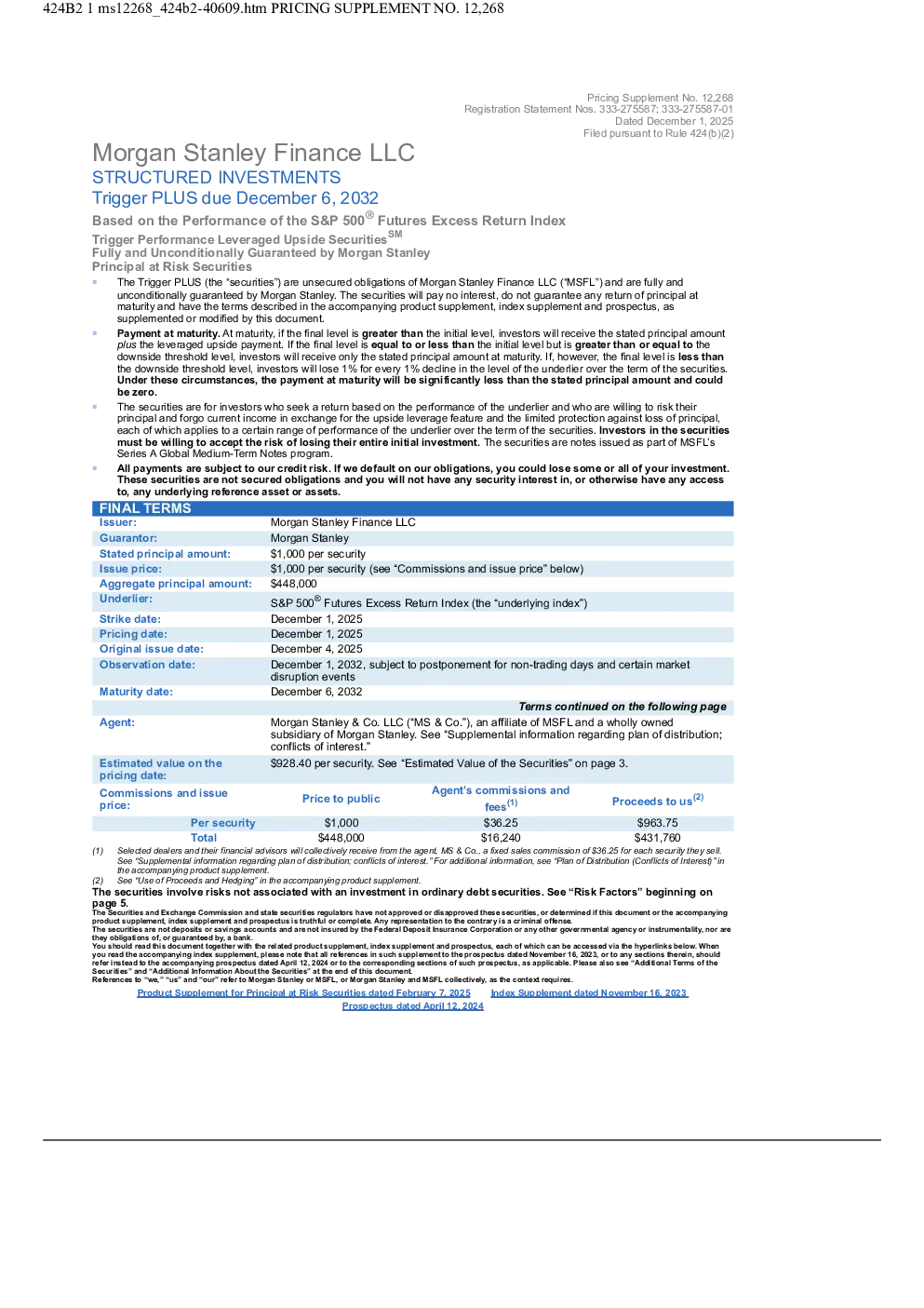
STRUCTURED INVESTMENTS Trigger PLUS due December 6, 2032 Based on the Performance of the S&P 500®Futures Excess Return IndexTrigger Performance Leveraged Upside SecuritiesSMFully and Unconditionally Guaranteed by Morgan StanleyPrincipal at Risk Securities ■The Trigger PLUS (the “securities”) are unsecured obligations of Morgan Stanley Finance LLC (“MSFL”) and are fully andunconditionally guaranteed by Morgan Stanley. The securities will pay no interest, do not guarantee any return of principal atmaturity and have the terms described in the accompanying product supplement, index supplement and prospectus, assupplemented or modified by this document. Payment at maturity.At maturity, if the final level isgreater thanthe initial level, investors will receive the stated principal amountplusthe leveraged upside payment. If the final level isequal to or less thanthe initial level but isgreater than or equal tothedownside threshold level, investors will receive only the stated principal amount at maturity. If, however, the final level isless thanthe downside threshold level, investors will lose 1% for every 1% decline in the level of the underlier over the term of the securities.Under these circumstances, the payment at maturity will be significantly less than the stated principal amount and could be zero. The securities are for investors who seek a return based on the performance of the underlier and who are willing to risk theirprincipal and forgo current income in exchange for the upside leverage feature and the limited protection against loss of principal,each of which applies to a certain range of performance of the underlier over the term of the securities.Investors in the securitiesmust be willing to accept the risk of losing their entireinitial investment.The securities are notes issued as part of MSFL’s All payments are subject to our credit risk. If we default on our obligations, you could lose some or all of your investment.These securities are not secured obligations and you will not have any security interest in, or otherwise have any accessto, any underlying reference asset or assets. page 5.The Securities and Exchange Commission and state securities regulators have not approved or disapproved these securities, or determined if this document or the accompanying product supplement, index supplement and prospectus is truthful or complete. Any representation to the contrary is a criminal offense.The securities are not deposits or savings accounts and are not insured by the Federal Deposit Insurance Corporation or any other governmental agency or instrumentality, nor arethey obligations of, or guaranteed by, a bank. You should read this document together with the related product supplement, index supplement and prospectus, each of which can be accessed via the hyperlinks below. Whenyou read the accompanying index supplement, please note that all references in such supplement to the prospectus dated November 16, 2023, or to any sections therein, shouldrefer instead to the accompanying prospectus dated April 12, 2024 or to the corresponding sections of such prospectus, as applicable. Please also see “Additional Terms of theSecurities” and “Additional Information About the Securities” at the end of this document. Estimated Value of the Securities The original issue price of each security is $1,000. This price includes costs associated with issuing, selling, structuring andhedging the securities, which are borne by you, and, consequently, the estimated value of the securities on the pricing date is What goes into the estimated value on the pricing date? In valuing the securities on the pricing date, we take into account that the securities comprise both a debt component and aperformance-based component linked to the underlier. The estimated value of the securities is determined using our own pricingand valuation models, market inputs and assumptions relating to the underlier, instruments based on the underlier, volatility and What determines the economic terms of the securities? In determining the economic terms of the securities, we use an internal funding rate, which is likely to be lower than oursecondary market credit spreads and therefore advantageous to us. If the issuing, selling, structuring and hedging costs borne by What is the relationship between the estimated value on the pricing date and the secondary market price of the securities? The price at which MS & Co. purchases the securities in the secondary market, absent changes in market conditions, includingthose related to the underlier, may vary from, and be lower than, the estimated value on the pricing date, because the secondarymarket price takes into account our secondary market credit spread as well as the bid-offer spread that MS & Co. would chargein a secondary market transaction of this type and other factors. However, because the costs associated with issuing, selling,structuring and hedging the securities are not fully