AI智能总结
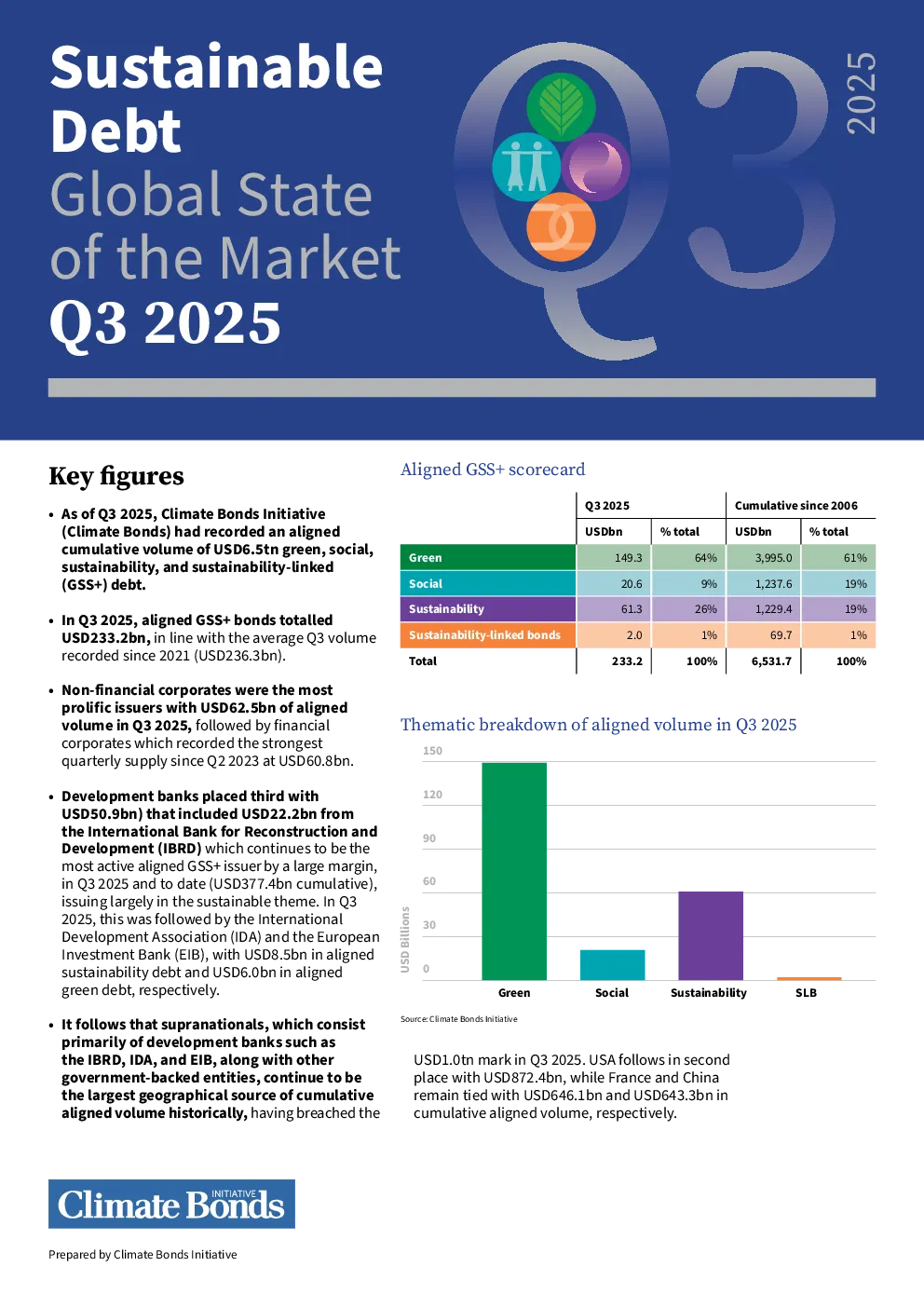
Key figures •As of Q3 2025, Climate Bonds Initiative(Climate Bonds) had recorded an alignedcumulative volume of USD6.5tn green, social,sustainability, and sustainability-linked •In Q3 2025, aligned GSS+ bonds totalledUSD233.2bn,in line with the average Q3 volumerecorded since 2021 (USD236.3bn). •Non-financial corporates were the mostprolific issuers with USD62.5bn of alignedvolume in Q3 2025,followed by financialcorporates which recorded the strongest •Development banks placed third withUSD50.9bn) that included USD22.2bn fromthe International Bank for Reconstruction andDevelopment (IBRD)which continues to be themost active aligned GSS+ issuer by a large margin,in Q3 2025 and to date (USD377.4bn cumulative),issuing largely in the sustainable theme. In Q32025, this was followed by the International •It follows that supranationals, which consistprimarily of development banks such asthe IBRD, IDA, and EIB, along with othergovernment-backed entities, continue to bethe largest geographical source of cumulative USD1.0tn mark in Q3 2025. USA follows in secondplace with USD872.4bn, while France and Chinaremain tied with USD646.1bn and USD643.3bn incumulative aligned volume, respectively. List of acronyms A&R: Adaptation and resilienceABS: Asset-backed securitiesAFFLU: Agriculture, forestry, food, and land useCBS: Climate Bonds StandardCBS v4: Climate Bonds Standard V4DM: Developed marketEM: Emerging marketESG: Environmental, social, and governanceEU: European UnionGBDB: Green Bond DatabaseGBP: ICMA Green Bond PrinciplesGHG: Greenhouse gas KPI: Key performance indicatorLAC: Latin America and CaribbeanMDB: Multilateral development bankS&S: Social and sustainabilitySME: Small and medium-sized enterpriseSSBDB: Social and Sustainability Bond DatabaseSBP: ICMA Social Bond PrinciplesSDG: Sustainable development goalSLB: Sustainability-linked bondSLL: Sustainability-linked loanSNAT: SupranationalSPT: Sustainability performance target Green-labelled debt continues torepresent the majority of alignedvolume, making up 64% ofaligned GSS+ volume in Q3 2025(USD149.3bn), which is close tothe average quarterly aligned Social Top non-sovereign Climate Bonds-aligned social issuersin Q3 2025 After strong supply in H1 2025,social-labelled debt volume droppedto USD20.6bn in Q3 2025, whichis 53% lower than the average Q3social volume since 2021. The Korea continues to lead social issuers with USD4.2bn inaligned social volume in Q3 2025. KHFC, along with12 other South Korean Issuers, issued USD8.7bndenominated in Korean Won, making it the mostissued currency in Q3 2025. Sustainability Aligned sustainability-labelleddebt continued to buildmomentum, pricing USD61.3bnin aligned sustainability-labelledvolume in Q3 2025, which is its Sustainability-linked bonds While the aligned sustainability-linked bond (SLB) volume in Q32025 (USD2.0bn) is lower than Q32024 (USD3.1bn), the annual SLBsupply on a year-to-date (YTD) basis,(USD11.7bn aligned volume) exceeds full year SLB supply for 2024 (USD9.5bn). Sloveniabecame the third sovereign in the world (first everin Europe) to issue an aligned SLB (USD1.2bn). Sovereigns Ninety percent of aligned sovereignsupply in Q3 2025 originated fromEuropean countries (USD20.0bn)headlined by Austria with USD5.0bnvolume across eight deals, the firstsovereign European Green Bond Appendix Scope of analysis This report includes four sustainable debt themes basedon the projects, activities, and expenditures financed:green, social, sustainability, and SLB. The GSS+ themes can Green:dedicated environmental benefits (captured since 2012). Social:dedicated social benefits (captured since 2020). Sustainability:green and social benefits combined into oneinstrument (captured since 2020). SLB:changes in coupon (almost always step-ups) linked thefulfilment of key performance indicators (KPIs) against entity-levelsustainability performance targets (SPTs) (captured since 2021). Transition bonds Historically, Climate Bonds recorded but did not screen bondsbearing the transition label. As of January 2024, Climate Bondsstopped reporting transition bonds as a separate category butregards them as a sub-set of the green label. Climate Bonds now SLBs are assessed according to Climate Bonds Sustainability-Linked Bond Database Methodology (SLBDB Methodology) and 1. Fully aligned:SLB targets cover all material sources ofemissions and are aligned with the relevant pathway. Methodology overview 2. Strongly aligned:SLB targets cover all material sources ofemissions and will be aligned with the relevant pathway by 2030. This report draws on three Climate Bonds databases: 3. Aligning:SLB targets cover all material sources of emissions,are aligned with the pathway on a % reduction basis, and the 1. Green Bond Database (GBDB) 2. Social and Sustainability Bond Database (SSBDB) 4. Not aligned:SLB targets fail to meet any of the abovecriteria, or do not meet the other requirements detailed in 3. SLB Database (S