卫生部门在支持父母和护理人员发挥其育儿潜力方面的作用
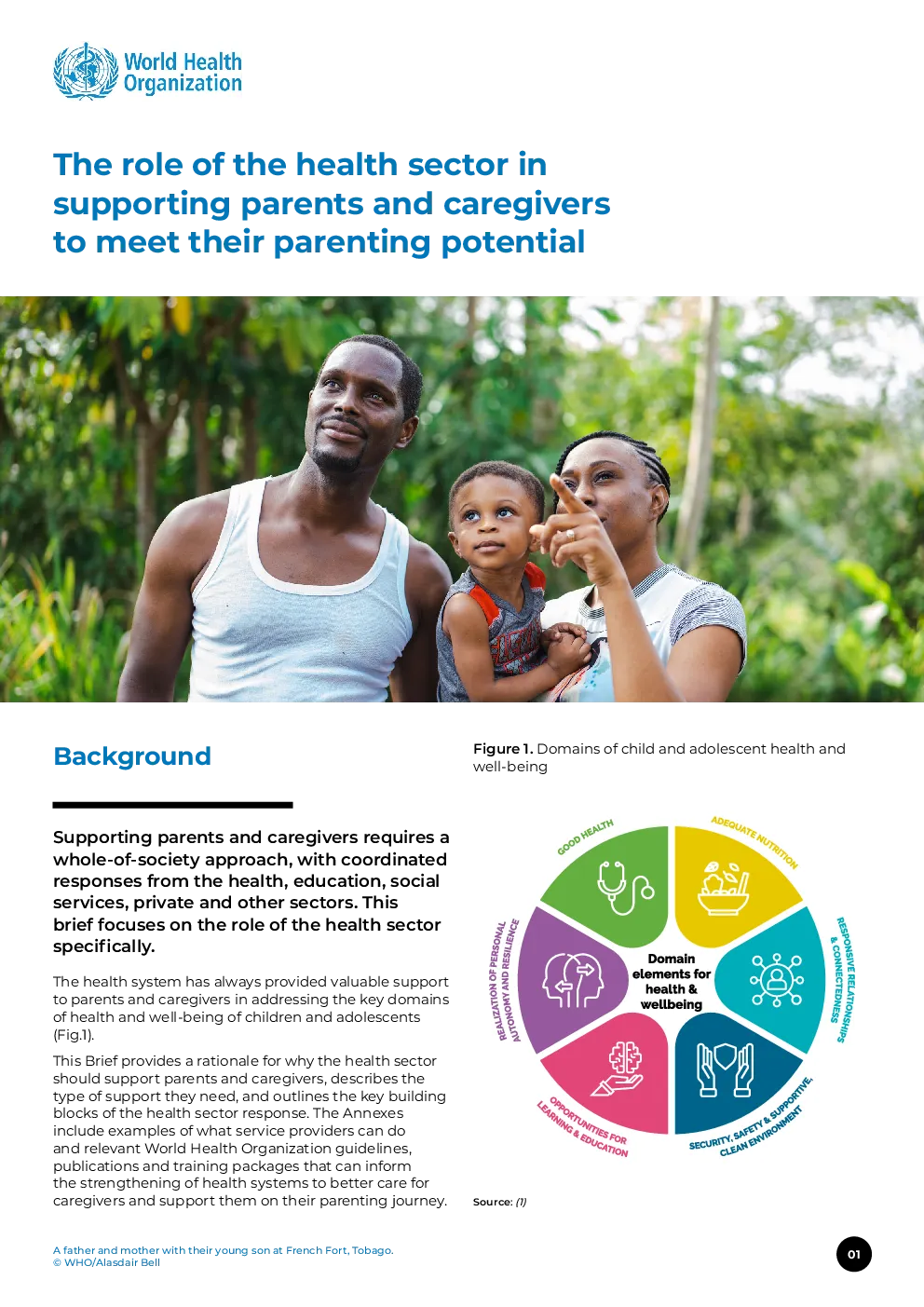
Background Supporting parents and caregivers requires awhole-of-society approach, with coordinatedresponses from the health, education, social The health system has always provided valuable supportto parents and caregivers in addressing the key domains This Brief provides a rationale for why the health sectorshould support parents and caregivers, describes thetype of support they need, and outlines the key buildingblocks of the health sector response. The Annexesinclude examples of what service providers can do and psychological wellbeing ofchildren and youth. It comprisesthe interactions, behaviours,emotions, knowledge, beliefs,attitudes, and practices to the interactions, behaviours,emotions, knowledge, beliefs,attitudes, and practices Key definitions •Parents and caregiversrefer toadults who are responsible forthe daily care and support ofa child or adolescent. Primarycaregivers include parents,families and other people who •Aparenting supportinterventionis a set ofstructured activities to help •In this document we use thetermsparents and caregiversto refer to the person and •Parentingis a core humanprocess that helps ensure the Why should the healthsector support parents What type of supportdo parents and caregivers Parenting is a critical accelerator for positiveoutcomes for children and adolescents(2,3,4). Support for caregivers should focus on: •Strengthening parenting behaviours:empoweringcaregivers to provide supportive, attentive care for •improve physical and mental health•improve child and adolescent development•increase wages and productivity•improve academic achievement •Promoting support-seeking:raising awareness aboutservices and support available; and •Supporting caregiver wellbeing:providing supportfor caregiver wellbeing and guiding them to prioritize The key building blocks forsupporting caregivers ofchildren and adolescentsacross the life course are Three-levelparenting support An enablingenvironment Existingservices The health sector should collaboratewith other services and sectors tocreate an enabling environment forcaregivers (see outer circle of Fig2). This relies on a comprehensivelegislative and policy framework,effective coordination mechanisms, The health sector should matchthe level of support that caregiversreceive to the intensity of theirneeds(6). All caregivers can benefitfrom universal support for improveparenting behaviours, support-seeking and wellbeing. However,services should also identify The health sector should useopportunities in existing services tostrengthen parenting behaviours,support-seeking and caregiver •Elicitation of parental, child oradolescent concerns; •Psychosocial and environmental •Comprehensive physicalexamination, including growth •Universal supportfor improvingparenting behaviours, support-seeking and wellbeing includes •Screening/checking for relevantconditions; •Counselling and delivery ofrelevant interventions;•Anticipatory guidance; and•Extra support or referral tomore specialized services whennecessary. •Targeted support for caregiverswith specific needs, for examplecommunity-based support •Intensive supportfor caregiverswith complex needs, for exampleindividualized counselling for How should thehealth sectordeliver support To ensure that healthservices are supportive ofparents and caregivers, the Remember Examples: •Notice that a pregnant woman looks anxious during a routinecheck-up and encourage her to reach out for support.•Support a new parent to make eye contact during feeding. A lot of what health serviceproviders are already doing is Strengthen Examples: •Ensure that all interactions with parents and caregivers are caringand respectful, build on existing strengths, and provide supportive, When existing services arestrengthened and delivered ata high quality, it reduces the •Create pathways for follow-up support through personalizedmessages or check-ins for parents and caregivers who missed Examples: Add •During an ultrasound check-up in the third trimester, draw theparents’ attention to their baby’s ability to recognize their parent’s Small but effective actions(“quick wins”) can be added toexisting services to optimizethe support that caregivers •Model for the parent an empathic and caring response to thechild’s fear of a needle during an immunization. •Provide low grade WIFI that patients can connect to, promptingthem to register with their name, contact information and the age Supporting parentingbehaviours, support-seeking Annex 1 provides examples of how health services cansupport caregivers at different stages of their child’sdevelopment, from the antenatal period, through toadolescence. These examples and priorities are derived Conclusion To support parents and caregivers, health systems should: •Focus on fostering supportive relationships with parents and caregivers•Recognize caregivers’ existing strengths and respond to areas where support is needed All parents and careg