您的浏览器禁用了JavaScript(一种计算机语言,用以实现您与网页的交互),请解除该禁用,或者联系我们。[联合国]:贸易:实现《巴黎协定》的催化剂 - 发现报告

贸易:实现《巴黎协定》的催化剂

商贸零售2025-11-18-联合国张***
AI智能总结
查看更多
贸易:实现《巴黎协定》的催化剂

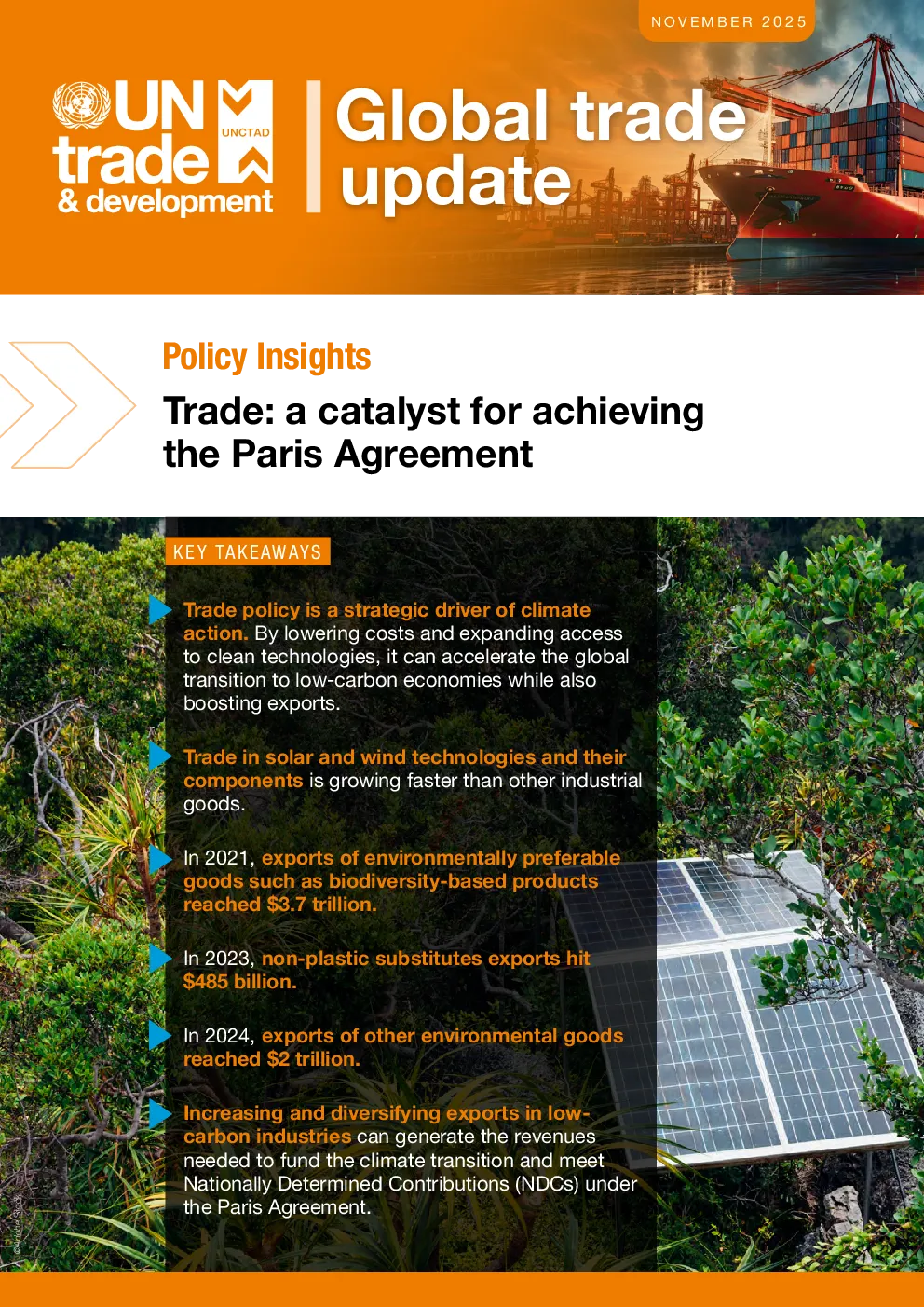
Policy Insights Trade: a catalyst for achieving K E Y TA K E AW AY S Trade policy is a strategic driver of climateaction.By lowering costs and expanding accessto clean technologies, it can accelerate the global Trade in solar and wind technologies and theircomponentsis growing faster than other industrial In 2021,exports of environmentally preferablegoods such as biodiversity-based products In 2023,non-plastic substitutes exports hit$485 billion. In 2024,exports of other environmental goodsreached $2 trillion. Increasing and diversifying exports in low-carbon industriescan generate the revenuesneeded to fund the climate transition and meet What does trade have to do with To effectively meet the goals of the Paris Agreement,1Parties are required to prepare and submitupdated nationally determined contributions (NDCs) every five years, aiming for the highestpossible ambition2. These NDCs must adopt an economy-wide approach that integrates climatepolicy with broader national economic and development strategies. NDCs are not just climatepledges; they represent each country’s commitment to reduce emissions, adapt to climateimpacts, and advance sustainable development. UNCTAD’s Guide for Policymakers on Trade Effective implementation of NDCs is also critical. Trade policy can be a strategic enabler forcountries to meet their climate goals while fostering economic growth. Measures such as tariffreduction or elimination for low-carbon goods, liberalization of trade in environmental servicesor harmonization and interoperability of sustainability standards can help attain climate goals. In While much attention has been paid to the role of trade in climate change, particularly throughembodied carbon in production and in transportation of goods, trade can also reduce thecosts of achieving the climate and other SDGs by facilitating access to the goods, services, To increase the understanding of whether and how national trade-related measures are integratedinto national climate plans, and how trade policy can support climate goals, UNCTAD mappedthe use of trade-related measures in previous NDCs (until September 2023)5of 60 developingcountries.6The mapping identified that trade-related measures are increasingly being used to Integrating trade policy measures more systematically into NDCs can enhance both ambitionand implementation. Strategic use of trade tools can help align economic development with •Increase the level of ambition and implementation to achieve climate change goals insynergy with national SDGs priorities.•Enhance adaptation strategies and ensure the resilience of export sectors.•Accelerate the transition to a low-carbon economy by identifying relevant opportunities toattract investment, and improve national policy coherence by providing entry points to linkclimate change, trade and investment strategies to participate in global markets alignedwith other national and development priorities.•Maintain or increase competitiveness and market access - mitigating the impact of raisingenvironmental standards and regulations, market trends and consumer preference.•Strengthen sustainable export diversification and promote the integration of the mostvulnerable people in low-carbon and climate-resilient value chains. Urgency to decarbonize The urgency to act is clear. Climate change, biodiversity loss,pollution, along with desertificationandother forms of environmental degradation,are among the greatest challenges of our time.They put increasing pressure on economic activities and hinder the achievement of sustainable Global warming has already exceeded the 1.5°C threshold, leading to increasingly severeenvironmental and societal consequences.Developing countries, especially those that areparticularly vulnerable to the effects of climate change, such as small island developing States(SIDS)and least developed countries (LDCs), areheavilyimpacted by these changes. Reducing There remains a narrow window to meet the Paris Agreement’s targets—if emissions are cutsharply and quickly, but recent NDCs fall short.10 Between 1 January 2024 and 30 September 2025, 64 Parties have submitted updated NDCsunder the Paris Agreement, ahead of the United Nations Climate Conference (COP30) takingplace in Belém, Brazil, in November 2025.11These countries represent only around 30 percent of global emissions.12Even with additional submissions expected from major economies, Only eleven of the 35 largest emitters—six developed and five developing countries—havesubmitted updated, more ambitious NDCs.14In 2023, the 35 largest emitters accounted for 91 per cent of carbon dioxide (CO2) and 73 per cent of global exports,15underscoring the need to Trade as a catalyst for climateadaptation and mitigation Enabling access to low-carbon technologies •Trade facilitates access to renewable energy technologies, helping countries transition tolow-carbon economies.•Global trade in solar and wind technologies and components has surge