您的浏览器禁用了JavaScript(一种计算机语言,用以实现您与网页的交互),请解除该禁用,或者联系我们。[韩国央行]:极端天气加剧的通货膨胀影响:关于持续性和非线性的证据 - 发现报告

极端天气加剧的通货膨胀影响:关于持续性和非线性的证据

2025-09-08-韩国央行L***
AI智能总结
查看更多
极端天气加剧的通货膨胀影响:关于持续性和非线性的证据

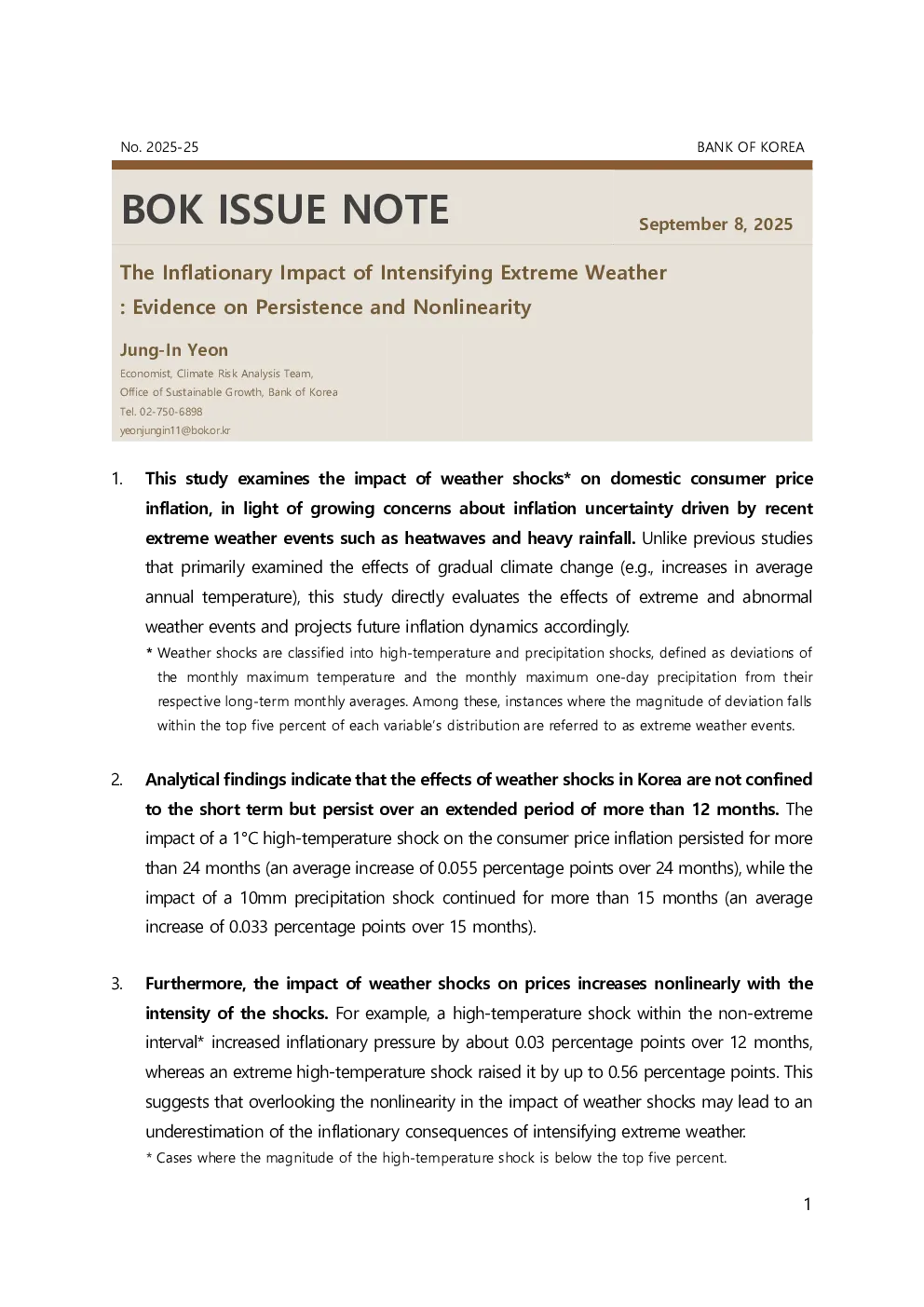
The Inflationary Impact of Intensifying Extreme Weather : Evidence on Persistence and Nonlinearity Jung-In Yeon Economist, Climate Risk Analysis Team,Office of Sustainable Growth, Bank of KoreaTel. 02-750-6898yeonjungin11@bok.or.kr 1.This study examines the impact of weather shocks* on domestic consumer priceinflation, in light of growing concerns about inflation uncertainty driven by recentextreme weather events such as heatwaves and heavy rainfall.Unlike previous studiesthat primarily examined the effects of gradual climate change (e.g., increases in averageannual temperature), this study directly evaluates the effects of extreme and abnormalweather events and projects future inflation dynamics accordingly. *Weather shocks are classified into high-temperature and precipitation shocks, defined as deviations ofthemonthly maximum temperature and the monthly maximum one-day precipitation from theirrespective long-term monthly averages. Among these, instances where the magnitude of deviation fallswithin the top five percent of each variable’s distribution are referred to as extreme weather events. 2.Analytical findings indicate that the effects of weather shocks in Korea are not confinedto the short term but persist over an extended period of more than 12 months.Theimpact of a 1°C high-temperature shock on the consumer price inflation persisted for morethan 24 months (an average increase of 0.055 percentage points over 24 months), while theimpact of a 10mm precipitation shock continued for more than 15 months (an averageincrease of 0.033 percentage points over 15 months). 3.Furthermore, the impact of weather shocks on prices increases nonlinearly with theintensity of the shocks.For example, a high-temperature shock within the non-extremeinterval* increased inflationary pressure by about 0.03 percentage points over 12 months,whereas an extreme high-temperature shock raised it by up to 0.56 percentage points. Thissuggests that overlooking the nonlinearity in the impact of weather shocks may lead to anunderestimation of the inflationary consequences of intensifying extreme weather.* Cases where the magnitude of the high-temperature shock is below the top five percent. 4.By detailed item category,goods prices, particularly those of agricultural and marineproducts, came under pronounced upward pressure from both high-temperature andprecipitation shocks. In contrast, service prices tended to experience upward pressurefrom high-temperature shocks but downward pressure from precipitation shocks.Thispattern likely reflects the fact that high-temperature shocks raise production costs byreducing labor productivity and increasing operating expenses, whereas precipitation shocksmainly affect services through demand-side channels by dampening consumption. 5.When incorporating climate projections from the Korea Meteorological Administration(KMA), including those related to extreme weather events, the upward pressure onfuture inflation arising from weather shocks is expected to continue increasing.Inparticular, if global warming accelerates due to reduced or delayed climate response efforts,the inflationary pressure from high-temperature shocks could rise to between 0.37 and 0.60percentage points during 2031~2050, and further to between 0.73 and 0.97 percentagepointsduring 2051~2100—roughly doubling from the current estimate(0.32~0.51percentage points). 6.To mitigate such inflationary pressures, it is essential to enhance productivity and ensuresupply resilience in climate-vulnerable sectors such as agriculture, livestock, and fisheryindustries, while alsoexpanding climate adaptation investmentin areas such as disaster-response infrastructure andestablishing insurance and financial safety nets. In addition,as extreme weather events become more frequent and persistent, it is crucial toassesstheir impacts on both the real and financial economies, as well as on the operatingenvironment of monetary policy, while strengthening research to develop policyresponses from a medium- to long-term perspective. ■Disclaimer: The views expressed herein are those of the author, and do not necessarily reflectthe official views of the Bank of Korea. When reporting or citing this paper, the author’s nameshould be always explicitly stated. ■The author thanks Seungho Nah, director of the Office of Sustainable Growth and DaekeonLee, head of the Climate Risk Analysis Team, for their constructive and valuable comments. that the scope and duration of their impactsmayexpand significantly,affecting not onlyclimate-sensitive items but also overall prices.Against this backdrop, this paper examines howthe intensification of extreme weather eventsinfluencesinflationtrendsandtheirtransmission mechanisms. On the findings, italso aims to propose medium- to long-termpolicydirections for Korea in responding toincreasingly severe climate conditions. Ⅰ. Introduction Extreme weather events refer to exceptionalcasesin which meteorological conditionsde