黄金市场评论:技术难题
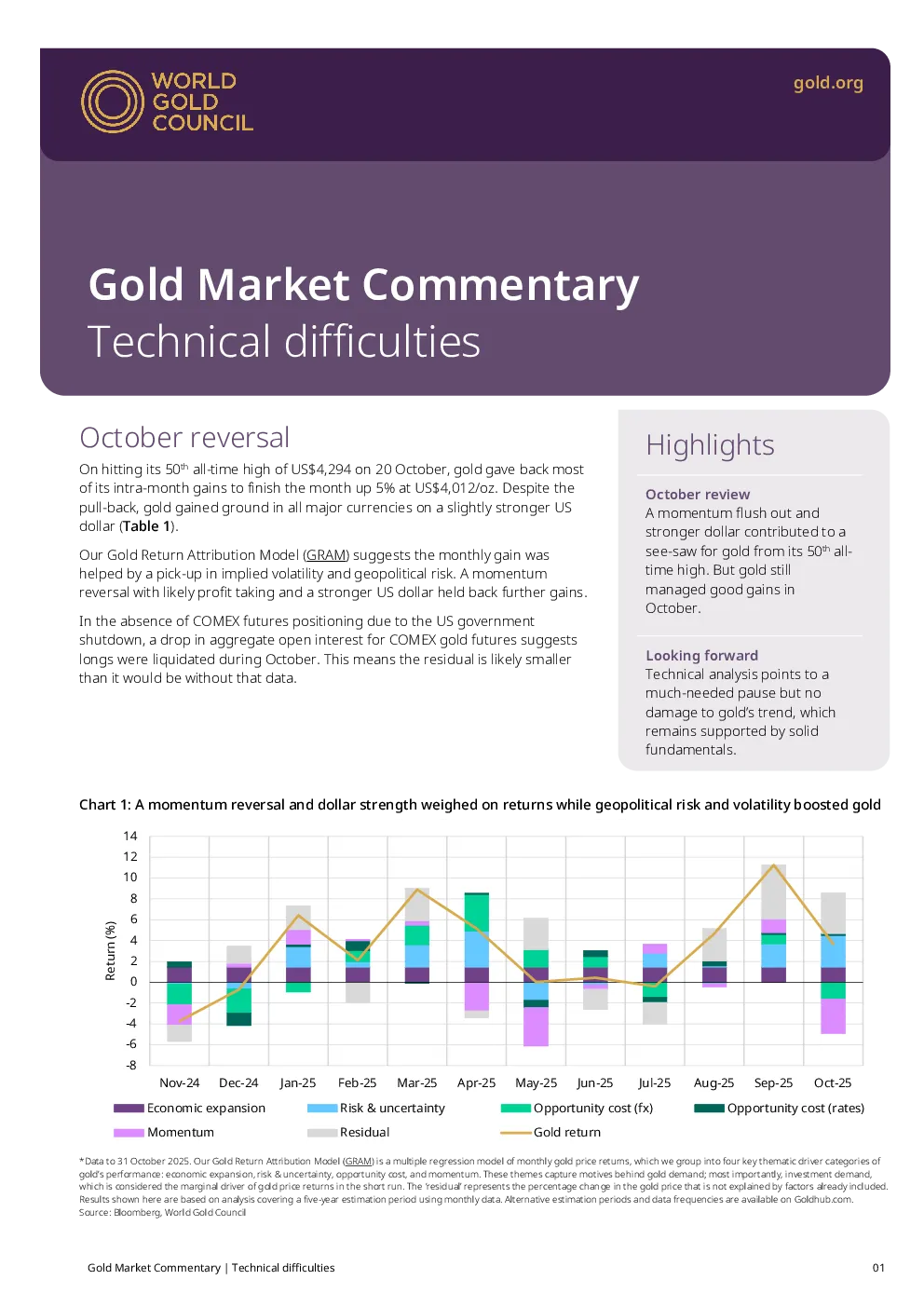
October reversal Highlights On hitting its 50thall-time high of US$4,294 on 20 October, gold gave back mostof its intra-month gains to finish the month up 5% at US$4,012/oz. Despite thepull-back, gold gained ground in all major currencies on a slightly stronger US OctoberreviewA momentum flush out and stronger dollar contributed to asee-saw for gold from its 50thall-time high. But gold still Our Gold Return Attribution Model (GRAM) suggests the monthly gain washelped by a pick-up in implied volatility and geopolitical risk. A momentum In the absence of COMEX futures positioning due to the US governmentshutdown, a drop in aggregate open interest for COMEX gold futures suggests Looking forwardTechnical analysis points to a much-needed pause but nodamage to gold’s trend, whichremains supported by solid classic “dip buyers” step back in (Figure3). Longer-term andmore important support is seen at the US$3,500/oz Aprilpeak, which, if seen, would represent a fall similar to those Reset or rout? Our forward-looking focus this month is purely on priceaction, given that this report comes hot on the heels of ourfundamentals-focused Q3Gold Demand Trendsreport and Should gold march higher, technical resistance levels abovethe US$4,382/oz current peak are seen next at US$4,420/oz,then US$4,500/oz-US$4,520/oz, ahead of US$4,675/oz. •An uptrend that had run too far too fast with overboughtmomentum levels•Volatility spikes similar to previous major peaks Technicals dissected Gold’s October peak marked a 66% gain for the year. Thepace of the move from mid-August resulted in historicallyoverbought technical momentum levels, with the market also *Daily data to 5 November 2025.Source: Bloomberg, World Gold Council The sharp rise in volatility when the price peaked in the thirdweek of October was similar to levels seen at the 2020, 2022and April 2025 peaks. Combined with a weekly RelativeStrength Index (RSI) momentum “sell” signal, this suggestswe have seen an uptrend that has run too far too fast and a With no long-term momentum “sell” signals seen thus far,our view is that an October decline will likely provide a *Weekly data to 5 November 2025.Source: Bloomberg, World Gold Council What’s next The key questions are more likely to be how long can such aphase last and what is the potential magnitude of a setback? We note that first key technical support is seen around itsmedium-term 55-day average and initial Fibonacciretracement of the rise from the 2022 low, both of which are We limited the number of analogs to the top four mostcorrelated, in order to reduce computation time. Currently,three of these four point to lower prices ahead (Figure4).2How reliable has this signal been in the past? Little better When all analogs point in the same direction, the historicalhit rate improves. But those occurrences are too rare to So a damp squib…but also somewhat reassuring, except forthose that rely on such indicators. In our view, there is no Analog signal In addition to the more traditional technicals, we examinedhistorical price analogs — moments in the past that “looksimilar to now” — which some traders/commentators use They’re visually compelling but likely spurious, relying on too-simple a premise, so we tested whether such parallels have 1.To measure similarity, we tried two approaches: simple Pearsoncorrelation and a z-score-based cross-correlation. The z-score methodproved most effective. Unlike Pearson, which is sensitive to leveldifferences, the z-score approach standardises each window and focuseson pattern similarity rather than absolute price levels. It helps downplayspurious correlations that can arise purely from shared long-term trends. 2.We built a simple framework to test whether price analogs have predictivepower. For each date in history the model looked back over a fixed window(e.g., 66 trading days, about three months) and found the most similar pastprice patterns. It then measured how prices moved in the following period(e.g., 22 days, roughly one a month) after those analogs. By repeating thisacross time, avoiding overlapping windows, and comparing predicted vs. Table 2: Our analysis suggest that past analogs providelittle value as a forecasting tool *Data is daily from 31 December 1971 to 24 October 2025. The training window is thecurrent rally compared to ‘similar’ analog price moves in the past, based on z-scorecorrelation. The forecast window is what happened subsequent to those past analogs. Wetested how well the signal forecast subsequent price direction, up or down. First we lookedat the accuracy in predicting direction when three out of four analogs were pointing in thesame direction, as we have today. Then we looked at how useful four analogs pointing in In summary Our recently publishedQ3 Gold Demand Trendsgivesinvestors the low-down on demand and supplyfundamentals, so we opted to focus purely on pricedynamics in this month’s GMC. This is of particular interestgiven mu