2025年第三季度英国可再生能源开发土地指数
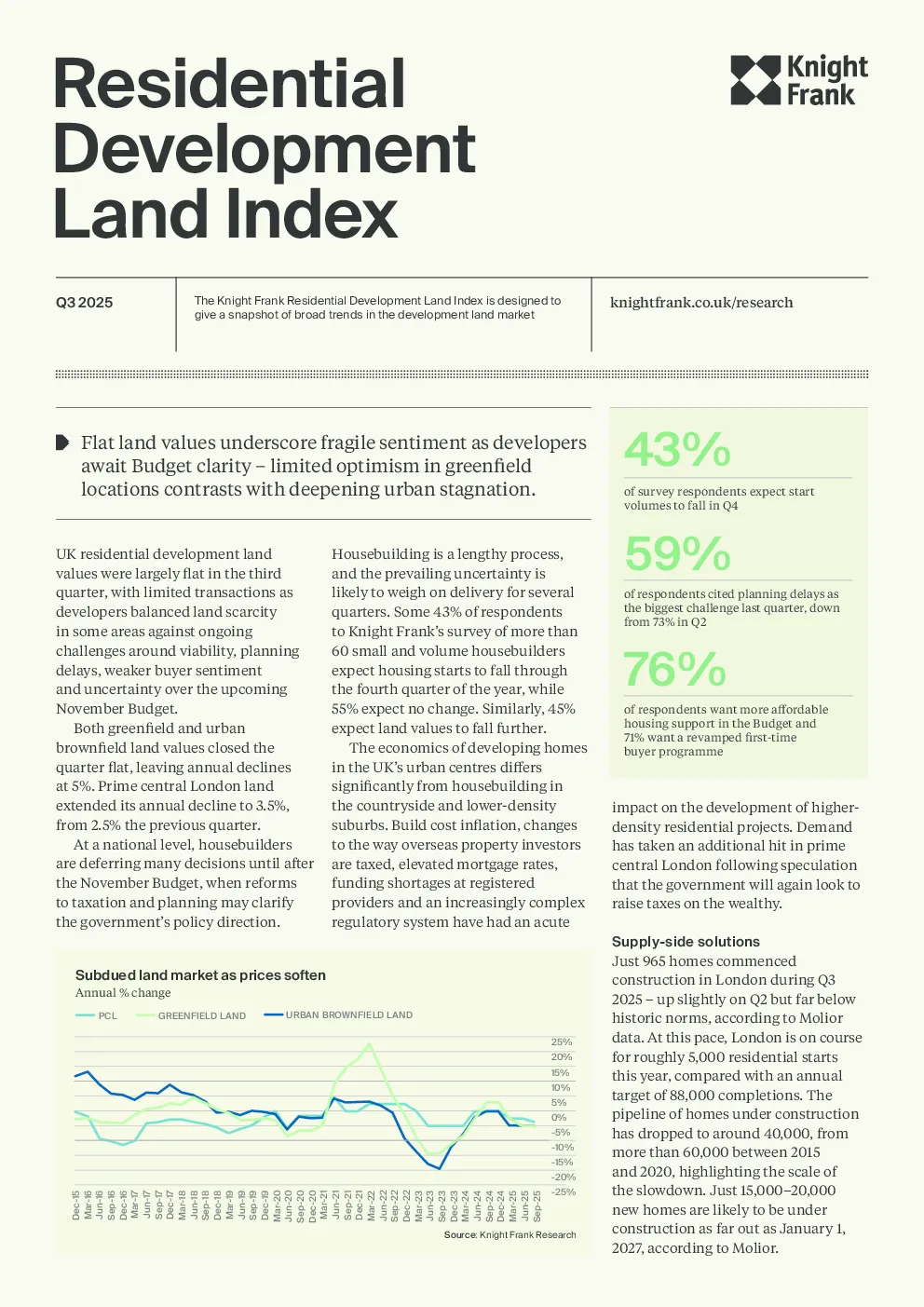
The Knight Frank Residential Development Land Index is designed togive a snapshot of broad trends in the development land market 43% Flat land values underscore fragile sentiment as developersawait Budget clarity – limited optimism in greenfieldlocations contrasts with deepening urban stagnation. of survey respondents expect startvolumes to fall in Q4 59% UK residential development landvalues were largely flat in the thirdquarter, with limited transactions asdevelopers balanced land scarcityin some areas against ongoingchallenges around viability, planningdelays, weaker buyer sentimentand uncertainty over the upcomingNovember Budget. Housebuilding is a lengthy process,and the prevailing uncertainty islikely to weigh on delivery for severalquarters. Some 43% of respondentsto Knight Frank’s survey of more than60 small and volume housebuildersexpect housing starts to fall throughthe fourth quarter of the year, while55% expect no change. Similarly, 45%expect land values to fall further. of respondents cited planning delays asthe biggest challenge last quarter, downfrom 73% in Q2 76% of respondents want more affordablehousing support in the Budget and71% want a revamped first-timebuyer programme Both greenfield and urbanbrownfield land values closed thequarter flat, leaving annual declinesat 5%. Prime central London landextended its annual decline to 3.5%,from 2.5% the previous quarter. The economics of developing homesin the UK’s urban centres differssignificantly from housebuilding inthe countryside and lower-densitysuburbs. Build cost inflation, changesto the way overseas property investorsare taxed, elevated mortgage rates,funding shortages at registeredproviders and an increasingly complexregulatory system have had an acute impact on the development of higher-density residential projects. Demandhas taken an additional hit in primecentral London following speculationthat the government will again look toraise taxes on the wealthy. At a national level, housebuildersare deferring many decisions until afterthe November Budget, when reformsto taxation and planning may clarifythe government’s policy direction. Supply-side solutions Just 965 homes commencedconstruction in London during Q32025 – up slightly on Q2 but far belowhistoric norms, according to Moliordata. At this pace, London is on coursefor roughly 5,000 residential startsthis year, compared with an annualtarget of 88,000 completions. Thepipeline of homes under constructionhas dropped to around 40,000, frommore than 60,000 between 2015and 2020, highlighting the scale ofthe slowdown. Just 15,000–20,000new homes are likely to be underconstruction as far out as January 1,2027, according to Molior. The government’s policy agenda hasso far focused on supply-side measures.Increases in technical staff at theBuilding Safety Regulator have startedto ease the Gateway 2 process, thoughit still adds significant uncertainty.Amendments to the Planning andInfrastructure Bill announced inOctober may limit opposition toresidential projects, while larger sitesmay soon be subject to a new fast-trackprocess. The Greater London Authorityhas also cut affordable housingthresholds for some sites from 35% to20% and eased some of London’s manyprescriptive design requirements. developers following a return-on-capital-employed (ROCE) model relyon so-called “golden brick” paymentsfrom housing associations for theaffordable units, which provide upfrontcash flow early in the build. Reducingthe share of affordable units cutsthose early contributions. In addition,developers now have more privateunits to sell into a subdued market,potentially adding risk, longer salesperiods and higher financing costs. clear driver of activity. By clarifyinghow lower-quality land within theGreen Belt can be redeveloped, ithas opened opportunities for Number of private units started,20+ unit schemes Still, 59% of housebuilders citedplanning delays as among the mostchallenging factors for their businessduring Q3, down from 73% the previousquarter. Negative buyer sentiment iscausing more concern, having risento 43.6% in Q3, up from 36.7% theprevious quarter. The low level of activeregistered providers came in third,at 28.2%, followed by the short-termoutlook for the UK economy, at 25.6%. Works in theory, but does it workin practice? Many of these changes will help tovarying degrees, but they are unlikelyto be enough to enable delivery tohit the government’s targets. Shouldthe GLA lower affordable housingthresholds, for example, profit-on-cost-driven developers will makefewer losses per scheme and willlikely increase delivery. However, Green shoots on grey belt Housebuilders in the suburbs andcountryside face fewer headwinds.The grey belt policy has emerged as a % of respondents Similarly, we asked housebuildersto rank what would be most likely toincrease their appetite for land anddevelopment, and 40% chose more first-time buyer support. Closely followed byplanning reform and inte