您的浏览器禁用了JavaScript(一种计算机语言,用以实现您与网页的交互),请解除该禁用,或者联系我们。[世界卫生组织]:世界卫生组织在东南亚地区的工作,区域主任报告,2024年1月1日至12月31日 - 发现报告

世界卫生组织在东南亚地区的工作,区域主任报告,2024年1月1日至12月31日

2025-10-03世界卫生组织R***
AI智能总结
查看更多
世界卫生组织在东南亚地区的工作,区域主任报告,2024年1月1日至12月31日

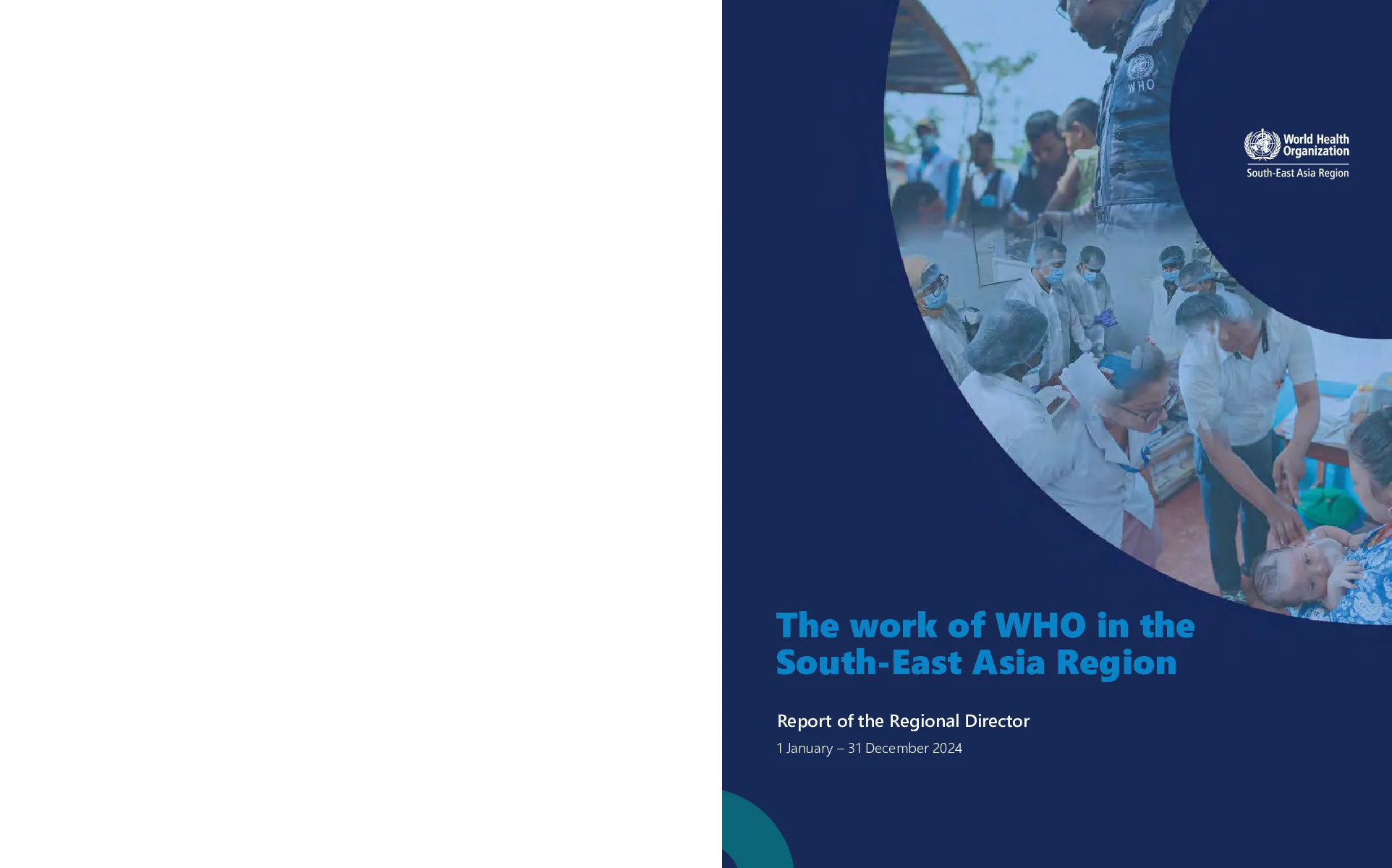
Report of the Regional Director1 January – 31 December 2024 The work ofWHOin the South-East Asia Region Report of the Regional Director 1 January–31 December 2024 ISBN: 978-92-9022-164-7 © World Health Organization 2025 Some rights reserved. This work is available under the Creative Commons Attribution-NonCommercial-ShareAlike 3.0 IGO licence (CC BY-NC-SA 3.0 IGO; https://creativecommons.org/licenses/by-nc-sa/3.0/igo). Under the terms of this licence, you may copy, redistribute and adapt the work for non-commercial purposes,provided the work is appropriately cited, as indicated below. In any use of this work, there should be nosuggestion that WHO endorses any specific organization, products or services. The use of the WHO logo isnot permitted. If you adapt the work, then you must license your work under the same or equivalent CreativeCommons licence. If you create a translation of this work, you should add the following disclaimer along withthe suggested citation: “This translation was not created by the World Health Organization (WHO). WHO is notresponsible for the content or accuracy of this translation. The original English edition shall be the binding andauthentic edition”. Any mediation relating to disputes arising under the licence shall be conducted in accordance with the mediationrules of the World Intellectual Property Organization. Suggested citation. The Work of WHO in the South-East Asia Region, Report of the Regional Director, 1January–31December 2024. New Delhi: World Health Organization, Regional Office for South-East Asia; 2025. Licence: CC BY-NC-SA 3.0 IGO. Cataloguing-in-Publication (CIP) data. CIP data are available at http://apps.who.int/iris. Sales, rights and licensing. To purchase WHO publications, see http://apps.who.int/bookorders. To submitrequests for commercial use and queries on rights and licensing, see http://www.who.int/about/licensing. Third-party materials. If you wish to reuse material from this work that is attributed to a third party, such as tables,figures or images, it is your responsibility to determine whether permission is needed for that reuse and to obtainpermission from the copyright holder. The risk of claims resulting from infringement of any third-party-ownedcomponent in the work rests solely with the user. General disclaimers. The designations employed and the presentation of the material in this publication do notimply the expression of any opinion whatsoever on the part of WHO concerning the legal status of any country,territory, city or area or of its authorities, or concerning the delimitation of its frontiers or boundaries. Dottedand dashed lines on maps represent approximate border lines for which there may not yet be full agreement.The mention of specific companies or of certain manufacturers’ products does not imply that they are endorsedor recommended by WHO in preference to others of a similar nature that are not mentioned. Errors and omissionsexcepted, the names of proprietary products are distinguished by initial capital letters. All reasonable precautions have been taken by WHO to verify the information contained in this publication.However, the published material is being distributed without warranty of any kind, either expressed or implied.The responsibility for the interpretation and use of the material lies with the reader. In no event shall WHO beliable for damages arising from its use. All photographs included are from the WHO photo library or contributed by WHO country offices. Printed in India Contents The Region in review From results to resilience: Health and well-being in the WHO South-East Asia Region3 Bangladesh13Bhutan23Democratic People’s Republic of Korea31India37Indonesia49Maldives59Myanmar67Nepal77Sri Lanka85Thailand95Timor-Leste105 Regional priorities and strategic initiatives115 Health Emergencies117Communicable Diseases129Global Leprosy Programme140Healthier populations and noncommunicable diseases145Health Systems Development157Family health, gender and life course167 179 The Region in review This chapter presents globaland regional health developments,highlighting the achievements, challengesand priorities that marked 2024 and will shapeWHO and Member State action in 2025. From results to resilience:Health and well-being in theWHO South-East Asia Region 2024 was a critical year for global health, the World Health Organization (WHO) andits Member States. It marked the conclusion of WHO’s Thirteenth General Programmeof Work (GPW 13), which since 2019 has guided WHO action to promote universal healthcoverage (UHC), protect health and advance overall health and well-being. GPW13 was originallyset to conclude in 2023; however, it was extended to 2025 to account for disruptions caused bythe COVID-19 pandemic – a crisis that Member States continue to recover from. WHO launched its first ever Investment Round at the Seventy-seventh World HealthAssembly in May.This was a major step forward in establishing