AI智能总结
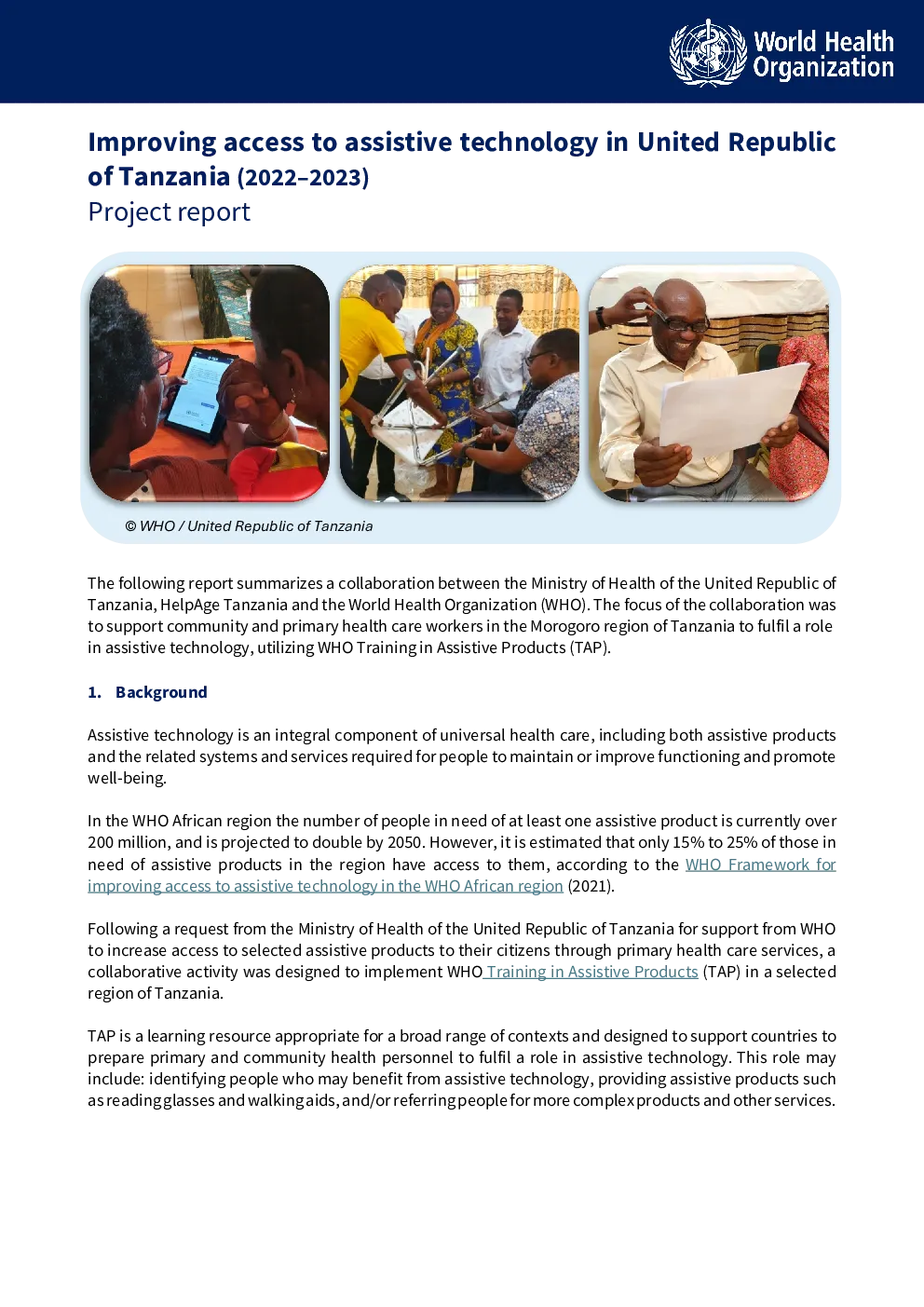
Project report The following report summarizes a collaboration between the Ministry of Health of the United Republic ofTanzania, HelpAge Tanzania and the World Health Organization (WHO). The focus of the collaboration wasto support community and primary health care workers in the Morogoro region of Tanzania to fulfil a rolein assistive technology, utilizing WHO Training in Assistive Products (TAP). 1.Background Assistive technology is an integral component of universal health care, including both assistive productsand the related systems and services required for people to maintain or improve functioning and promotewell-being. In the WHO African region the number of people in need of at least one assistive product is currently over200 million, and is projected to double by 2050. However, it is estimated that only 15% to 25% of those inneed of assistive products in the region have access to them, according to theWHO Framework forimproving access to assistive technology in the WHO African region(2021). Following a request from the Ministry of Health of the United Republic of Tanzania for support from WHOto increase access to selected assistive products to their citizens through primary health care services, acollaborative activity was designed to implementWHO Training in Assistive Products(TAP) in a selectedregion of Tanzania. TAP is a learning resource appropriate for a broad range of contexts and designed to support countries toprepare primary and community health personnel to fulfil a role in assistive technology. This role mayinclude: identifying people who may benefit from assistive technology, providing assistive products suchas reading glasses and walking aids, and/or referring people for more complex products and other services. 2.Project purpose and scope The purpose of this project was to increase access to assistive technology by building the capacity of theprimary and community workforce to fulfil a role in assistive technology. To achieve this, the project aimedto integrate the provision of selected assistive products within primary health centres. It also aimed totrain community providers, and establish a referral pathway for access to assistive products from thecommunity to the primary health centres, and where required, district hospitals. The geographical scope of the project encompassed two districts within the Morogoro region, with theintention to use lessons learned to inform further scale-up to other districts and regions. Personnel were trained using TAP, with the support of local mentors. Community health personnel,including home-based care providers, were trained to identify and refer people in need of an assistiveproduct, while primary health personnel were trained to identify and provide a selected range of assistiveproducts for: vision, mobility, self care, and cognition. See example products in Fig. 1 and a full list ofproducts in Annex 2. The Ministry of Health Medical Stores Department supported the distribution of products to be providedas part of the project to participating health facilities, establishing the foundation for future supply chainmanagement. 3.Project achievements P e r s o n n e l179primary and community level health personnelweretrained to fulfil a role in assistivetechnology (see Annex 1, chart 1). These personnel were divided into three learner groups:dispensaries, health centres and home based care providers.14 health personnel, from secondary health facilities in the region supported the training asmentors. Learning outcomes included:•increased knowledge and skills on assistive technology amongst the health workforce whohad not previously taken training in assistive technology (see Annex 1, chart 2);•increased health force taking a role in assistive technology provision (see Annex 1, chart 3)•development of national mentors who can support future TAP training, considered veryimportant by primary and community learners (Annex 1, chart 4);•increased knowledge amongst health service managers on procurement, supply chain andservice delivery requirements for assistive products. 4.Acknowledgements WHO would like to thank all in-country partners and participating health services, specifically:•Ministry of Health of the United Republic of Tanzania; •President’s Office Regional and Local Government Authorities;•Regional Administrative Secretary Morogoro Region;•HelpAge International in Tanzania;•Morogoro Older Person’s Association(MOREPEO). This project was funded with the generous support of UK aid via the AT2030 programme, led by theGlobal Disability Innovation Hub. Additional support was provided by a generous in-kind donation ofassistive products by the Latter-Day Saints Charities. Chart 3 Future needs for AT provision: % of all learners who recognize each area as 'very important'for effective assistive product provision. © World Health Organization 2025.Some rights reserved. This work is available under theCC BY-NC-SA3.0 IGOlicence. Suggeste