您的浏览器禁用了JavaScript(一种计算机语言,用以实现您与网页的交互),请解除该禁用,或者联系我们。[世界卫生组织]:在乌克兰实现基本辅助技术的快速获取(2022-2023):项目报告 - 发现报告

在乌克兰实现基本辅助技术的快速获取(2022-2023):项目报告

2025-10-05世界卫生组织玉***
AI智能总结
查看更多
在乌克兰实现基本辅助技术的快速获取(2022-2023):项目报告

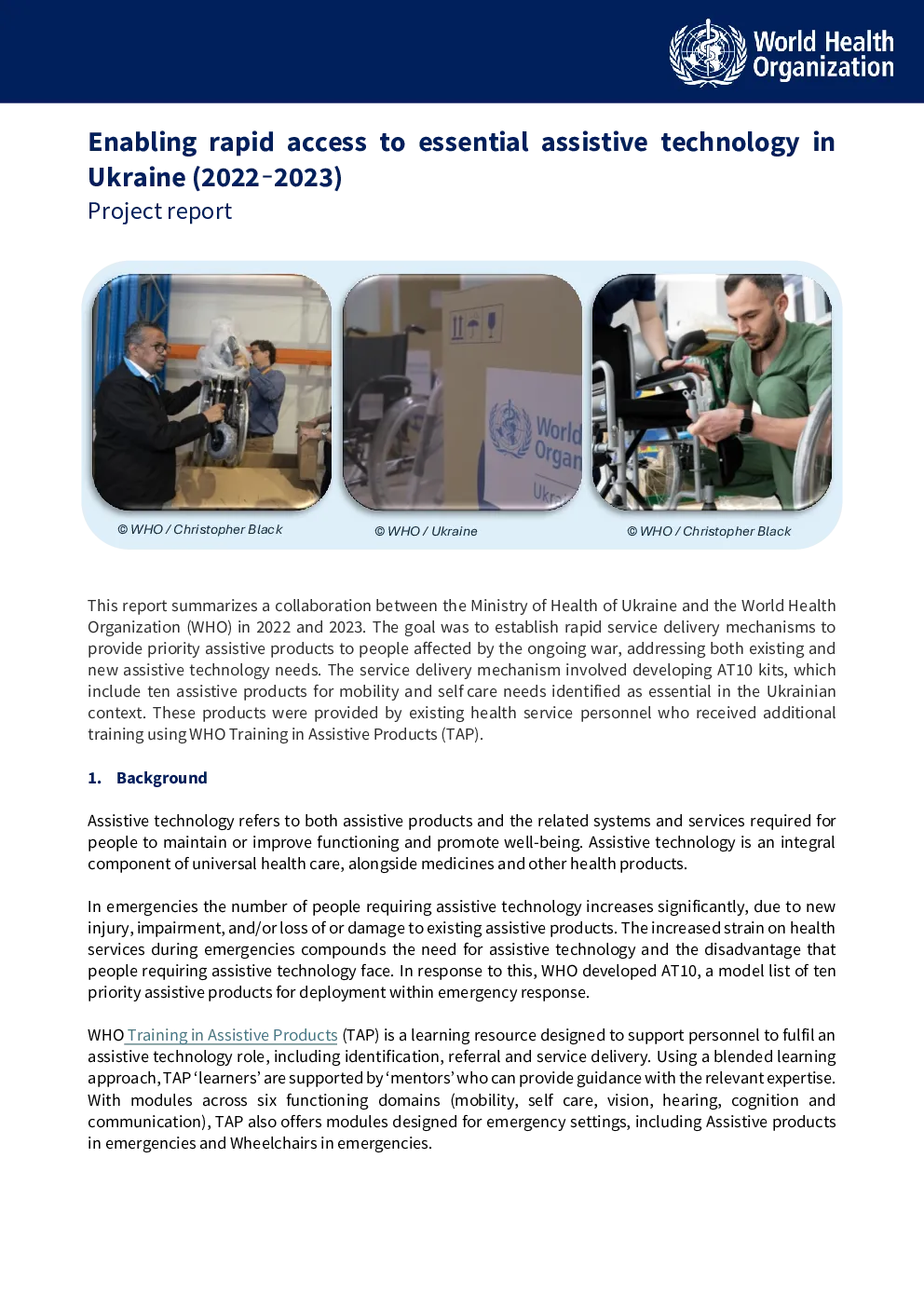
Project report This report summarizes a collaboration between the Ministry of Health of Ukraine and the World HealthOrganization (WHO) in 2022 and 2023. The goal was to establish rapid service delivery mechanisms toprovide priority assistive products to people affected by the ongoing war, addressing both existing andnew assistive technology needs. The service delivery mechanism involved developing AT10 kits, whichinclude ten assistive products for mobility and selfcare needs identified as essential in the Ukrainiancontext. These products were provided by existing health service personnel who received additionaltraining using WHO Training in Assistive Products (TAP). 1.Background Assistive technology refers to both assistive products and the related systems and services required forpeople to maintain or improve functioning and promote well-being. Assistive technology is an integralcomponent of universal health care, alongside medicines and other health products. In emergencies the number of people requiring assistive technology increases significantly, due to newinjury, impairment, and/or loss of or damage to existing assistive products. The increased strain on healthservices during emergencies compounds the need for assistive technology and the disadvantage thatpeople requiring assistive technology face. In response to this, WHO developed AT10, a model list of tenpriority assistive products for deployment within emergency response. WHO Training in Assistive Products (TAP) is a learning resource designed to support personnel to fulfil anassistive technology role, including identification, referral and service delivery. Using a blended learningapproach, TAP ‘learners’are supported by ‘mentors’ whocan provide guidance with the relevant expertise.With modules across six functioning domains (mobility, self care, vision, hearing, cognition andcommunication), TAP also offers modules designed for emergency settings, including Assistive productsin emergencies and Wheelchairs in emergencies. 2.Project purpose and scope The purpose of this project was to integrate assistive technology into the emergency response in Ukraineand enable rapid access to essential assistive products through appropriate service delivery mechanisms. The geographical scope of the project covered key oblasts (regions) in Eastern Ukraine and the populationidentified as having the highest priority assistive technology needs; those requiring simple mobility andself care products. The project initially aimed to provide assistive products to internally displaced people through establishedhealth services with the capacity to provide mobility and self care products. As the war evolved it becameevident that the mobility and self care needs of the general population were high and needed to be met,in addition to internally displaced people. During the early phase of the project many people eitherremained in their home region, and/or had returned to their homes. The project involved two phases:1.Provision of five AT10 kits to nine health facilities in five oblasts, including training 66 personnel and 19 mentors.2.Revision of AT10 kit contents and participating health facilities, based on learning from phase 1.Provision of a further four AT10 kits and training of an additional 18 personnel from four healthfacilities in three oblasts, and three additional mentors. Personnel identified for the project included health personnel with existing experience and understandingof assistive technology (see Annex 1, chart 1), to reduce training needs and ensure sustainability ofprovision. Activities were modified to be sensitive to the challenges of the health emergency in the context of ongoingwar, and the needs of the population. For example, during the first phase health personnel took TAPmodules online individually, rather than as a group in-person training as is often the case in non-emergency contexts. 3.Project achievements 4.Acknowledgements This project was a collaboration between WHO Country Office Ukraine, WHO Regional Office forEurope, and WHOheadquarters. WHO would like to thank all in-country partners and services, especially the Ministries of Health, of SocialPolicy, and the Office of the President of Ukraine. Thanks also to the following organizations for providing financial support for this project: ATscale; UkraineHumanitarian Fund; Swiss Agency for Development and Cooperation; Ministry of Health, Germany;European Union Directorate-General for European Civil Protection and Humanitarian Aid Operations. Annex1: Projectdata(based on data for84 learners and 22 mentors) Chart 1 Building on existing capacity to ensure sustainability% breakdown of health personnel engaged as TAP learners % of learners and mentors deeming each area as 'very important' for effective assistiveproduct provision © World Health Organization 2025.Some rights reserved. This work is available under theCC BY-NC-SA3.0 IGOlicence. Suggested citation.Enabling rapi