您的浏览器禁用了JavaScript(一种计算机语言,用以实现您与网页的交互),请解除该禁用,或者联系我们。[联合国]:尽管政策变化和不确定性,全球贸易仍然强劲 - 发现报告

尽管政策变化和不确定性,全球贸易仍然强劲

2025-10-20-联合国表***
AI智能总结
查看更多
尽管政策变化和不确定性,全球贸易仍然强劲

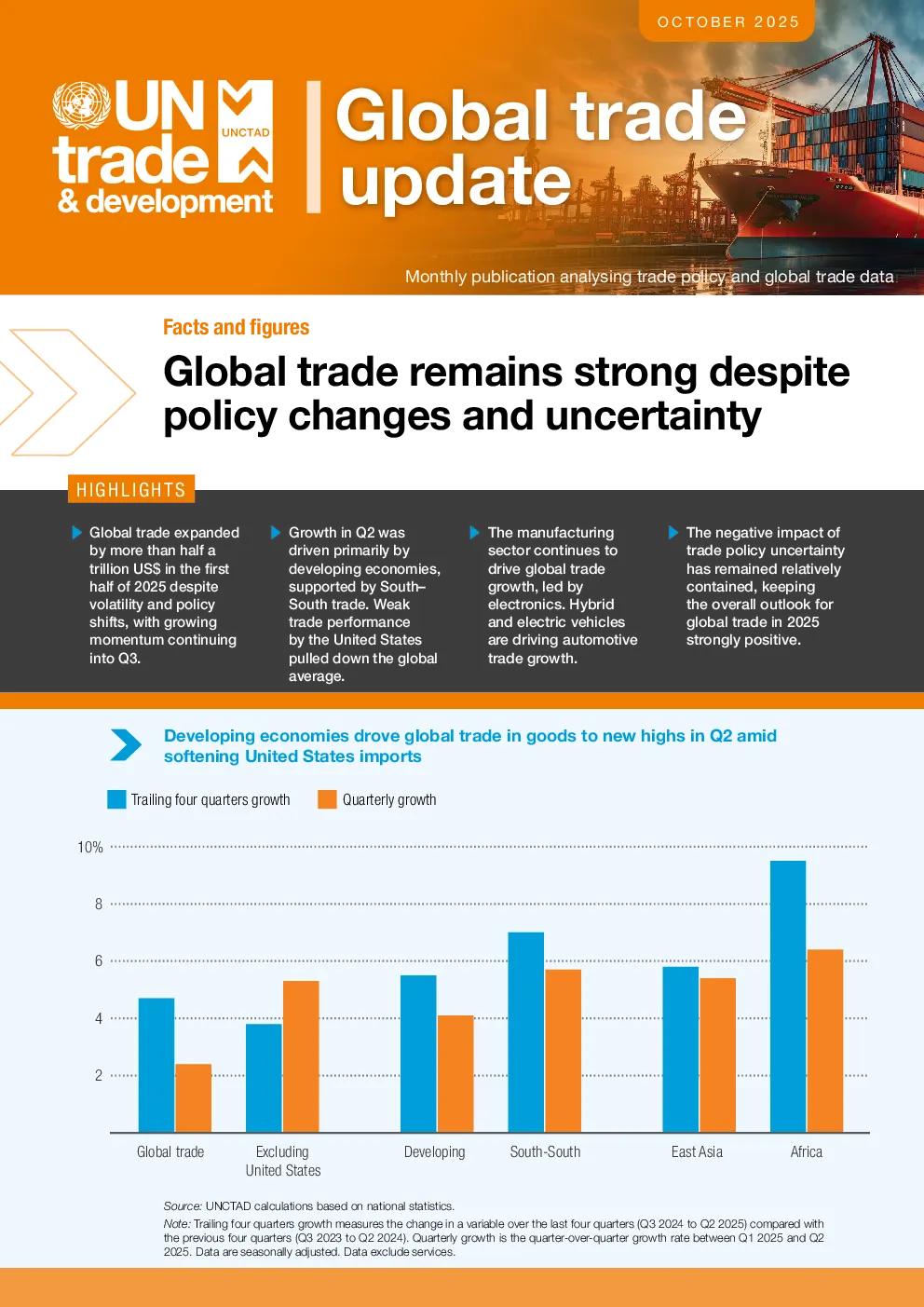
Monthly publication analysing trade policy and global trade data Facts and figures Global trade remains strong despitepolicy changes and uncertainty H I G H L I G H T S The manufacturingsector continues todrive global tradegrowth, led byelectronics. Hybridand electric vehiclesare driving automotivetrade growth. The negative impact oftrade policy uncertaintyhas remained relativelycontained, keepingthe overall outlook forglobal trade in 2025strongly positive. Growth in Q2 wasdriven primarily bydeveloping economies,supported by South–South trade. Weaktrade performanceby the United Statespulled down the globalaverage. Global trade expandedby more than half atrillion US$ in the firsthalf of 2025 despitevolatility and policyshifts, with growingmomentum continuinginto Q3. Developing economies drove global trade in goods to new highs in Q2 amidsoftening United States imports Global trade trends and nowcast Global trade in goods and services continued its positive trajectory in the second quarter of 2025 (Q22025), recording a quarter-over-quarter (QoQ) increase of about 2.5 per cent. Both goods and services sawsignificant gains compared to Q1 2025. Trade in goods saw its growth rate edge up from about 2 to 2.5 percent QoQ, while growth in trade in services returned to positive territory after contracting in Q1. The UNCTADnowcast points to continued growth in Q3 2025, with goods expected to expand by about 2.5 per cent QoQand services accelerating strongly to about 4 per cent QoQ. On a trailing four quarters (T4Q) basis, growthremains robust—around 5 per cent for goods and 6 per cent for services. Barring major negative shocks inthe final months of 2025, the value of global trade is projected to surpass its record levels of 2024. Global trade in goods and services remains strong in Q2 and Q3 of 2025Trailing four quarters and quarterly growth in the value of trade in goods and services Prices for traded goods registered a slight uptick in Q2 2025, with preliminary estimates pointing to asignificant increase in Q3. This suggests that while the increase in the value of trade in the first half of 2025was driven by higher volumes, the increase in Q3 is expected to be fueled partly by rising prices. Global trade outlook Overall, trade growth remained positive in the first half of 2025, despite rising trade policy uncertainty,persistent geopolitical tensions, and a challenging global economic environment. During this period,global trade increased by about US$ 500 billion compared with the second half of 2024, althoughgrowth patterns were volatile. During Q2 2025, both goods and services trade showed consistentexpansion, largely supported by the strong performance of developing economies, while trade ofdeveloped economies was subdued because of a significant drop in United States imports. Looking ahead to the rest of 2025, global trade is expected to remain resilient and reach recordhighs by the end of the year. Despite turbulence from shifting United States trade policy, globaltrade dynamics have so far shown limited disruption, with developing economies maintaining strongcommitment to trade as a foundation for growth. Still, uncertainty over United States policy remainsa notable risk. Forward-looking indicators send mixed signals: China’s Purchasing Managers’ Index(PMI) stayed below 50 in August, signaling contraction, while the United States PMI remained wellabove 50, pointing to expansion. Shipping measures also diverged, with the Shanghai ContainerizedFreight Index declining but the Baltic Dry Index rising. Overall, trade momentum should continue, butgrowth patterns will vary regionally. Negative factors hindering the trade outlook: Persisting trade policy uncertainty in the United States Although the United States has concluded some trade deals, many details still need to be finalized.Moreover, negotiations with several of its most important trading partners remain ongoing, leavingroom for further policy shifts that could affect global trade flows. In addition, additional sector-specific tariffs remain a distinct possibility. Continuing geopolitical tensions and ongoing conflicts Geopolitical instability is expected to continue affecting global trade, while ongoing conflictsshow no signs of easing. Some of these factors could intensify, potentially altering regional tradedynamics and potentially leading to energy and food security concerns. Resurgence of restrictive policy as a response to global overcapacity Domestic-focused industrial strategies, combined with reduced demand for imported goods inthe United States, may exacerbate oversupply in certain sectors, prompting countries to adoptdefensive trade measures. This trend was already evident in Q2 2025 for some sectors (e.g.,steel) and may expand to other industries in the near term. Positive factors influencing the global trade outlook: Upward revisions to global growth forecasts, combined with the potential for additional monetaryeasing in