AI智能总结
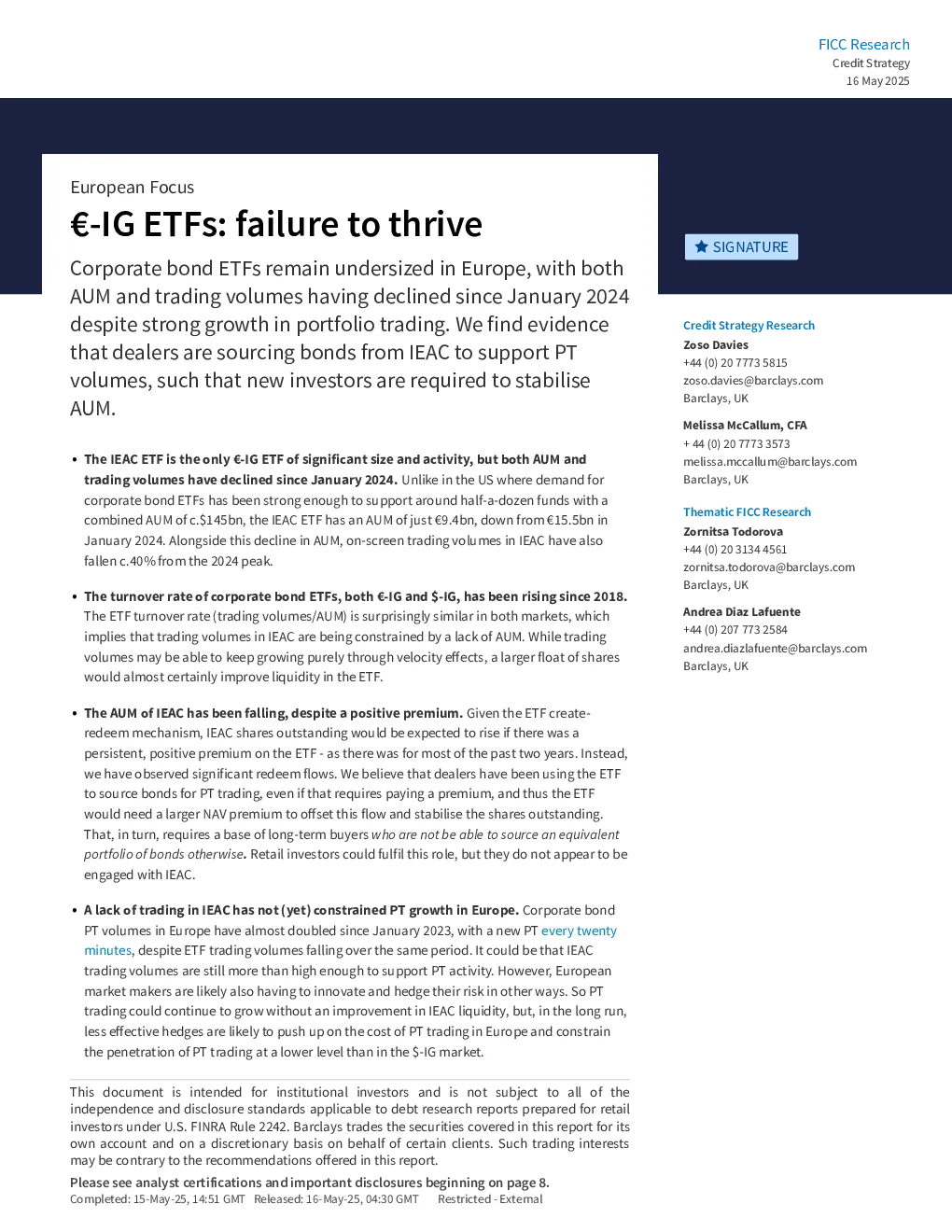
Restricted - External Credit Strategy ResearchZoso Davies+44 (0) 20 7773 5815zoso.davies@barclays.comBarclays, UKMelissa McCallum, CFA+ 44 (0) 20 7773 3573melissa.mccallum@barclays.comBarclays, UKThematic FICC ResearchZornitsa Todorova+44 (0) 20 3134 4561zornitsa.todorova@barclays.comBarclays, UKAndrea Diaz Lafuente+44 (0) 207 773 2584andrea.diazlafuente@barclays.comBarclays, UK European corporate bond ETFs: failing to growPortfolio trading in Europe continues to grow quickly: using our proprietary algorithm toidentify portfolio trades in MiFiDII transaction records, we estimate that a new trade is executedevery 20 minutes in European markets and that annual volumes reached over €200bn in 2024,or c.10% of dealer-to-client volumes for €-IG. Many of the dealers that facilitate these tradesmanage their risk along two axis. First, by attempting to avoid adverse selection and biases inorder to maintain a risk profile that is as close to some reference index (in Europe this isoftenthe Bloomberg Euro Corporate Index, LECPTREU) and then by hedging that homogenisedmarket risk, primarily using bond ETFs.FIGURE 1. IG portfolio trading in Europe continues to grow, and is taking up an increasing share oftotal bond trading volumesNotes: PT volumes are estimated from public MiFiDII records, using a machine-learning algorithm. Our sample includeseuro-denominated bonds.Source: MiFiDII Post-trade Reporting Data, Barclays ResearchAs such, it was widely anticipated that rising PT and ETF volumes would grow together, asincreased PT trading resulted in more hedging flows, improving the liquidity of the ETFs, whichwould further lower the cost of portfolio trading in a virtuous cycle. But trading in IEAC, by farthe dominant €-IG ETF, has not kept pace with the rapid rise in PT volumes in Europe. In fact,IEAC trading volumes peaked in January 2024 and are now down more than 50% from thoselevels (Figure 2). While this is not visibly constraining the rise in portfolio trading in Europe, thusfar, it is clearly a concern given that IEAC and similar ETFs were expected to be the main risk-management tool for dealersofferingportfolio trading liquidity to clients. 2 FIGURE 3. The corporate bond ETF universe in Europe is small andFIGURE 4. Accordingly, trading volumes are only a fraction of thosesupported inthe $-IG market02040608010012014020172018201920202021Trading, bnIEAC LN EquityAs of 31 March 2025. ETFs considered in this reportUS ETFs: LQD, SPIB, SPLB, VCIT, VCLT, VCSHSource: Bloomberg, Barclays Research(Lack of) AUM is holding IEAC backIt is a telling feature of the €-IG market that only one ETF (IEAC) has notable AUM and tradingvolumes. This compares to the $-IG market where AUM and trading activity is spread acrossmore than half a dozen relevant tickers (Figure 3). As such, the trading volumes in EuropeanETFs have always lagged those in the $-ETF complex (Figure 4). That said, we find it interestingthat ETF trading volumes (rebased trading levels, not shown) were growing at a similar pace inboth regions until c. 2024,afterwhich IEAC began to visibly lag the $-IG ETF complex.Digging into the decline in IEAC trading volumes, is it noteworthy that the velocity or turnover ofthe ETF (monthly trading volumes/AUM) has not fallen as sharply as overall trading volumes andthat the turnover in IEAC has been structurally higher than for the $-ETF complex (Figure 5)since 2020. Also telling is that the shares outstanding for IEAC have been falling, while shares inUS ETF have generally been on an upward trend (Figure 6) since 2024. That said, the growth in $-ETF AUM has been driven by VCIT, whereas shares in LQD have been falling and their evolutionin fact looks quite similar to the evolution of IEAC, something we discuss in more detail below. 2022202320242025US ETFs3 FIGURE 5. The turnover rate of IEAC has been higher than the US ETFFIGURE 6. ...but shares outstanding have been structurally fallingsince 2024, not the case for US ETFs4050607080901001101201307009001,1001,3001,5001,7001,9002,1002,30020182019202020212022202320242025US ETFsIEAC LN (RHA)US ETFs: LQD, SPIB, SPLB, VCIT, VCLT, VCSH. Millions of shares.Source: Bloomberg, Barclays ResearchBased on the sum of the data, it appears to us that a lack of AUM/shares outstanding hasbecome a significant constraint on trading volumes for IEAC. Anecdotally, we have heard thatthis is particularly apparent in the cost to borrow shares in the ETF, another signal that free-float in the ETF is a binding constraint on at least some trading activity. Thus, we believe it isimportant to understand why IEAC is "failing to thrive", and as a result failing to activate thevirtuous cycle of higher ETF trading volumes leading to lower PT costs (and therefore higher PTvolumes).Eating the seed cornWhile a decline in ETF shares outstanding isde factoan outflow from the product, if this wasdue to a large imbalance of demand to sell corporate bonds we would expect it to be associatedwith a large, persistent, an