您的浏览器禁用了JavaScript(一种计算机语言,用以实现您与网页的交互),请解除该禁用,或者联系我们。[Hotelivate]:2025年印度酒店业趋势与机遇 - 发现报告

2025年印度酒店业趋势与机遇

休闲服务2025-10-10Hotelivate高***
2025年印度酒店业趋势与机遇

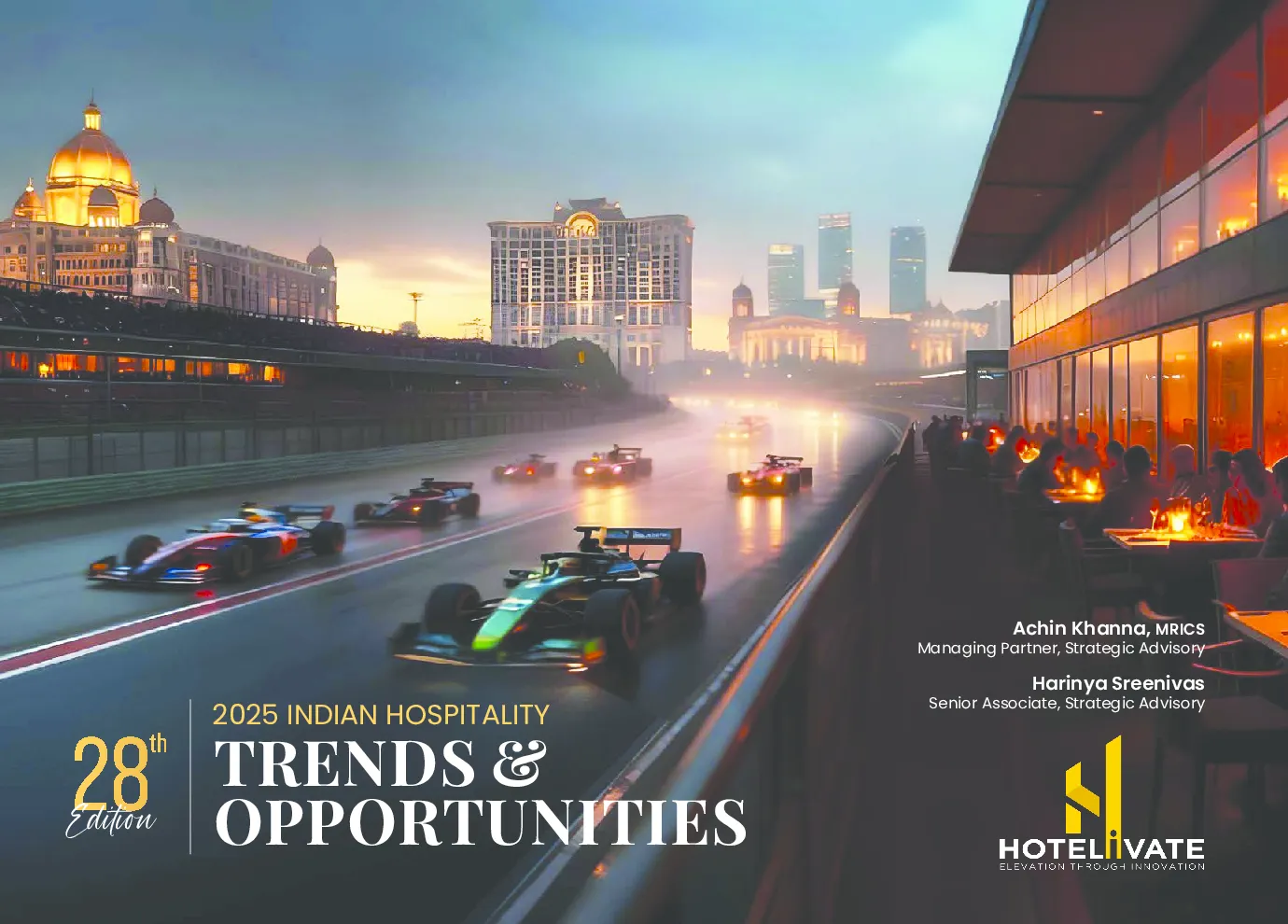
Hospitality inthe Fast Lane“ bringing Lando Norris like energy and raw horsepower in its expanding inventory,while Delhi shows Ayrton Senna like maturity and consistency. “The gap, however, between the frontrunners and the midfield is widening: the fourlead urban markets (Mumbai, Delhi, Bengaluru & Hyderabad) delivered a strongperformance this season, with ADR up about 8% and RevPAR up over 12% year-on-year. The rest of the field, by contrast, posted only modest gains of about 3.2%in ADR and 3.4% in RevPAR.It would therefore be a folly to simply assume thatthe blended nationwide RevPAR jump of 5.7% is reflective of a continually strongupcycle. “Race strategy is a balance between pushing hard and knowingwhen to hold back. Patience often wins more races than aggression” Lewis Hamilton The Indian Hospitality Industry is charging down the track at full throttle. This paceof growth and acceleration over the past two years is not very different fromwitnessing a Grand Prix — precision engineering, high-speed manoeuvres, andthe constant balance between risk and reward.The hotel industry has three keymetrics: how current markets are performing, what the supply pipeline aheadlooks like, and how the demand–supply balance is playing out across city tiers,segments, and brands.For 28 years, the Hotelivate Trends & Opportunities reporthas been the sector’s remote monitoring framework that helps hotel owners &operators analyse performance, identify overtaking opportunities, and anticipatewhere warning flags may appear. Having completed the third year of its post-pandemicupcycle,the industry has delivered yet another record-breakingseason. But just as Max Verstappen’s blistering run from 2021 to 2024, and LewisHamilton’s seven-title dominance before that have shown, no winning streak lastsforever; and in hospitality, upcycles too are not permanent. Are we edging closerto the end of this upcycle, and does that mean a downcycle is on the horizon?Alternatively, is it just that the standard deviation between crests and troughs isdiminishing, thereby altering how we witness cycles altogether? The proposed supply pipeline, additionally, reflects a bold strategy introducingbranded hotels into 177 new markets. This is powered by infrastructure developmentunlocking new opportunities across the country, and developers moving beyondthe classic circuits into emerging markets.For the first time in over a decade,India’s proposed supply has crossed the 1,00,000-room mark — a 58% surge inthe next five years.It’s an aggressive push for growth, but experience remindsus that boldness without patience can quickly become unsustainable; and thattiming and execution are just as critical as ambition. Leisure markets are showingstrong performance at the luxury end of the spectrum. However, the influx oflower-positioned hotels has diluted overall averages and, in some cases, eventriggered RevPAR decline. Similarly, smaller industrial towns reflect ambitioussupply additions that can outpace current demand realities. Unless supply iscarefully matched to prevailing market conditions, the risk of underperformanceincreases meaningfully. In addition to the traditional top 20 markets, this year’s Trends & Opportunitiesreport identifies key markets to watch — sectors where precision in strategywill define the outcome. It also highlights trends and potential opportunities:leveraging India’s infrastructure boom, localising global models, and adapting toevolving traveller expectations. Despite turbulence across the global markets — economic slowdowns, geopoliticalheadwinds, and investor caution — India has kept its pace strong. Domesticdemandhas been powering the industry forward,even when internationalarrivals remained inconsistent. Most leisure-heavy markets found a rhythm,posting records in performance. But just as Kimi Raikkonen notes: “You don’t wina championship by being fastest once.” This applies directly to markets like Goa,which is showing signs of fatigue — proof that strategy, not just pace, defineslong-term winners. Mumbai secured pole position yet again, leading the countryin Room Revenue per key and ranking on the podium in all other key metrics.Bengaluru and New Delhi complete the top three by inventory, with Bengaluru Right now, the industry feels like a Grand Prix in full flow — engines screaming,strategies diverging, and the pressure to deliver mounting. Brands, owners, andoperators are all racing, each hoping to outpace rivals. However, as mentionedin the very beginning,it’s not just speed. It’s about racecraft: knowing when toattack, when to defend, and when to press the brakes. Aboutthe Report Hotelivate, a multifaceted hospitality consulting firm offering specialised services to clients across Asia Pacificand the Middle East, is proud to present the 2025 Indian Hospitality Trends & Opportunities report, our 28thedition. The current participation base of 2,008 hotels with a total inventory of 1,96,464 rooms offers thoroughcover