您的浏览器禁用了JavaScript(一种计算机语言,用以实现您与网页的交互),请解除该禁用,或者联系我们。[韩国银行]:近期韩元与人民币的联动 - 发现报告

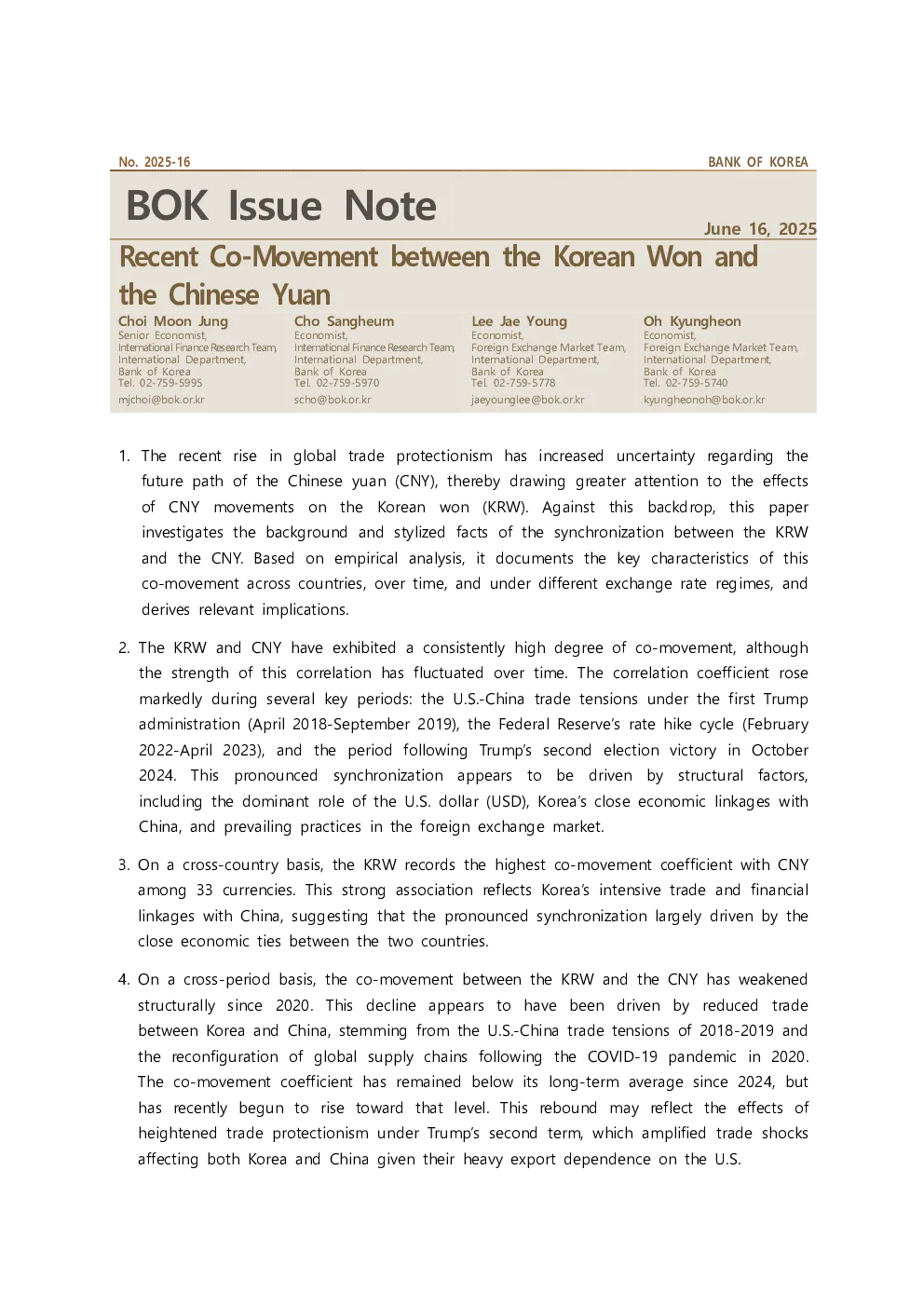
近期韩元与人民币的联动

2025-06-16-韩国银行徐***
AI智能总结
查看更多
近期韩元与人民币的联动

RecentCo-MovementbetweentheKoreanWonandtheChineseYuan OhKyungheonEconomist,ForeignExchangeMarketTeam,InternationalDepartment,BankofKoreaTel.02-759-5740kyungheonoh@bok.or.kr ChoSangheumEconomist,InternationalFinanceResearchTeam,InternationalDepartment,Bankof KoreaTel.02-759-5970scho@bok.or.kr ChoiMoonJungSeniorEconomist,InternationalFinanceResearchTeam,InternationalDepartment,BankofKoreaTel.02-759-5995mjchoi@bok.or.kr LeeJaeYoungEconomist,ForeignExchangeMarketTeam,InternationalDepartment,Bankof KoreaTel.02-759-5778jaeyounglee@bok.or.kr 1.The recent rise in global trade protectionism has increased uncertainty regarding thefuturepath of the Chinese yuan(CNY),thereby drawing greater attention to the effectsofCNY movements on the Korean won(KRW).Against this backdrop,this paperinvestigatesthe background and stylized facts of the synchronization between the KRWandthe CNY.Based on empirical analysis,it documents the key characteristics of thisco-movementacross countries,over time,and under different exchange rate regimes,andderivesrelevant implications. 2.The KRW and CNY have exhibited a consistently high degree of co-movement,althoughthestrength of this correlation has fluctuated over time.The correlation coefficient rosemarkedlyduring several key periods:the U.S.-China trade tensions under the first Trumpadministration(April 2018-September 2019),theFederal Reserve’s rate hike cycle(February2022-April2023),and the period following Trump’s second election victory in October2024.This pronounced synchronization appears to be driven by structural factors,includingthe dominant role of the U.S.dollar(USD),Korea’sclose economic linkages withChina,and prevailing practices in the foreign exchange market. 3.On a cross-country basis,the KRW records the highest co-movement coefficient with CNYamong33 currencies.This strong association reflects Korea’s intensive trade and financiallinkageswith China,suggesting that the pronounced synchronization largely driven by thecloseeconomic tiesbetween thetwo countries. 4.On a cross-period basis,the co-movement between the KRW and the CNY has weakenedstructurallysince 2020.This decline appears to have been driven by reduced tradebetweenKorea and China,stemming from the U.S.-China tradetensions of2018-2019 andthereconfiguration of global supply chains following the COVID-19 pandemic in 2020.Theco-movement coefficient has remained below its long-term average since 2024,buthasrecently begun to rise toward that level.This rebound may reflect the effects ofheightenedtrade protectionism under Trump’s second term,which amplified trade shocksaffectingboth Korea and China given theirheavy export dependence on theU.S. 5.On a cross-regime basis,the KRW exhibits asymmetric co-movement with the CNY,displayingstrongersynchronizationduringdepreciationregimesandweakersynchronizationduring appreciation regimes.This asymmetry is mainly attributable to thesimultaneousweakening of both currencies against the USD,competition between KoreaandChina in global export markets,and Korea’s floating exchange rate system.Moreover,couplingregimes have tended to persist longer than decoupling regimes,with the periodsinceDecember2023 identified as a synchronized phase. 6.Considering the key characteristics of KRW-CNY synchronization examined in this paperandthe increased uncertainty surrounding the outlook for CNY,KRW is likely to beinfluencedby movements in CNY.In light of these considerations,it is necessary tocontinuouslymonitor the trajectory of CNY while paying close attention to developmentsintheU.S.-China trade tensions. ▪Disclaimer:The views expressed herein are those of the authors,and do notnecessarilyreflect the official views of the Bank of Korea.When reporting on orcitingthispaper,theauthors’namesshouldalways beexplicitlystated. ▪We would like to express our appreciation to Yoon Kyoungsoo,Director ofInternationalDepartment,Yang Yang Hyeon,Head of the International FinancialPlanningDepartment,andParkKi-dok,Headof the International Finance ResearchTeamfortheir generous help inpreparingthispaper. Ⅰ.Introduction Inresponse to the U.S.announcement on April 2(local time)of reciprocal tariffs onChineseimports,China announced retaliatory tariffs on April 4.Subsequently,both countriesraisedtheir tariff rates in rapid succession(April 8,9,and 10)1).On April 9,the effective dateofthe U.S.reciprocal tariffs,the U.S.also announced a 90-day suspension of tariffs onimportsfrom countries other than China.As a result,the broader trend of rising global tradeprotectionismevolved into a bilateral tradeconflictbetween theU.S.and China. Againstthis backdrop,China set the onshore Chinese yuan(CNY)exchange rate above the7.20level–widely regarded as a psychological threshold in the market–rising from 7.1980onApril 7 to 7.2038 on April 82).Consequently,the offshore yuan(CNH)weakened sharply,withthe USD/CNH rate reaching 7.35 on April 9(a 0.9%depreciation between April 4 and 9),itshighest level since the global financ