AI智能总结
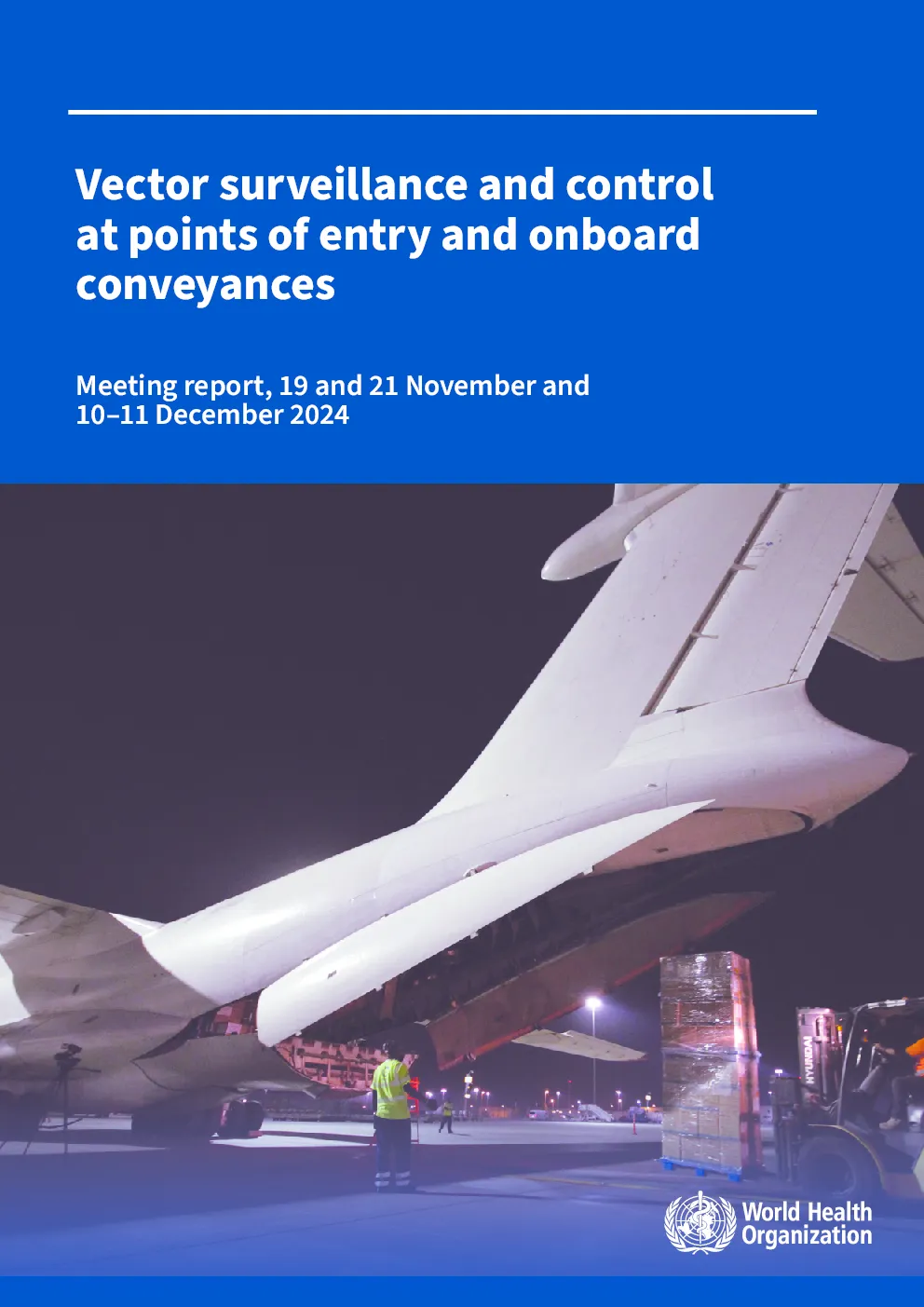
Meeting report, 19 and 21November and10–11December2024 Vector surveillance and controlat points of entry and onboardconveyances Meeting report, 19 and 21November and10–11December2024 Main identifier (electronic version): 10.2471/B09510Main identifier (print version): PID420 © World Health Organization 2025 Some rights reserved. This work is available under the Creative Commons Attribution-NonCommercial-ShareAlike3.0IGO licence (CCBY-NC-SA3.0IGO;https://creativecommons.org/licenses/by-nc-sa/3.0/igo). Under the terms of this licence, you may copy, redistribute and adapt the work for non-commercial purposes,provided the work is appropriately cited, as indicated below. In any use of this work, there should be no suggestionthat WHO endorses any specific organization, products or services. The use of the WHO logo is not permitted. If youadapt the work, then you must license your work under the same or equivalent Creative Commons licence. If youcreate a translation of this work, you should add the following disclaimer along with the suggested citation: “Thistranslation was not created by the World Health Organization (WHO). WHO is not responsible for the content oraccuracy of this translation. The original English edition shall be the binding and authentic edition”. Any mediation relating to disputes arising under the licence shall be conducted in accordance with the mediationrules of the World Intellectual Property Organization (http://www.wipo.int/amc/en/mediation/rules/). Suggested citation.Vector surveillance and control at points of entry and onboard conveyances: meeting report,19 and 21 November and 10-11 December 2024. Geneva: World Health Organization; 2025.https://doi.org/10.2471/B09510. Licence:CCBY-NC-SA3.0IGO. Cataloguing-in-Publication (CIP) data.CIP data are available athttps://iris.who.int/. Sales, rights and licensing.To purchase WHO publications, seehttps://www.who.int/publications/book-orders.To submit requests for commercial use and queries on rights and licensing, seehttps://www.who.int/copyright. Third-party materials.If you wish to reuse material from this work that is attributed to a third party, such astables, figures or images, it is your responsibility to determine whether permission is needed for that reuse andto obtain permission from the copyright holder. The risk of claims resulting from infringement of any third-party-owned component in the work rests solely with the user. General disclaimers.The designations employed and the presentation of the material in this publication do notimply the expression of any opinion whatsoever on the part of WHO concerning the legal status of any country,territory, city or area or of its authorities, or concerning the delimitation of its frontiers or boundaries. Dotted anddashed lines on maps represent approximate border lines for which there may not yet be full agreement. The mention of specific companies or of certain manufacturers’ products does not imply that they are endorsedor recommended by WHO in preference to others of a similar nature that are not mentioned. Errors and omissionsexcepted, the names of proprietary products are distinguished by initial capital letters. All reasonable precautions have been taken by WHO to verify the information contained in this publication.However, the published material is being distributed without warranty of any kind, either expressed or implied.The responsibility for the interpretation and use of the material lies with the reader. In no event shall WHO be liablefor damages arising from its use. Cover photo:Credit: EMRO It was suggested that WHO raise awareness of the risks of mosquito breeding in cargo and mosquitoconveyance in unit load devices in cargo. (See section 3) (World Health Organization airlifts healthsupplies from WHO/Dubai hub to Benghazi, Libya - September 2022) Contents ForewordivAcknowledgementsvMeeting participantsvDeclaration of interestsviiAbbreviationsviiExecutive summaryviii 1.Introduction11.1Vector control and disinsection under the International Health Regulations (2005)11.2Context2 2.Summary of discussions32.1Efficacy against mosquitoes32.2Development of new insecticides32.3Non-chemical methods of disinsection: issues and research agenda42.4Safety and toxicity data52.5Other unintended consequences and secondary outcomes62.6Vector surveillance and control72.7Molecular testing82.8Research agenda9 3.Summary of suggestions from the External Expert Group10 4.References11 Annex. Meeting agenda13 Foreword In 2024, the total number of dengue cases worldwide reached a record high of morethan 14 million, with approximately 11 000 of these cases resulting in death. In response,governments in many countries contacted the World Health Organization (WHO) forinformation about the methods and procedures for disinsection of aircraft and otherinternational conveyances, to stop the spread of vector-borne diseases such as dengue.Under the International Health Regulations (2005)