您的浏览器禁用了JavaScript(一种计算机语言,用以实现您与网页的交互),请解除该禁用,或者联系我们。[世界卫生组织]:根除雅司病:评估传播中断的血清学调查指南 - 发现报告

根除雅司病:评估传播中断的血清学调查指南

2025-09-06世界卫生组织何***
AI智能总结
查看更多
根除雅司病:评估传播中断的血清学调查指南

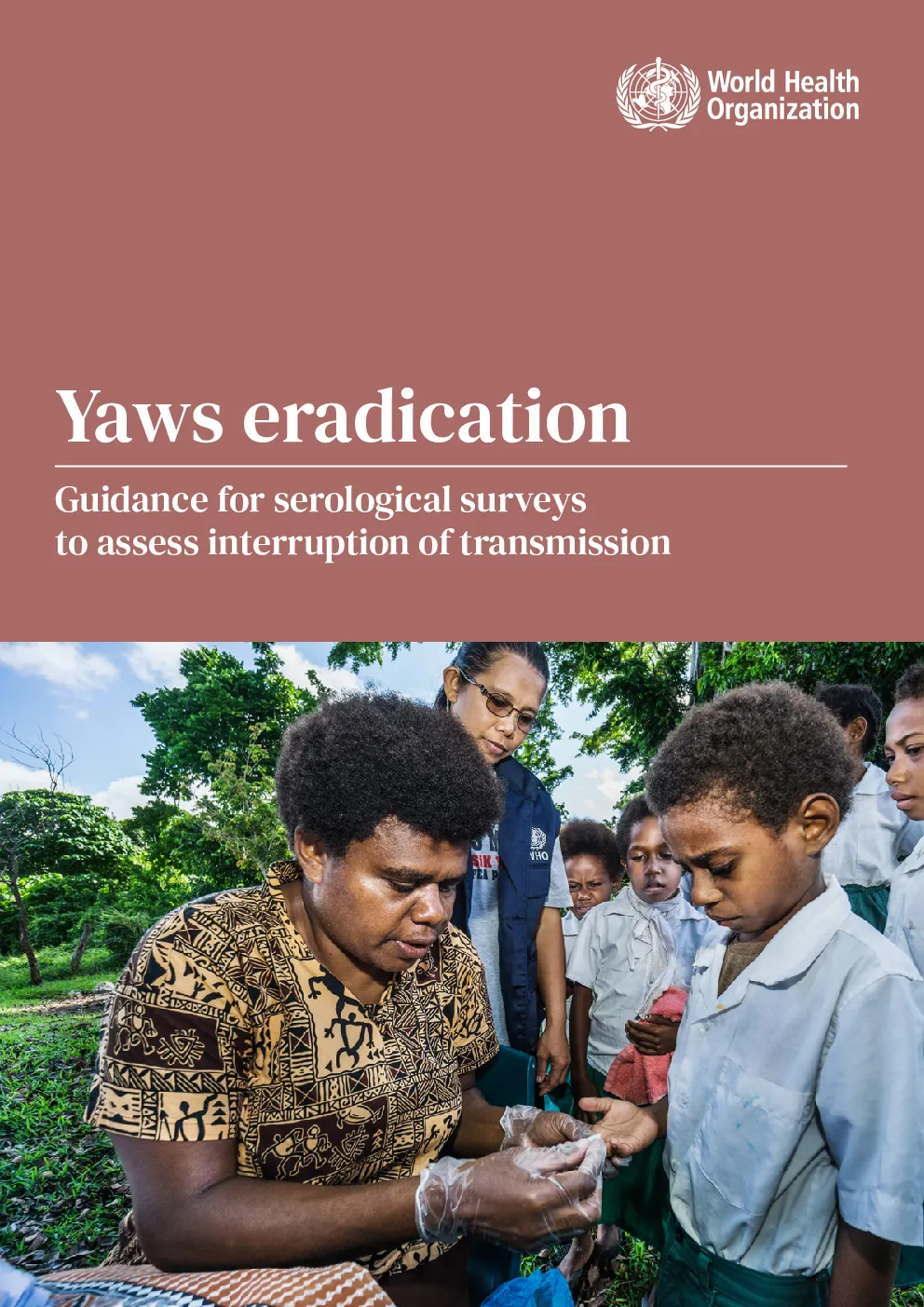
Guidance for serological surveysto assess interruption of transmission Yaws eradication Guidance for serological surveysto assess interruption of transmission Yaws eradication: guidance for serological surveys to assess interruption of transmission ISBN 978-92-4-010715-1 (electronic version)ISBN 978-92-4-010716-8 (print version) © World Health Organization 2025 Some rights reserved. This work is available under the Creative Commons Attribution-NonCommercial-ShareAlike3.0IGO licence (CCBY-NC-SA3.0IGO;https://creativecommons.org/licenses/by-nc-sa/3.0/igo). Under the terms of this licence, you may copy, redistribute and adapt the work for non-commercial purposes,provided the work is appropriately cited, as indicated below. In any use of this work, there should be no suggestionthat WHO endorses any specific organization, products or services. The use of the WHO logo is not permitted. Ifyou adapt the work, then you must license your work under the same or equivalent Creative Commons licence. Ifyou create a translation of this work, you should add the following disclaimer along with the suggested citation: “Thistranslation was not created by the World Health Organization (WHO). WHO is not responsible for the content oraccuracy of this translation. The original English edition shall be the binding and authentic edition”. Any mediation relating to disputes arising under the licence shall be conducted in accordance with the mediationrules of the World Intellectual Property Organization (http://www.wipo.int/amc/en/mediation/rules/). Suggested citation.Yaws eradication: guidance for serological surveys to assess interruption of transmission.Geneva: World Health Organization; 2025. Licence:CCBY-NC-SA3.0IGO. Cataloguing-in-Publication (CIP) data. CIP data are available athttps://iris.who.int/. Sales, rights and licensing.To purchase WHO publications, seehttps://www.who.int/publications/book-orders. Tosubmit requests for commercial use and queries on rights and licensing, seehttps://www.who.int/copyright. Third-party materials.If you wish to reuse material from this work that is attributed to a third party, such astables, figures or images, it is your responsibility to determine whether permission is needed for that reuse and toobtain permission from the copyright holder. The risk of claims resulting from infringement of any third-party-ownedcomponent in the work rests solely with the user. General disclaimers.The designations employed and the presentation of the material in this publication do notimply the expression of any opinion whatsoever on the part of WHO concerning the legal status of any country,territory, city or area or of its authorities, or concerning the delimitation of its frontiers or boundaries. Dotted anddashed lines on maps represent approximate border lines for which there may not yet be full agreement. The mention of specific companies or of certain manufacturers’ products does not imply that they are endorsed orrecommended by WHO in preference to others of a similar nature that are not mentioned. Errors and omissionsexcepted, the names of proprietary products are distinguished by initial capital letters. All reasonable precautions have been taken by WHO to verify the information contained in this publication.However, the published material is being distributed without warranty of any kind, either expressed or implied. Theresponsibility for the interpretation and use of the material lies with the reader. In no event shall WHO be liable fordamages arising from its use. Cover Image © WHO/Yoshi Shimizu. Deworming and yaws screening programme in Vanuatu. Contents Acknowledgements The World Health Organization (WHO) gratefullyacknowledges the members of the Informal WHOWorking Group on Yaws Survey Protocol Development(“the Working Group”) for their contributions to thisdocument. The methodology was drafted by theWorking Group between March 2023 and November2024. The Chair of the Working Group was ProfessorJohn Gyapong (Centre for Neglected Tropical DiseasesResearch, University of Health and Allied Sciences, Ho,Ghana); the rapporteur was Professor Oriol Mitjà (FightInfectious Diseases Foundation, Hospital Germans Triasi Pujol, Spain). Revankar (Public health medical consultant, New Jersey,United States of America); and Professor GhislainEmmanuel Sopoh (Regional Institute of Public Health,University of Abomey-Calavi, Cotonou, Benin). WHO thanks Professor Chris Drakeley (London Schoolof Hygiene & Tropical Medicine, London, UnitedKingdom of Great Britain and Northern Ireland) and DrGillian Stresman (University of South Florida Collegeof Public Health, Tampa, United States of America) fortheir participation in meetings and their insights on theFreedom From Infection approach; and Ms Laia Bertranand Mr Gerard Carot Sans (Fight Infectious DiseasesFoundation, Hospital Germans Trias i Pujol, Spain) fortheir contributions. Core members The following core members of the Working Groupwere respo