您的浏览器禁用了JavaScript(一种计算机语言,用以实现您与网页的交互),请解除该禁用,或者联系我们。[德国阿登纳基金会]:希腊暑假后的新路线 - 发现报告

希腊暑假后的新路线

2025-09-24德国阿登纳基金会王***
AI智能总结
查看更多
希腊暑假后的新路线

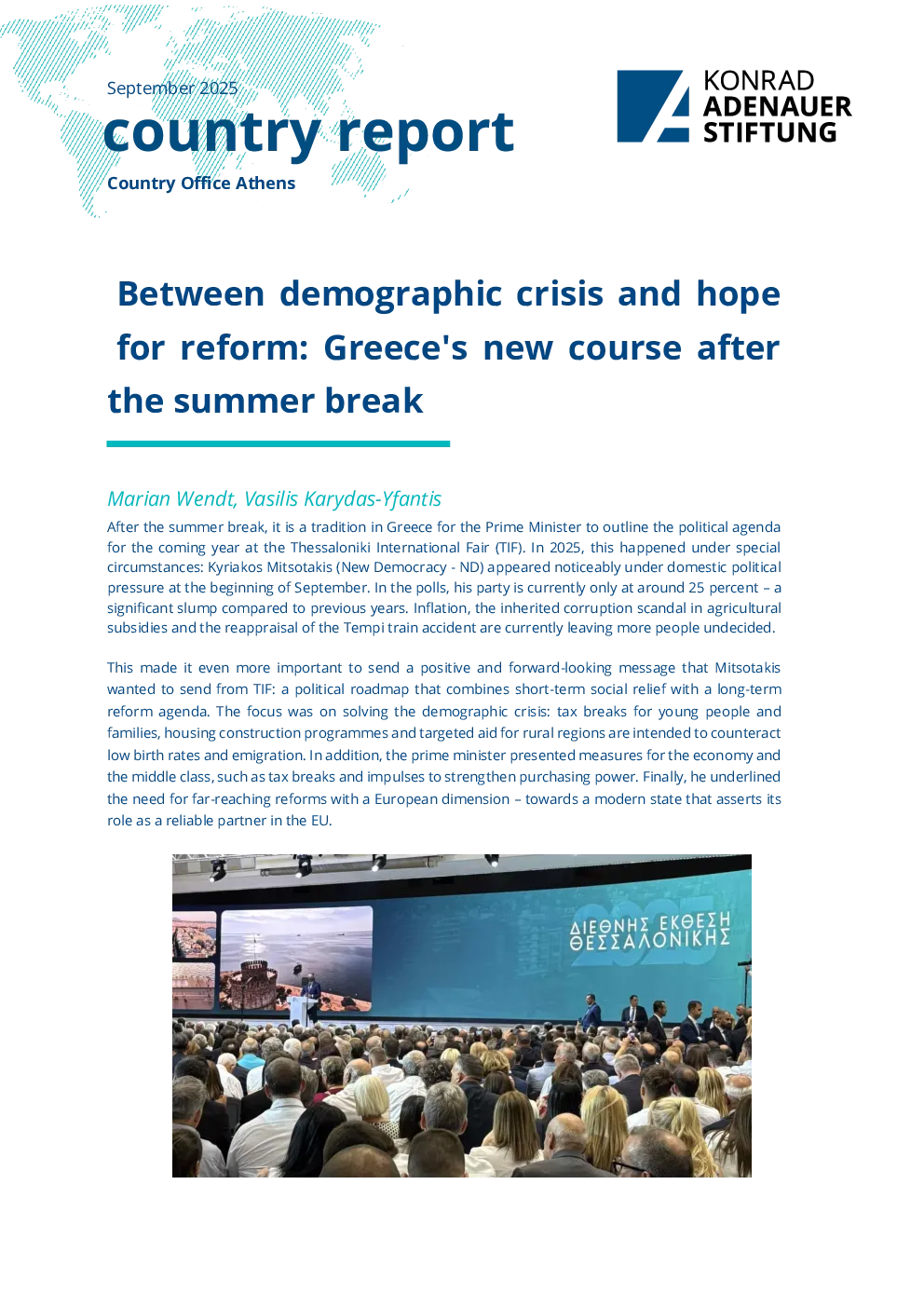
Between demographic crisis and hopefor reform: Greece's new course afterthe summer break Marian Wendt, Vasilis Karydas-Yfantis After the summer break, it is a tradition in Greece for the Prime Minister to outline the political agendafor the coming year at the Thessaloniki International Fair (TIF). In 2025, this happened under specialcircumstances: Kyriakos Mitsotakis (New Democracy-ND) appeared noticeably under domestic politicalpressure at the beginning of September. In the polls, his party is currently only at around 25 percent–asignificant slump compared to previous years. Inflation, the inherited corruption scandal in agriculturalsubsidies and the reappraisal of the Tempi train accident are currently leaving more people undecided. This made iteven moreimportant to send a positive and forward-looking message that Mitsotakiswanted to send from TIF: a political roadmap that combines short-term social relief with a long-termreform agenda. The focus was on solving the demographic crisis: tax breaks for young people andfamilies, housing construction programmes and targeted aid for rural regions are intended to counteractlow birth rates and emigration. In addition, the prime minister presented measures for the economy andthe middle class, such as tax breaks and impulses to strengthen purchasing power. Finally, he underlinedthe need for far-reaching reforms with a European dimension–towards a modern state that asserts itsrole as a reliable partner in the EU. Political starting point Demographic profile of Greece Thedemographic profile of Greece shows asociety in shrinking and ageing. The population in2025comprised around 10.4 million people,although the natural population development isnegative: fewer children are born than people die.The total increase isonly +0.13%. The fertility rateof 1.43 is well below the reproduction level of 2.1,albeit in line with the European average. At thesame time, about 24% of the population is alreadyolder than 65 years. This demographic ageingplaces considerable strainon the pension andhealthcare systems.In addition,there is themigrationof young,well-educated workersabroad, which exacerbates the shortage of skilledworkers. The development is also visible in theeducation sector:For three decades, more than750 schools have been closed due to decliningstudent numbers, with another 15 closures at thebeginningof the 2025/2026 school year.Thecombinationof low birth rates,an ageingpopulationand brain drain poses a structuralchallengefor Greece,which in the long termendangers economic dynamism as well as socialcohesion and the country's future viability. The context of the Thessaloniki International Fair2025 illustrates a realignment of political forces inGreece.TheNDgovernmentofKyriakosMitsotakis, in office for over six years, is trying toconvey an image of stability and forward-lookingpolicyintimesofeconomicstressanddemographicchallenges.Themeasurespresented in Thessaloniki are primarily aimed atthe middle class and youth–voter groups that areparticularly crucial for the political future. At thesametime,the opposition is changing:thesocialist PASOK has become the second strongestforce,while SYRIZA is weakened by internalconflictsand splits.This creates a politicallandscape in upheaval, in which the governmentwantsto consolidate its dominance and theopposition is looking for credible alternatives. Three politicalobjectives Demography and social cohesion The demographic problem was at the heart of thePrimeMinister'sannouncementsattheThessaloniki International Fair and was presentedas one of the greatest national challenges withlong-termsocialandpoliticalimplications.KyriakosMitsotakis presented a package ofmeasures that, on the one hand, are intended tokeep young people in Greece and open up betterprospects for them, and on the other hand, toprovide targeted support for families with childrenin order to counteract the low birth rate and thebrain drain. Specifically, the program includes acomplete tax exemption for young adults up to 25years of age with an income of up to 20,000 eurosp.a., as well as significant tax benefits for families,which are staggered according to the number ofchildren. For families with many children, the tax itselfas a force for"stability with socialresponsibility". The tax reforms thus have a dualfunction:on the one hand,they act as aneconomic instrument to strengthen purchasingpower, and on the other hand, as a political signalthat the government takes the everyday life of themiddle class seriously. In the logic of the electioncampaign, this is intended to secure the trust ofthose voters who traditionally decide on electionresults. burden can even be eliminated completely. Inaddition, a new housing programme has beenannounced: 2,000 apartments are to be built onformermilitary sites,75%of which will beallocated to families without their own house,while 25% will be reserved formembers of thearmedforces.The regions also benefit,forexamplethrough the co