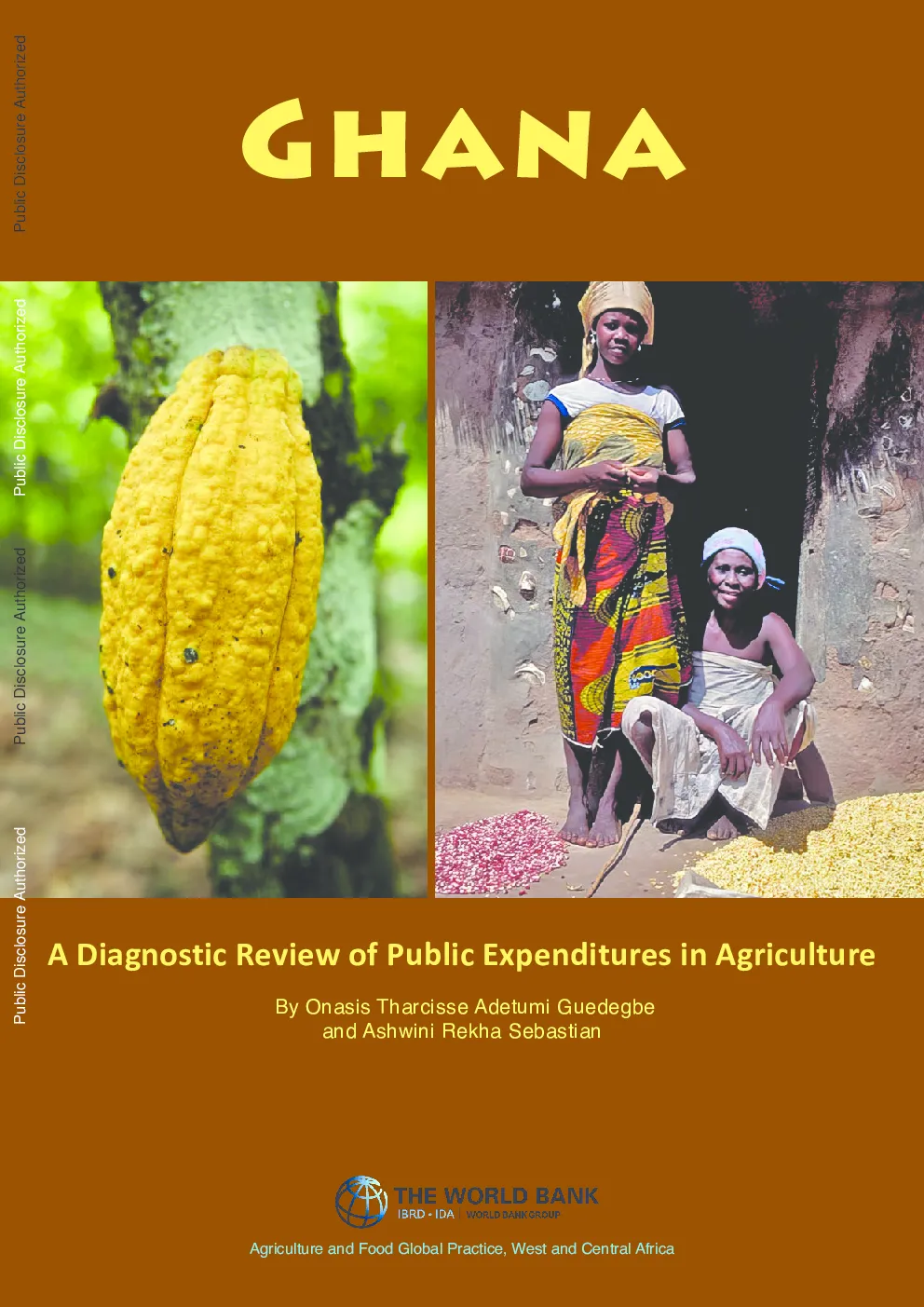
Ghana's agricultural sector plays a crucial role in the country's economy, contributing significantly to GDP and employment. However, the sector faces challenges such as resource-driven growth, suboptimal public investment prioritization, and misalignment of policies with climate and sustainability goals. Key findings include:
-
Resource-driven growth dynamics: Recent agricultural growth in Ghana has been primarily input-driven rather than productivity-driven. Public support has largely stimulated input use rather than enhancing efficiency, resulting in growth with limited sustainability.
-
Misguided public spending: Current expenditures dominate public spending in agriculture, limiting allocation to capital investment. This is despite the crucial role of capital investment in upgrading agriculture value chains, increasing productivity, and ensuring sustainability.
-
Cocoa sector challenges: Despite significant funding, inefficiencies persist in the cocoa sector, causing substantial losses. The COCOBOD Turnaround Strategy has the potential to generate positive net gains, which could be reinvested in the developing of the cocoa and non-cocoa sectors.
-
Untapped productivity potential: Potential-yield gaps and limited investment in R&D and extension services (especially e-extension) constitute a missed opportunity to enhance agricultural efficiency and output quality, and to build climate resilience.
-
Implementation shortcomings: Budget execution rates of government spending in agriculture are uneven, and inefficiencies limit the effectiveness of government and donor-funded projects and programs.
Recommendations:
-
Repurpose public spending: Shift subsidies to capital expenditures, enhance spending efficiency, integrate climate objectives, adopt gradual stop-gap measures, leverage technology, and attract private and partner financing for sustainable, productivity-led agricultural growth.
-
Advance comprehensive farmer support: Adopt a holistic value chain approach, integrating digital platforms, non-public extension systems, climate-smart practices, and inclusive agribusiness models to enhance impact, sustainability, and job creation.
-
Improve public expenditure planning and execution: Address inefficiencies, enhance agricultural expenditure data collection, integrate climate objectives into planning, and adopt project-level apportionment parameters to ensure accurate, efficient and sustainable resource allocation.
-
Increase profitability and transparency in the cocoa sector: Positive COCOBOD earnings should fund cocoa and non-cocoa agriculture. Adopt reforms to enhance transparency in MOFA reporting on cocoa-related expenditures.
-
Address inefficiencies in agricultural development projects: Focus on project design, capacity building of farmer-based organizations, innovative financing, complementary investment in infrastructure, and public-private partnerships.
The report emphasizes the need for a strategic overhaul of agricultural investments and policy adjustments to enhance productivity, reduce inefficiencies, and ensure a more equitable and effective distribution of resources within the sector.