通过孟加拉国的技术和职业教育与培训建立社区复原力(英)
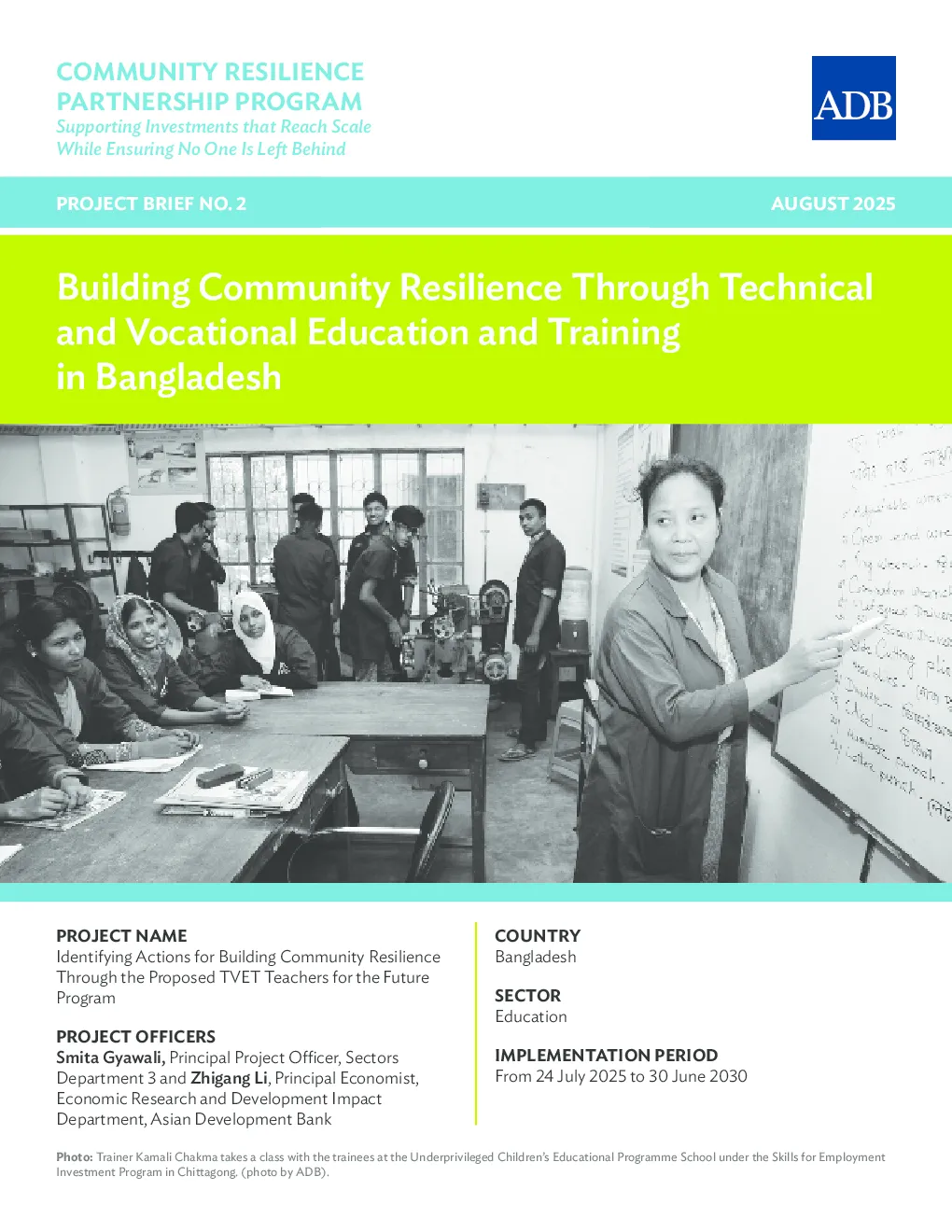
Supporting Investments that Reach ScaleWhile Ensuring No One Is Left Behind Building Community Resilience Through Technical COUNTRYBangladesh PROJECT NAMEIdentifying Actions for Building Community Resilience Through the Proposed TVET Teachers for the Future SECTOREducation PROJECT OFFICERSSmita Gyawali,Principal Project Officer, Sectors IMPLEMENTATION PERIODFrom 24 July 2025 to 30 June 2030 Department 3 andZhigang Li, Principal Economist,Economic Research and Development Impact 2Community Resilience Partnership Program Project Brief No. 2 CLIMATE RISK AND RESILIENCE PROFILE Bangladesh ranks 46th in the 2022 Climate Risk Indexaand 178th in the ND-GAIN Country Index. It is highly exposed to climate-related hazards such as floods, droughts, extreme heat, tropical cyclones, storm surges,and sea-level rise. High population density, poverty, and reliance on climate-sensitive sectors for water and food security, particularlywater resources, agriculture, fisheries and livestock, exacerbate its vulnerability and exposure to natural hazards. Climate change projected to alter precipitation patterns with likely unprecedented extremes, increased averagetemperature and extreme heat events, and contribute to sea-level rise. aClimate Risk Index: The annual Climate Risk Index analyzes to what extent countries have been affected by the impacts of weather-related loss events (storms,floods, heat waves, etc.).https://www.germanwatch.org/en/cri.bThe ND-GAIN Country Index summarizes a country’s vulnerability to climate change and other global challenges in combination with its readiness to improveresilience, with higher rankings signifying greater vulnerabilities (i.e., 192 is the most vulnerable and 1 least vulnerable). A total of 192 countries are ranked from low CURRENT POLICY CONTEXT CRPP TRUST FUND SUPPORT The Government of Bangladesh has identified developing skills,knowledge, and human capital as one of its core strategies forbuilding resilience and tackling climate change. Its NationalAdaptation Plan 2023–2050 includes six core goals, one ofwhich focuses on transformative capacity-building andinnovation for climate change adaptation, to equip its Funds from the Community Resilience Partnership Program(CRPP) Trust Fund were used to evaluate available climateadaptation considerations for integration into the proposed TVET systems have the potential toprovide services to vulnerable populationacross the country for much-needed Technical and vocational education and training (TVET)systems have the potential for building climate resilience inBangladesh, including resilience of the vulnerable communitiesdependent on climate-sensitive sectors for livelihoods.Thus, there is a need to reorient the TVET system to alignit with national policy and planning goals related to climatechange. For instance, the Mujib Climate Prosperity PlanDecade 2030 includes strategic investments in low-carbondevelopment initiatives and tackling frontline climate threats, The CRPP supported this project because TVET systems havethe potential to provide services to vulnerable populationacross the country for much-needed climate-resilient skillsbuilding. However, these systems need support to providesuch services. As such, CRPP Trust Fund resources supportedthe detailed analyses of (i) relevant TVET curriculum andteaching materials in three subject areas: agro-processing, civilengineering, and digital skills, and entry points for integratingclimate adaptation considerations; and (ii) the transformativepotential of the TVET system for building climate resiliencein Bangladesh and policy recommendations to inform the ⚜focusing efforts on the teacher development system withdedicated resources to improve teacher competencies and THE PROJECT The Asian Development Bank (ADB) approved theTVETTeachers for Future (TTF) Results-Based Lending Program As part of the initial project design, a climate risk andadaptation assessment was carried out to assess currentand future climate risks in Bangladesh, and identifyrelevant adaptation measures that could be included inthe design and delivery of the project’s core activitiesto maximize the potential of TVET system to deliveron resilience building. The assessment identifiedsignificant challenges posed by climate change impactson socioeconomic development in Bangladesh, and theneed for improved education and skills to manage climaterisk. The assessment also emphasized the importance for the Government of Bangladesh to improve equitableavailability of qualified TVET teachers. The TTF Programwill be implemented over 2025-2030 and will help(i) expand modern TVET teacher training; (ii) strengthenpedagogical and technical skills of TVET teachersand educators in modern and emerging technologies;and (iii) improve TVET teacher management, The TTF Program aims to bring transformationalchanges to Bangladesh’s TVET system and add ⚜supporting the holistic development of TVET teachertraining system in curricu