您的浏览器禁用了JavaScript(一种计算机语言,用以实现您与网页的交互),请解除该禁用,或者联系我们。 [PitchBook]:从峰值到转折点:随着贷款人放松,赞助商股权减弱 - 发现报告

从峰值到转折点:随着贷款人放松,赞助商股权减弱

金融 2025-08-21 - PitchBook 张曼迪
报告封面

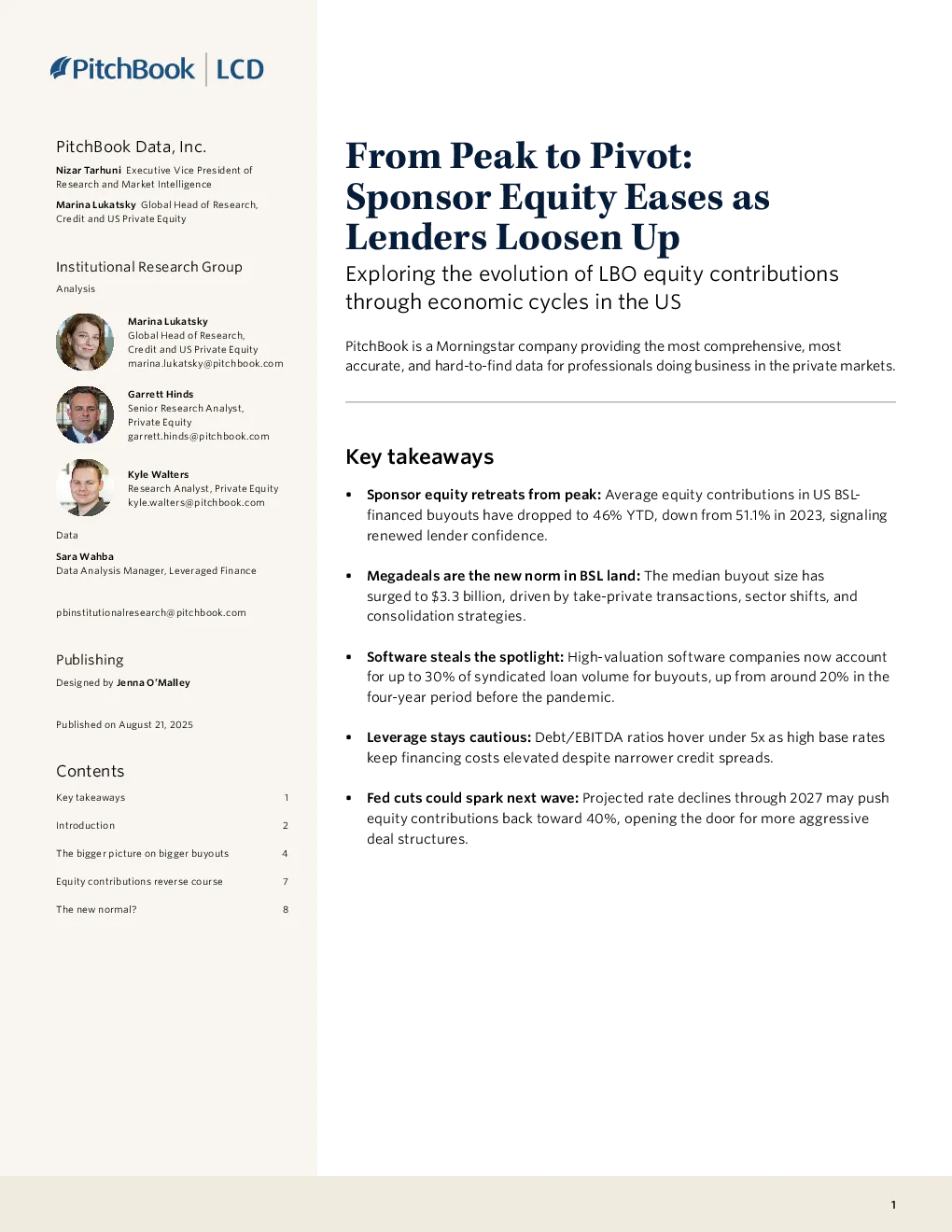
From Peak to Pivot:Sponsor Equity Eases asLenders Loosen Up PitchBook Data, Inc. Nizar TarhuniExecutive Vice President ofResearch and Market Intelligence Marina LukatskyGlobal Head of Research,Credit and US Private Equity Exploring the evolution of LBO equity contributionsthrough economic cycles in the US Analysis Marina LukatskyGlobal Head of Research,Credit and US Private Equitymarina.lukatsky@pitchbook.com PitchBook is a Morningstar company providing the most comprehensive, mostaccurate, and hard-to-find data for professionals doing business in the private markets. Garrett HindsSenior Research Analyst,Private Equitygarrett.hinds@pitchbook.com Key takeaways Kyle WaltersResearch Analyst, Private Equitykyle.walters@pitchbook.com •Sponsor equity retreats from peak:Average equity contributions in US BSL-financed buyouts have dropped to 46% YTD, down from 51.1% in 2023, signalingrenewed lender confidence. Data Sara Wahba Data Analysis Manager, Leveraged Finance •Megadeals are the new norm in BSL land:The median buyout size hassurged to $3.3 billion, driven by take-private transactions, sector shifts, andconsolidation strategies. pbinstitutionalresearch@pitchbook.com •Software steals the spotlight:High-valuation software companies now accountfor up to 30% of syndicated loan volume for buyouts, up from around 20% in thefour-year period before the pandemic. PublishingDesigned byJenna O’Malley Published on August 21, 2025 •Leverage stays cautious:Debt/EBITDA ratios hover under 5x as high base rateskeep financing costs elevated despite narrower credit spreads. Contents •Fed cuts could spark next wave:Projected rate declines through 2027 may pushequity contributions back toward 40%, opening the door for more aggressivedeal structures. Key takeaways1Introduction2The bigger picture on bigger buyouts4Equity contributions reverse course7The new normal?8 Introduction While US buyout activity has yet to rebound to the heights seen before interest ratessurged, trends in sponsor equity contributions are pointing to a more stable market.After hitting a cycle high of 51.1% in 2023—amid the most aggressive rate hikes ina generation—the average equity contribution has eased back to 46% of deal valueso far in 2025. This level is consistent with the 2019-2022 period, based on dealsfinanced through the broadly syndicated loan (BSL) market, and suggests thatdealmakers are regaining confidence regarding leverage, even if overall volumesremain muted. As valuations have soared over the past decade, sponsors have had to put moreskin in the game. In the years following the global financial crisis (GFC), equitycontributions hovered in the high-30% range before shifting into low-40% territoryfrom 2015 through 2018. This gradual climb coincided with a marked rise inpurchase price multiples for buyouts funded in the BSL market, which peaked at11.9x EBITDA in 2022—more than three full turns higher than a decade earlier. At the same time, the BSL market has steadily shifted toward financing largercompanies—and that shift has accelerated in recent years. The growing prevalenceof private credit and the tendency for companies to remain private longer havepushed more sizable deals into the syndicated loan space. This is evident in therising scale of buyouts: Until 2019, both average and median deal sizes remainedbelow $2 billion. But by 2022, both metrics surpassed that mark. Even as overall dealactivity has slowed in the high-rate environment of the past three years, deal sizeshave continued to climb, with the median buyout size reaching $3.3 billion in theyear to date. Since rate hikes began in 2022, buyouts under $1 billion have virtually disappearedfrom the BSL market. These smaller deals made up nearly 30% of the BSL-financedLBO deal count a decade ago—and still accounted for 12% as recently as 2019—butnow they represent only a negligible share. This decline underscores the migrationof smaller borrowers toward private credit. When the private credit market startedto take off around eight years ago, these lenders looked first to smaller borrowersfor opportunities. Fund sizes were smaller, as were the buy-and-hold sizes ofprivate credit lenders. As fund sizes increased, private credit lenders began touse their ability to provide ever-larger loans as a selling point to PE firms and theirborrower companies. The bigger picture on bigger buyouts Beyond the expanding role of direct lenders, several structural forces have driventhe growth in buyout transaction sizes. In the rising-rate environment, collateralizedloan obligations and other institutional investors active in the speculative-gradelending space have shown a clear preference for higher-quality credit: targetcompanies with stronger fundamentals and more compelling growth trajectories.This flight to quality has pushed capital toward larger, more resilient businesses,reinforcing the upward drift in deal sizes across the BSL market. While overall buyout volume r