东盟与美国关税壁垒:经济格局与政策应对
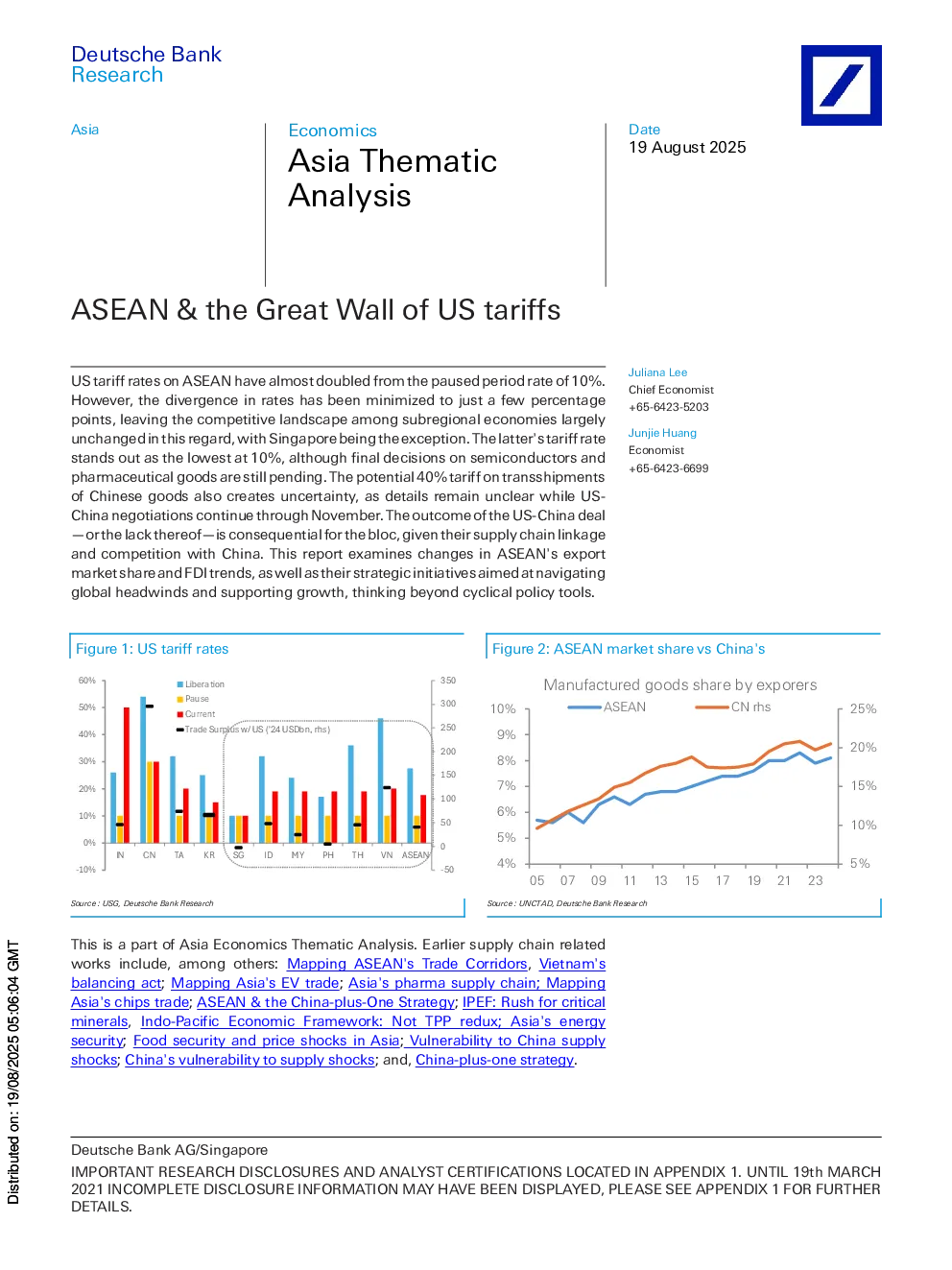
EconomicsAsia Thematic Asia Analysis ASEAN & the Great Wall of US tariffs Juliana LeeChief Economist+65-6423-5203 US tariff rates on ASEAN have almost doubled from the paused period rate of 10%.However, the divergence in rates has been minimized to just a few percentagepoints, leaving the competitive landscape among subregional economies largelyunchanged in this regard, with Singapore being the exception. The latter's tariff ratestands out as the lowest at 10%, although final decisions on semiconductors andpharmaceutical goods are still pending. The potential 40% tariff on transshipmentsof Chinese goods also creates uncertainty, as details remain unclear while US-China negotiations continue through November. The outcome of the US-China deal—or the lack thereof—is consequential for the bloc, given their supply chain linkageand competition with China. This report examines changes in ASEAN's exportmarket share and FDI trends, as well as their strategic initiatives aimed at navigatingglobal headwinds and supporting growth, thinking beyond cyclical policy tools. Junjie HuangEconomist+65-6423-6699 This is a part of Asia Economics Thematic Analysis. Earlier supply chain relatedworks include, among others: Mapping ASEAN's Trade Corridors, Vietnam'sbalancing act; Mapping Asia's EV trade; Asia's pharma supply chain; MappingAsia's chips trade; ASEAN & the China-plus-One Strategy; IPEF: Rush for criticalminerals,Indo-Pacific Economic Framework:Not TPP redux;Asia's energysecurity; Food security and price shocks in Asia; Vulnerability to China supplyshocks; China's vulnerability to supply shocks; and, China-plus-one strategy. ASEAN's Economic Landscape and Policy Levers Central bankers in ASEAN have downplayed the positive surprises in Q2 GDP,anticipating a growth correction in the second half of the year as export front-loading reverses and higher US tariffs take effect. This aligns with our long-heldview, particularly given the significant surge in ASEAN exports to the US. Looking forward, the projected slowdown in ASEAN growth to 4.5% in 2026 from4.6% in 2025 and 5% in 2024 may prove too optimistic. The anticipated exportdecline may exceed a simple correction—deeper and longer than our forecast—especially given our assumption of a mere soft patch in G2 growth, as per our USandEuropean economists'expectations.That said,ASEAN monetarypolicymakers are looking past positive surprises, acting preemptively to supportgrowth amid elevated uncertainties, as recently reiterated by the Bank of Thailand. Source : CEIC, Deutsche Bank Research ASEAN central banks have delivered an average of 75 bps in rate cuts this cycle, andfurther easing is anticipated, as shown below. Rate cuts may exceed our currentexpectations, particularly if the Federal Reserve lowers rates more aggressivelythan our US economist's forecast of a 75 bps reduction. At the same time, becausecyclical macro policy tools are not designed to address underlying structural shifts,ASEAN policymakers have embarked on strategic initiatives to help the economynavigate global headwinds. Sectoral shifts in exports ASEAN is undeniably at a critical juncture, facing the choice between allowing itsgrowth potential to further deteriorate and embarking on an ambitious path tocultivate new growth engines and boost productivity. The US tariff shock—introducinggreater competition from US firms within ASEAN—arrives aseconomies like Thailand already contend with significant competitive pressurefrom Chinese producers, both for global market share and within their domesticmarkets. Despite recent gains, economies like Vietnam must remain vigilant abouttheir relative cost increases compared to China. Moreover, Thailand’s industrialproduction has not kept pace with its export growth, resulting in persistently lowindustrial capacity utilization rates. Source : UNCTAD, Deutsche Bank Research Regarding trade composition,while ASEAN increased its global export marketshare, the gains were modest compared to China. ASEAN's share edged up by 0.6percentage points to 8.3% over the three years ending in 2024, relative to the pre-COVID period, while China's share surged by 2.7 percentage points to 20.5%. Source : UNCTAD, Deutsche Bank Research Within ASEAN,Vietnamdistinguished itself with the strongest growth, expandingits share by 0.4 percentage points to 2.1%, with well-balanced gains across variouslevels of tech intensity, labor skill, and natural resource endowments.Malaysiafollowed, with a 0.2 percentage point increase to 1.4%, primarily fueled by high-skilland tech-intensive goods.Singapore's share inched up by 0.1 percentage points to2.3%, driven by medium-skill, tech-intensive goods, whileIndonesiaalso saw a 0.1percentage point uptick to 0.7%, largely attributed to low-skill, tech-intensivegoods.In contrast,the Philippines and Thailand both experienced a 0.1percentage point contraction, falling to 0.3% and 1.3%, respectively, across a broadrange of sectors. Source : UNCTA