您的浏览器禁用了JavaScript(一种计算机语言,用以实现您与网页的交互),请解除该禁用,或者联系我们。[巴克莱银行]:范式转变:全球投资组合经理摘要 - 发现报告

范式转变:全球投资组合经理摘要

2025-08-24-巴克莱银行G***
AI智能总结
查看更多
范式转变:全球投资组合经理摘要

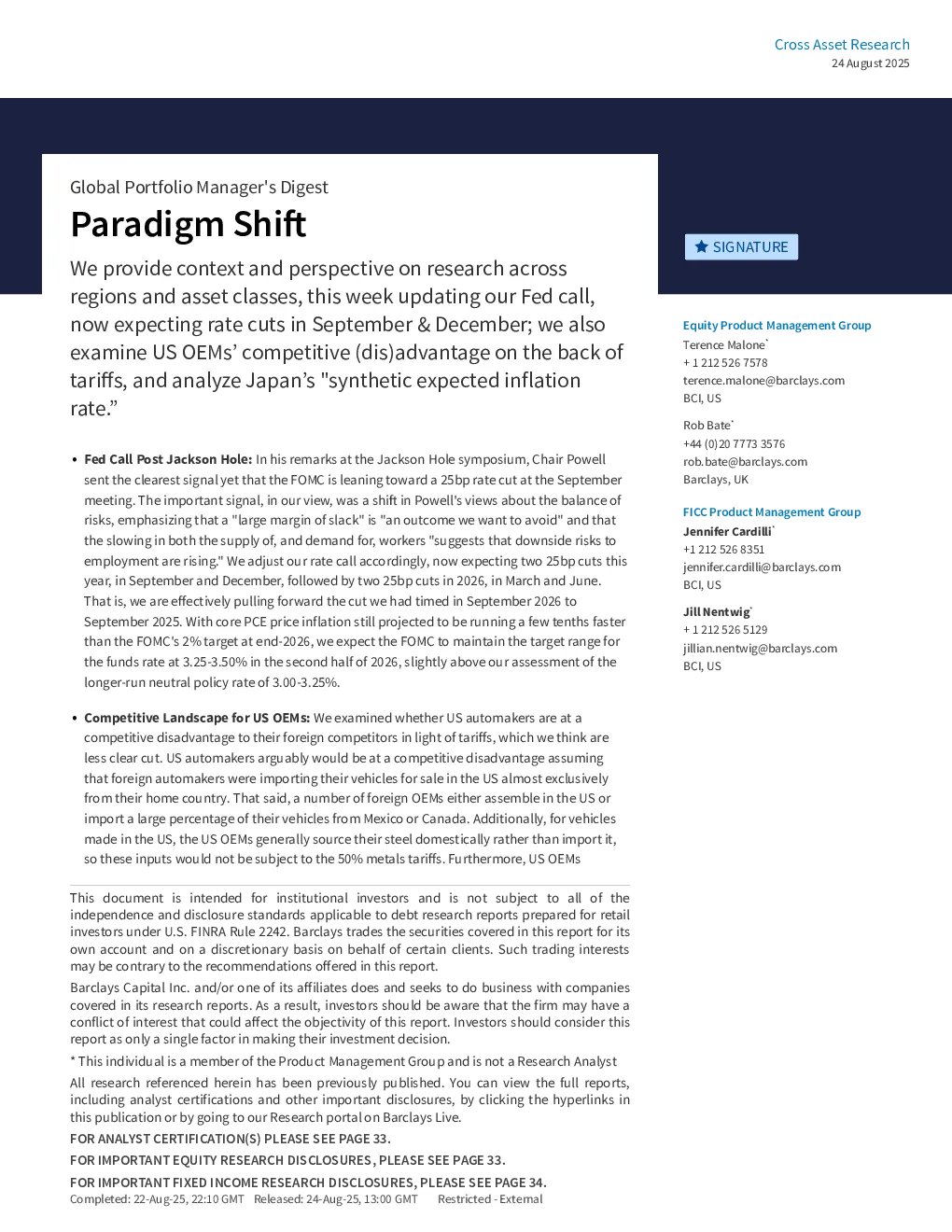
ParadigmShift We provide context and perspective on research acrossregions and asset classes, this week updating our Fed call,now expecting rate cuts in September & December; we alsoexamine US OEMs’ competitive (dis)advantage on the back oftariffs,and analyze Japan’s "synthetic expected inflationrate.” Equity Product Management Group Terence Malone*+ 1 212 526 7578terence.malone@barclays.comBCI, US Rob Bate*+44 (0)20 7773 3576rob.bate@barclays.comBarclays, UK •Fed Call Post Jackson Hole:In his remarks at the Jackson Hole symposium, Chair Powellsent the clearest signal yet that the FOMC is leaning toward a 25bp rate cut at the Septembermeeting. The important signal, in our view, was ashiftin Powell's views about the balance ofrisks, emphasizing that a "large margin of slack" is "an outcome we want to avoid" and thatthe slowing in both the supply of, and demand for, workers "suggests that downside risks toemployment are rising." We adjust our rate call accordingly, now expecting two 25bp cuts thisyear, in September and December, followed by two 25bp cuts in 2026, in March and June.That is, we areeffectivelypulling forward the cut we had timed in September 2026 toSeptember 2025. With core PCE price inflation still projected to be running a few tenths fasterthan the FOMC's 2% target at end-2026, we expect the FOMC to maintain the target range forthe funds rate at 3.25-3.50% in the second half of 2026, slightly above our assessment of thelonger-run neutral policy rate of 3.00-3.25%. FICC Product Management GroupJennifer Cardilli*+1 212 526 8351jennifer.cardilli@barclays.comBCI, US Jill Nentwig*+ 1 212 526 5129jillian.nentwig@barclays.comBCI, US •Competitive Landscape for US OEMs:We examined whether US automakers are at acompetitive disadvantage to their foreign competitors in light oftariffs,which we think areless clear cut. US automakers arguably would be at a competitive disadvantage assumingthat foreign automakers were importing their vehicles for sale in the US almost exclusivelyfrom their home country. That said, a number of foreign OEMs either assemble in the US orimport a large percentage of their vehicles from Mexico or Canada. Additionally, for vehiclesmade in the US, the US OEMs generally source their steel domestically rather than import it,so these inputs would not be subject to the 50% metalstariffs.Furthermore, US OEMs Thisdocument is intended for institutional investors and is not subject to all of theindependence and disclosure standards applicable to debt research reports prepared for retailinvestors under U.S. FINRA Rule 2242. Barclays trades the securities covered in this report for itsown account and on a discretionary basis on behalf of certain clients. Such trading interestsmay be contrary to the recommendationsofferedin this report. Barclays Capital Inc. and/or one of itsaffiliatesdoes and seeks to do business with companiescovered in its research reports. As a result, investors should be aware that the firm may have aconflict of interest that couldaffectthe objectivity of this report. Investors should consider thisreport as only a single factor in making their investment decision. * This individual is a member of the Product Management Group and is not a Research Analyst All research referenced herein has been previously published. You can view the full reports,including analyst certifications and other important disclosures, by clicking the hyperlinks inthis publication or by going to our Research portal on Barclays Live. FOR ANALYST CERTIFICATION(S) PLEASE SEE PAGE 33.FOR IMPORTANT EQUITY RESEARCH DISCLOSURES, PLEASE SEE PAGE 33.FOR IMPORTANT FIXED INCOME RESEARCH DISCLOSURES, PLEASE SEE PAGE 34.Completed: 22-Aug-25, 22:10 GMTReleased: 24-Aug-25, 13:00 GMTRestricted - External currently enjoy a credit from thetariffson imported auto parts used in the assembly offinished autos in the US. And USMCA-compliant parts imported from Mexico or Canada arecurrently nottariffed.This means that US-assembled vehicles with at least 85% USMCAcontent likely will have limited, if any,tariffimpact net of the credit. •The BoJ’s “Synthetic Expected Inflation Rate”:The real policy rate in Japan is sharplylower than that in the US and euro area, hovering deeply in negative territory. The definitionof underlying inflation is ambiguous, and multiple indicators are referenced. Among them,Governor Ueda cites the "synthetic expected inflation rate," which uses principal componentanalysis to synthesize the inflation expectation indicators of businesses, households, andexperts, as a measure that the BoJ monitors. To that end, we note that the BoJ uses the meanand variance of the inflation expectation indicators from expert surveys. However, in terms ofpredictive power for future inflation rates, expert surveys are significantly inferior to businesssurveys. We therefore used the mean and variance of business surveys and found that thesynthetic expected inflation rate is clearly above 2%, at 2.42% in t