2025-26年高等教育变革的五种方式
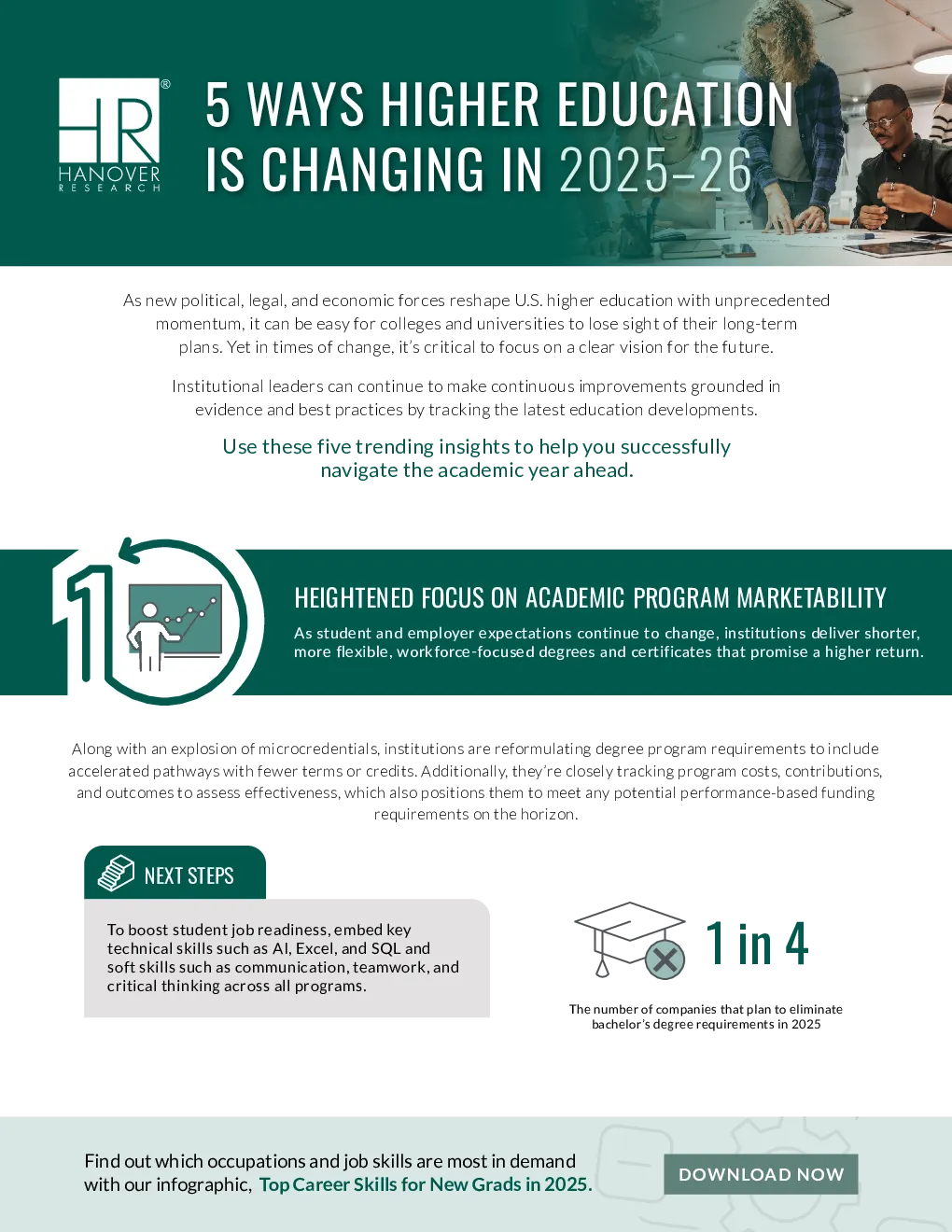
As new political, legal, and economic forces reshape U.S. higher education with unprecedentedmomentum, it can be easy for colleges and universities to lose sight of their long-termplans. Yet in times of change, it’s critical to focus on a clear vision for the future. Institutional leaders can continue to make continuous improvements grounded inevidence and best practices by tracking the latest education developments. Use these five trending insights to help you successfullynavigate the academic year ahead. HEIGHTENED FOCUS ON ACADEMIC PROGRAM MARKETABILITY As student and employer expectations continue to change, institutions deliver shorter,more flexible, workforce-focused degrees and certificates that promise a higher return. Along with an explosion of microcredentials, institutions are reformulating degree program requirements to includeaccelerated pathways with fewer terms or credits. Additionally, they’re closely tracking program costs, contributions,and outcomes to assess effectiveness, which also positions them to meet any potential performance-based fundingrequirements on the horizon. NEXT STEPS 1 in 4 To boost student job readiness, embed keytechnical skills such as AI, Excel, and SQL andsoft skills such as communication, teamwork, andcritical thinking across all programs. The number of companies that plan to eliminatebachelor’s degree requirements in 2025 Find out which occupations and job skills are most in demandwith our infographic,Top Career Skills for New Grads in 2025. RAPID U.S. POLITICAL CHANGE JEOPARDIZES STUDENT ACCESS AND AID Despite recent enrollment gains, coalescing threats to student aid, institutional funding,immigration policy, and cost of living hamper institutions’ student recruitment and retentionefforts. Many students are motivated to attend college, but the shifting political landscape is generating uncertainties that coulderode recent enrollment gains or alter which students see college as attainable. Yet even amid budget cuts, institutions areinnovating recruitment practices and aid policies to be student-centered and value-added. NEXT STEPS Conduct an admitted student survey tounderstand incoming students’ current painpoints and identify changes that will supportmore students through the application andenrollment process in the future. The percentage of admitted students who deferred or declinedoffers due to financial aid or loan repayment concerns, while25% cited research uncertainty in higher ed Hear how other institutions are countering current enrollmentchallenges in our on-demand webinar,Higher Ed EnrollmentUnlocked: Strategies that Work Now. FUNDING CHALLENGES UPEND LONGER-TERM SOLVENCY PLANS A rocky financial and regulatory environment pushes colleges and universities to rethinktraditional approaches to their budgeting and strategic planning processes. Institutions are adapting to headwinds from budget shortfalls, enrollment challenges, rising costs, and funding policy changes.To substantiate institutional impact and illuminate opportunities, many campuses have accelerated strategic planningprocesses or intensified revenue diversification efforts. To do so, they’re leaning into institution-wide alignment, centralizedresource management, and scenario planning. NEXT STEPS Ensure your strategic plan is actionableby establishing high-level, measurable keyperformance indicators (KPIs) to ensure budgetsand decisions consistently align with mission-focused priorities. The percentage of U.S. college budget officers who say thatfederal policy changes are moderately or severely impactingtheir institution’s basic financial planning Learn how institutions are securing foundation and corporatefunding in our on-demand webinar,Creative Grant Seeking in aChallenging Landscape. STUDENT SUCCESS METRICS TAKE CENTER STAGE Colleges and universities emphasize support and services that strengthen studentconnections and bolster mental and emotional health, while closely measuring theimpact of those initiatives. Institutions often excel at creating student services but have struggled to ensure they’re accessible, relevant, and used bystudents. Colleges and universities are examining and reconfiguring how they deliver, promote, and measure their supportand success services. They’re also investing more in evidence-informed practices and tracking outcomes from engagement. NEXT STEPS Monitor student service utilization rates and collectfeedback through multiple methods. Conductstudent surveys and focus groups to learn aboutsupport needs, satisfaction, and awareness levels toredefine services for greater impact. The percentage of students who feel a sense of isolation oralienation at their institution due to an aspect of their identity Find out what matters most to the next cohort of studentswith our2025 National Admitted Student Survey. INSTITUTIONAL BRANDING SHIFTS FOCUS FROM RANKINGS TO VALUE While public and legislative trust in higher education waivers, campu