您的浏览器禁用了JavaScript(一种计算机语言,用以实现您与网页的交互),请解除该禁用,或者联系我们。 [普华永道]:共享自动驾驶汽车(SAV)的演进:市场潜力、用户接受度与早期采用者群体 - 发现报告

共享自动驾驶汽车(SAV)的演进:市场潜力、用户接受度与早期采用者群体

交运设备 2024-04-01 普华永道 梅斌
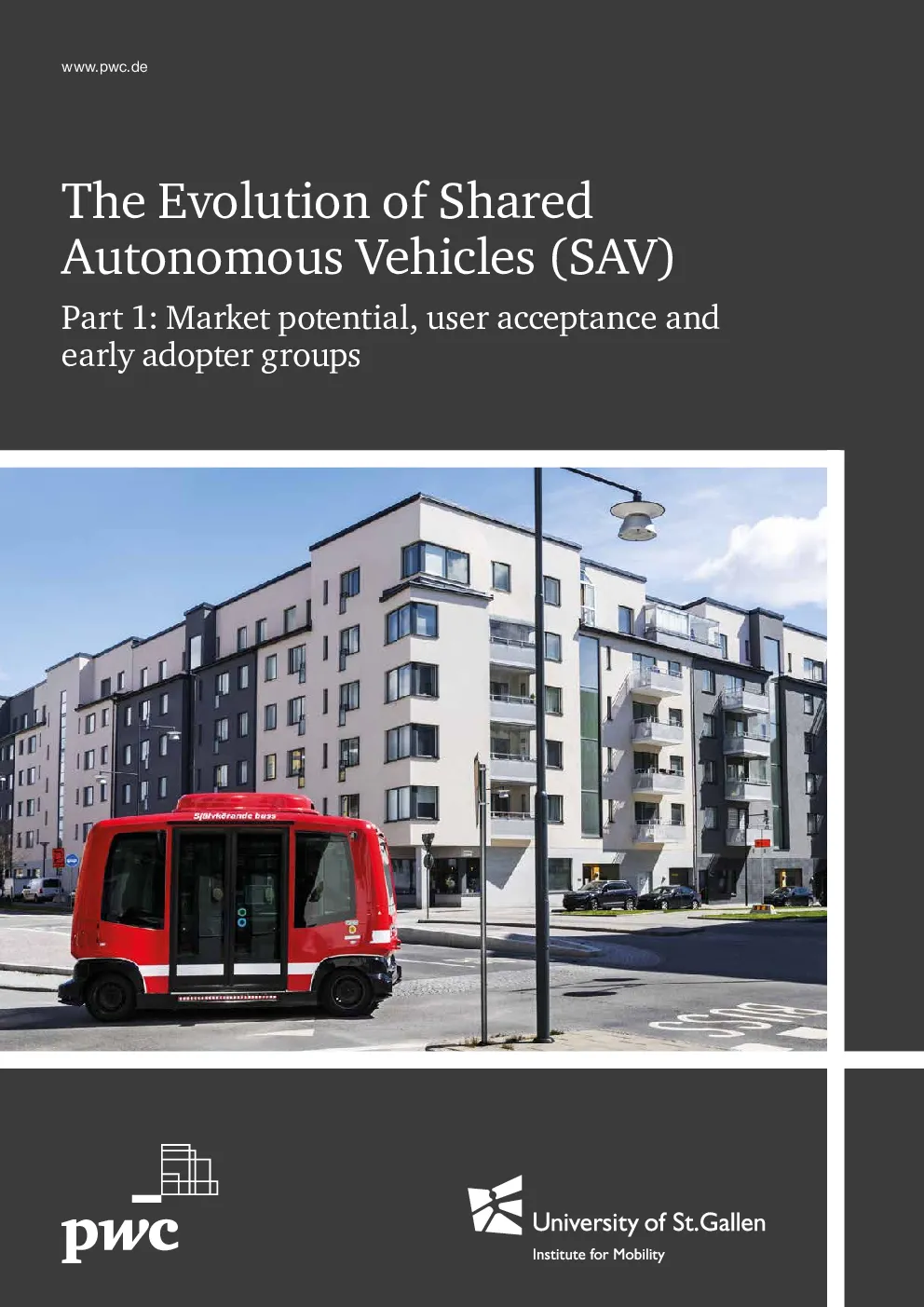
报告封面

Part 1: Market potential, user acceptance andearly adopter groups The Evolution of Shared Autonomous Vehicles (SAV) Published by PricewaterhouseCoopers GmbH Wirtschaftsprüfungsgesellschaft By Marvin Greifenstein, Hartmut Güthner, Philipp Scharfenberger, Peter Kauschke,Andreas Herrmann and Felix Kuhnert April 2024, 26 Pages, 12 Figures, Soft cover All rights reserved. This material may not be reproduced in any form, copied onto microfilm or savedand edited in any digital medium without the explicit permission of the editor. This publication is intended to be a resource for our clients, and the information therein was correctto the best of the authors’ knowledge at the time of publication. Before making any decision or takingany action, you should consult the sources or contacts listed here. The opinions reflected are thoseof the authors. The graphics may contain rounding differences. This Whitepaper is partly based on the following journal article: Greifenstein, M. (2024). FactorsInfluencing the User Behaviour of Shared Autonomous Vehicles (SAVs): A Systematic LiteratureReview. Transportation Research Part F: Traffic Psychology and Behaviour, 100, 323–345. Page 1 Getty Images/Johner Images, page 4/5 Getty Images/Westend61, page 12 Getty Images/Bloomberg, page 14 Getty Images/Future Publishing, page 16 Getty Images/Bloomberg,page 21 Getty Images/RgStudio “The challenges of transforming mobility are enormous. To developnew solutions, we must also ask new questions. Through the closeexchange with the IMO-HSG, we expect to gain important impulses.” Felix KuhnertPartner and Automotive Leader, PwC Germany “In the new lab, we want to put current mobilitysystems to the test. Our goal is to research mobilitybehavior in order to make mobility more efficient,accessible and environmentally friendly in the future.” Prof. Dr. Andreas HerrmannDirector Institute for Mobility, University of St. Gallen PwC Lab for Smart Mobility The mobility sector faces numerousfuture challenges: mobility needs tobe highly connected, environmentallysustainable, universally accessibleat all times and in all places. Atthe same time, it should continueto be affordable – essentially,it should be “smart”. Creatingconcepts and solutions that meetall these requirements demands acomprehensive understanding of thecomplexities involved. The PwC Lab for Smart Mobility is led by: To address this, the Institutefor Mobility (IMO-HSG), one of40 independently managed researchinstitutes and centres at the Universityof St. Gallen, joined forces withPwC Germany to establish the PwCLab for Smart Mobility. This newlyformed think tank examines modelsof connected and sustainable mobilityfor the future as well as their impacton people’s mobility behaviour. Inaddition, the Lab for Smart Mobilityexplores how the mobility industryevolves, and which products andsolutions it will be likely to offer. Prof Dr Andreas Herrmannandreas.herrmann@unisg.ch Felix Kuhnert felix.kuhnert@pwc.com Dr Peter Kauschke Dr Philipp Scharfenbergerphilipp.scharfenberger@unisg.ch The present study is part of a series ofpublications by the PwC Lab for SmartMobility. It is based on the researchconducted by Marvin Greifenstein,in close collaboration with the SmartMobility team at PwC Germany. Marvinis a doctoral student and researchassistant at the Institute for Mobility atthe University of St. Gallen (IMO-HSG). Table of Contents Table of Figures.......................................................................................................5 1Four global megatrends influencing the evolution ofsmart mobility................................................................................................. 62Defining SAV types and anticipating a market scenariofor a shared autonomous era....................................................................... 93Increase in SAV consumer studies around the globeand across various vehicle types............................................................... 114Determinants shaping consumer acceptance of SAVs.......................... 135Users embracing SAVs: exploring early adopter groups........................ 156SAVs at our doorstep: key practical implications.................................... 17 Appendix............................................................................................................... 19References............................................................................................................23About the Authors................................................................................................. 24 Table of Figures Fig. 1Four global megatrends shape the direction of thesmart mobility evolution............................................................................. 6Fig. 2Challenges of our cities today................................................................... 7Fig. 3SAV types include robo-taxis, robo-shuttles and robo-buses................. 9Fig. 4Expe