您的浏览器禁用了JavaScript(一种计算机语言,用以实现您与网页的交互),请解除该禁用,或者联系我们。[TaiyangNews]:2025年太阳能电池与组件技术趋势:TOPCon、HJT与BC关键发展 - 发现报告

2025年太阳能电池与组件技术趋势:TOPCon、HJT与BC关键发展

电气设备2025-05-07-TaiyangNews张***
AI智能总结
查看更多
2025年太阳能电池与组件技术趋势:TOPCon、HJT与BC关键发展

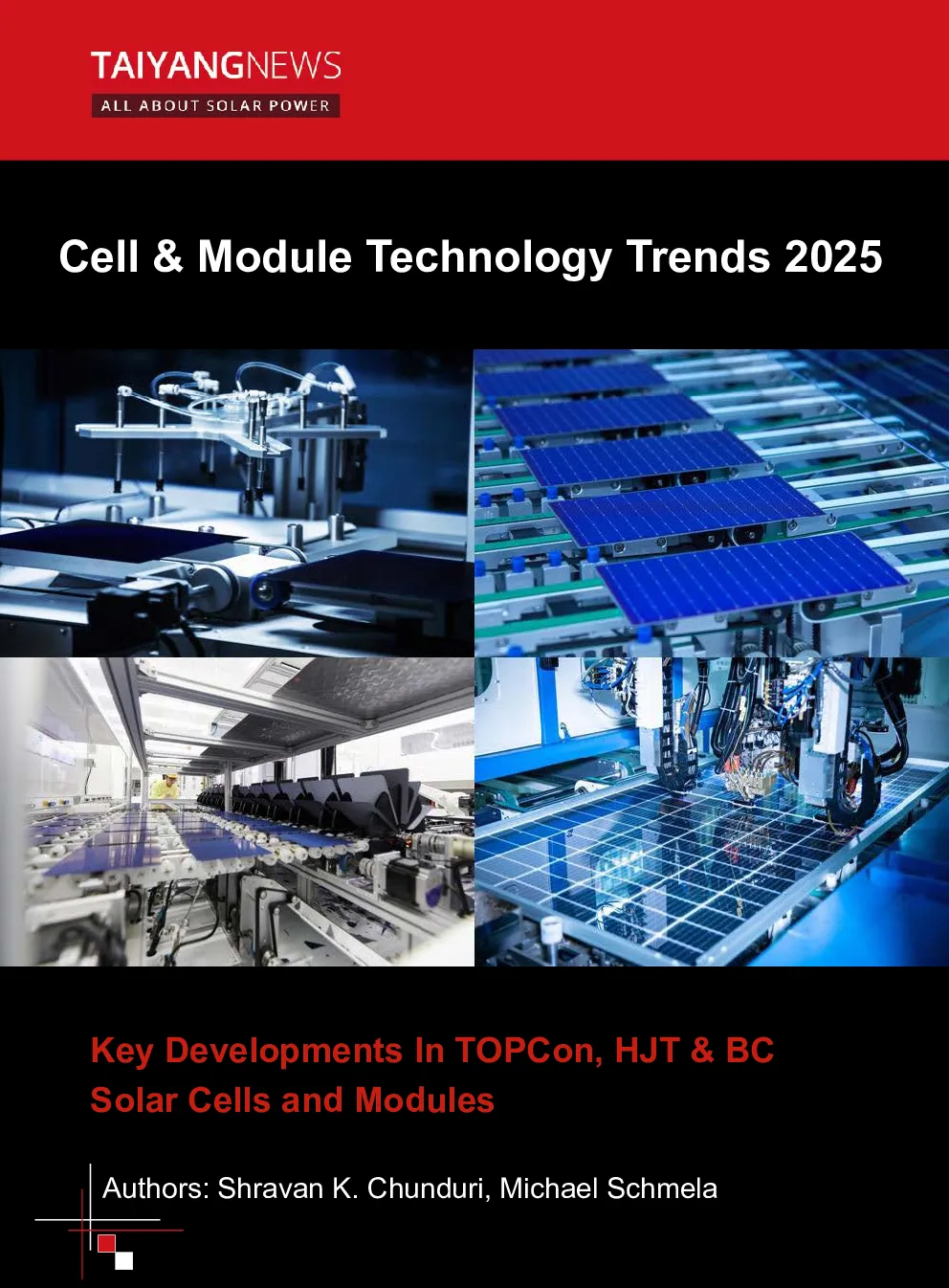
Cell & Module Technology Trends 2025 Key Developments In TOPCon, HJT & BCSolar Cells and Modules Executive Summary undergone a key shift from doped amorphoussilicon to microcrystalline silicon, which has becomea standard. The next frontier lies in metallizationcost reduction. Manufacturers are moving in 3 keydirections: increasing the number of busbars andeventually eliminating them through zero-busbar(ZBB) designs; lowering the paste laydown byreducing the finger width and reducing the silverconsumption by lowering the silver loading; andultimately going silver-free. Companies are alsofocusing on high mobility TCO material used in HJTprocessing. Today’s PV technology landscape reflects anecosystem where multiple technologies coexist.While TOPCon has emerged as the standard,its contemporaries – heterojunction (HJT) andthe more advanced back contact (BC) structure-are also in high-volume production, with notableprogress across all. Although some innovationsremain technology-specific, others – especially atthe module level – are increasingly applicable acrossplatforms. This report offers a high-level overview ofsuch developments. Starting upstream, an important innovation in ingotproduction is LONGi’s proprietary TRCZ process,which offers precise resistivity control from seedto tail while maintaining RCZ’s cost advantages.TaiRay wafers made via TRCZ also enable bettergettering. Regarding wafer specifications, BC is themost demanding, followed by TOPCon, while HJTis the most forgiving, particularly in terms of oxygencontent. BC technology is more opaque compared toits peers due to the proprietary nature of itsdevelopment. However, insights from industryleaders like LONGi, AIKO, and SPIC reveal sharedthemes. BC is a platform that can be based onvarious cell architectures. However, the majority ofmanufacturers are using bipolar passivated contacts.Laser technology plays a vital role in BC solar cellmanufacturing, particularly in enabling the rear-sidestructuring that defines this architecture. While therehave been some growing pains with lasers in thebeginning, today’s laser can very well support thethroughput as well as quality requirements of BC cellmakers. When it comes to metallization, all major BCmanufacturers are actively exploring ways to reduceor replace silver, with a clear focus on copper-basedsolutions. And adopting ZBB is a common strategyto reduce silver consumption. In TOPCon, one major advancement is laser-assistedcontact formation, which decouples metal contactrecombination from contact resistivity. Depositionmethods like LPCVD and PECVD now delivercomparable performance, having overcome earlierlimitations. PVD is also emerging as a viable thirdoption. Another notable trend is edge passivation,addressing defects from slicing large wafers intohalves. Simultaneously, vendors are developingtools tailored to half-cell processing, a practice longestablished in HJT. Meanwhile, patent disputes havecreated uncertainty in some markets, promptingshifts away from TOPCon – especially in the U.S.Looking ahead, Several TOPCon manufacturers areexploring rear poly – fingers – borrowed from BCdesigns – to reduce parasitic absorption and boostefficiency by applying polysilicon only beneath rearmetal contacts At the module level, the industry is witnessing a shiftfrom a ‘one-size-fits-all’ approach to products toapplication-specific designs. Module manufacturersare now tailoring their BOMs to meet the diversedemands of different climates, installationenvironments, and system configurations. As aresult, almost every traditional component – beit glass, encapsulant type, backsheet, or frame –has an alternative, enhancing the application andintegration spectrum of PV. For HJT, the foundational structure has already Enjoy reading our Cell & Module Technology Trends 2025 Shravan K. ChunduriHead of Technology, TaiyangNewsshravan.chunduri@taiyangnews.info+91 996 327 0005Hyderabad, India Michael SchmelaManaging Director, TaiyangNewsmichael.schmela@taiyangnews.info+49 173 15 70 999Duesseldorf, Germany ABC INFINITEDual-Glass Module Elegant DesignFull BackStandard Size1762x1134x30Ultimate Power475W AIKO-A-MCE54Db Discover more at IntersolarA3.470 at SNEC5.2H E680 www.aikosolar.com Contents Advertisers: •LONGip. 2•AIKOp. 4•JA Solarp. 6•JinkoSolarp. 10•DMEGC Solarp. 14•Trinasolarp. 19•VON ARDENNEp. 22•GCLp. 28•Tongweip. 31•Risen Energyp. 34•DAS Solarp. 38•HANGZHOU FIRSTp. 41•DKEMp. 44•Solametp. 49•Cybridp. 51•Huasunp. 55 © TaiyangNews 2025All rights reserved.Cell & Module Technology Trends 2025ISBN 978-3-949046-30-8 The text, photos and graphs in this report are copyrighted (cover photo credit:JinkoSolar, AIKO, Huasun, LONGi ). TaiyangNews does not guarantee reliability,accuracy or completeness of this report's content. TaiyangNews does not acceptresponsibility or liability for any errors in this work. Publisher:TaiyangNews UG (haftungsbeschraenkt)An der Golzheimer Heide 2340468 Duesseldorf, Germanywww.t