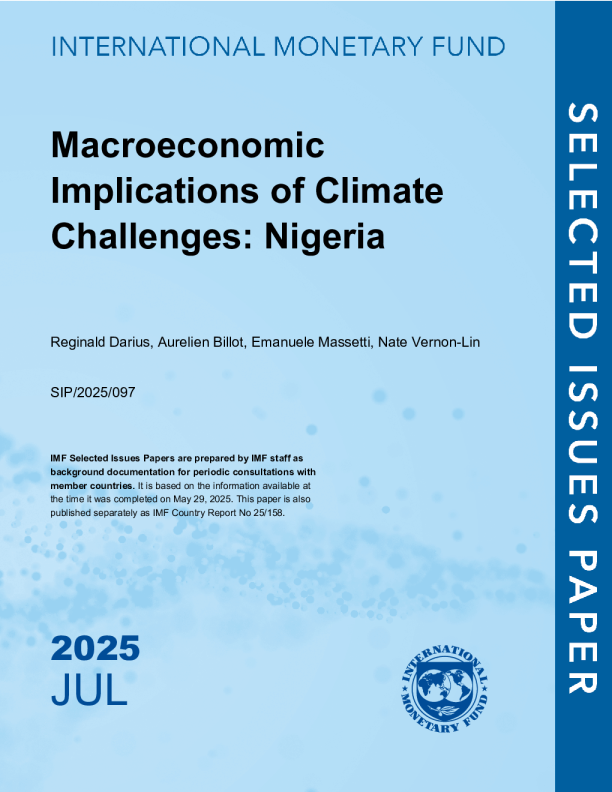
气候挑战对尼日利亚的宏观经济影响

Reginald Darius, Aurelien Billot, Emanuele Massetti, Nate Vernon-Lin SIP/2025/097 IMF Selected Issues Papers are prepared by IMF staff asbackground documentation for periodic consultations withmember countries.It is based on the information available atthe time it was completed on May 29, 2025. This paper is alsopublished separately as IMF Country Report No 25/158. 2025JUL IMF Selected Issues Paper African Department Macroeconomic Implications of Climate Challenges: NigeriaPrepared by Reginald Darius, Aurelien Billot, Emanuele Massetti, Nate Vernon-Lin Authorized for distribution by Axel SchimmelpfennigJuly 2025 IMF Selected Issues Papersare prepared by IMF staff as background documentation for periodicconsultations with member countries.It is based on the information available at the time it wascompleted on May 29, 2025. This paper is also published separately as IMF Country Report No 25/158. ABSTRACT:Climate events significantly impact Nigeria's growth outlook, fiscal sustainability, balance ofpayments and financial sector, potentially undermining macroeconomic stability. Extreme weather events andtheir frequency have a direct effect on growth and the balance of payments. An expected sea level rise wouldpose significant economic cost for Nigeria, damaging infrastructure in coastal areas such as Lagos—the maincommercial and financial center. While relatively small, the financial sector is exposed to spillovers to assetquality and may even be directly impacted via its physical presence in Lagos. Fiscal policy will have to addresslower tax revenues from lower growth and higher demands for spending on disaster relief, infrastructure repair,and investments in climate adaptation and mitigation. As a result, Nigeria will face fiscal and associatedexternal financing gaps. RECOMMENDED CITATION:Darius, R.; A. Billot; E. Massetti and N. Vernon-Lin. 2025. MacroeconomicImplications of Climate Challenges in Nigeria. Selected Issues Paper SIP/2025/097. International MonetaryFund, Washington D.C. SELECTED ISSUES PAPERS Nigeria:MacroeconomicImplications of ClimateChallenges Prepared by Reginald Darius (AFR), Aurelien Billot, Emanuele Massetti,Nate Vernon-Lin (FAD)1 NIGERIA SELECTED ISSUES Approved ByTheAfricanDepartment PreparedBy Reginald Darius(AFR),Aurelien Billot,EmanueleMassetti,and Nate Vernon-Lin(FAD).ChrisStumphius (AFR) provided research assistance and JoannaDelcambre (AFR) editorial support. CONTENTS MACROECONOMIC IMPLICATIONS OF CLIMATE CHALLENGES _____________________2 A. Executive Summary ___________________________________________________________________2B. Introduction ___________________________________________________________________________3C. Adaptation ____________________________________________________________________________4D. Mitigation _____________________________________________________________________________9 FIGURES 1. Climate Disasters ______________________________________________________________________32. Temperature - National Average ______________________________________________________43. Precipitation ___________________________________________________________________________54. Historical Time Series of Selected Indicators of Extreme Weather_____________________55. Macro-economic Impact of Warming and Extreme Weather Events __________________76. Costs of Sea-Level Rise ________________________________________________________________77. Emissions and Emissions-Intensity Relative to Comparator Countries in 2022 ________98. Nigeria's Emissions Profile____________________________________________________________109. Emissions Projections and Impact of Recent Reforms ________________________________1210. Mitigation Costs and Needed Emissions Price to Achieve Mitigation Targets ______1311. Impact of Emissions Pricing on Production Costs by Sector ________________________14 TABLES 1. Summary of Nigeria's Mitigation Main Policies ______________________________________112. Trade-offs Across Policy Instruments_________________________________________________15 References ______________________________________________________________________________18 MACROECONOMIC IMPLICATIONS OF CLIMATECHALLENGES1 Climate events significantly impact Nigeria's growth outlook, fiscal sustainability, balance of paymentsand financial sector, potentially undermining macroeconomic stability. Extreme weather events andtheir frequency have a direct effect on growth and the balance of payments.An expected sea level risewould pose significant economic cost for Nigeria, damaging infrastructure in coastal areas such asLagos—the main commercial and financial center. While relatively small, the financial sector isexposed to spillovers to asset quality and may even be directly impacted via its physical presence inLagos. Fiscal policy will have to address lower tax revenues from lower growth and higher demands forspending on disaster relief, infrastructure repair, and investments in climate adapta