您的浏览器禁用了JavaScript(一种计算机语言,用以实现您与网页的交互),请解除该禁用,或者联系我们。 [亚开行]:减少中华人民共和国农业甲烷排放 - 发现报告

减少中华人民共和国农业甲烷排放

农林牧渔 2025-08-03 亚开行 庄晓瑞
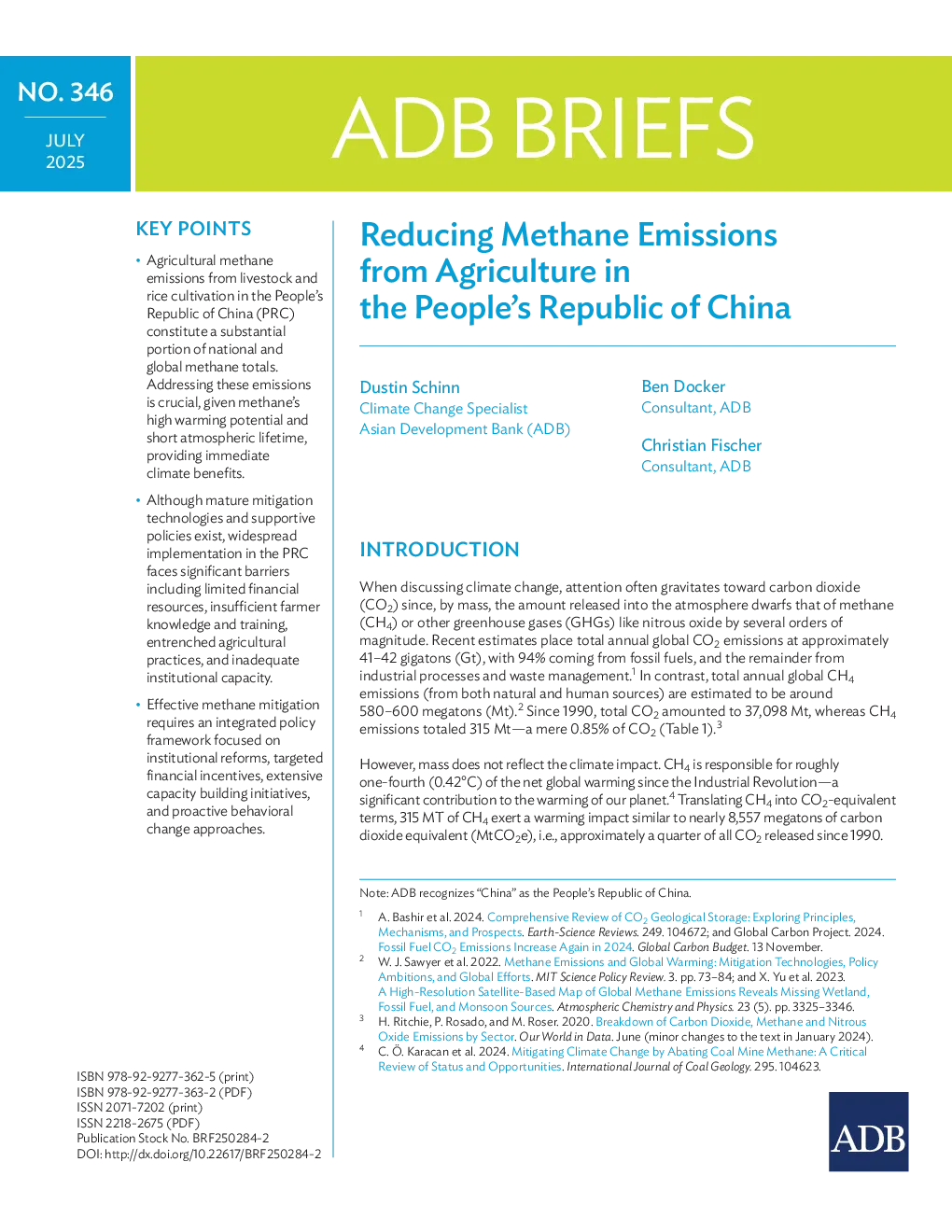
报告封面

KEY POINTS Reducing Methane Emissionsfrom Agriculture inthe People’s Republic of China •Agricultural methaneemissions from livestock andrice cultivation in the People’sRepublic of China (PRC)constitute a substantialportion of national andglobal methane totals.Addressing these emissionsis crucial, given methane’shigh warming potential andshort atmospheric lifetime,providing immediateclimate benefits. Ben DockerConsultant, ADBChristian FischerConsultant, ADB Dustin SchinnClimate Change SpecialistAsian Development Bank (ADB) •Although mature mitigationtechnologies and supportivepolicies exist, widespreadimplementation in the PRCfaces significant barriersincluding limited financialresources, insufficient farmerknowledge and training,entrenched agriculturalpractices, and inadequateinstitutional capacity. INTRODUCTION When discussing climate change, attention often gravitates toward carbon dioxide(CO2) since, by mass, the amount released into the atmosphere dwarfs that of methane(CH4) or other greenhouse gases (GHGs) like nitrous oxide by several orders ofmagnitude. Recent estimates place total annual global CO2emissions at approximately41–42 gigatons (Gt), with 94% coming from fossil fuels, and the remainder fromindustrial processes and waste management.1In contrast, total annual global CH4emissions (from both natural and human sources) are estimated to be around580–600 megatons (Mt).2Since 1990, total CO2amounted to 37,098 Mt, whereas CH4emissions totaled 315 Mt—a mere 0.85% of CO2(Table 1).3 •Effective methane mitigationrequires an integrated policyframework focused oninstitutional reforms, targetedfinancial incentives, extensivecapacity building initiatives,and proactive behavioralchange approaches. However, mass does not reflect the climate impact. CH4is responsible for roughlyone-fourth (0.42°C) of the net global warming since the Industrial Revolution—asignificant contribution to the warming of our planet.4Translating CH4into CO2-equivalentterms, 315 MT of CH4exert a warming impact similar to nearly 8,557 megatons of carbondioxide equivalent (MtCO2e), i.e., approximately a quarter of all CO2released since 1990. Note: ADB recognizes “China” as the People’s Republic of China. 1A. Bashir et al. 2024. Comprehensive Review of CO2Geological Storage: Exploring Principles,Mechanisms, and Prospects.Earth-Science Reviews.249. 104672; and Global Carbon Project. 2024.Fossil Fuel CO2Emissions Increase Again in 2024.Global Carbon Budget. 13 November.2W. J. Sawyer et al. 2022. Methane Emissions and Global Warming: Mitigation Technologies, PolicyAmbitions, and Global Efforts.MIT Science Policy Review.3. pp. 73–84; and X. Yu et al. 2023.A High-Resolution Satellite-Based Map of Global Methane Emissions Reveals Missing Wetland,Fossil Fuel, and Monsoon Sources.Atmospheric Chemistry and Physics.23 (5). pp. 3325–3346.3H. Ritchie, P. Rosado, and M. Roser. 2020. Breakdown of Carbon Dioxide, Methane and NitrousOxide Emissions by Sector.Our World in Data. June (minor changes to the text in January 2024).4C. Ö. Karacan et al. 2024. Mitigating Climate Change by Abating Coal Mine Methane: A CriticalReview of Status and Opportunities.International Journal of Coal Geology.295. 104623. ISBN 978-92-9277-362-5 (print)ISBN 978-92-9277-363-2 (PDF)ISSN 2071-7202 (print)ISSN 2218-2675 (PDF)Publication Stock No. BRF250284-2DOI: http://dx.doi.org/10.22617/BRF250284-2 As of 2025, the remaining carbon budget is shrinking fast: scientistsestimate we can emit only 235 gigatons of carbon dioxide equivalent(GtCO2e) and still retain a 50% chance of staying below 1.5°C,roughly 585 GtCO2e for a 1.7°C limit, and about 1,110 GtCO2e for2.0°C. At today’s output, the 1.5°C allowance would be spent in just6 years, the 1.7°C budget in around 14 years, and the 2.0°C budget inabout 27 years. Although the annual growth of CO2emissions hasslowed from nearly 3.0% per year in the 2000s to roughly 0.6 % peryear between 2014 and 2023, total emissions are still edging upwardrather than falling at the steep rate required.5 wetlands, and thawing permafrost can release large stores ofpreviously frozen organic matter, leading to increased CH4release.Wetland CH4emissions alone could rise 50%–80% this centurywithout mitigation, potentially outpacing all current anthropogenicCH4sources.9 Understanding the origins of this potent GHG is therefore criticalfor targeted mitigation. Global CH4emissions stem from a diversemix of sources, which can be broadly categorized as naturalprocesses and human activities. The Global Methane Budget Studyascribed approximately 40% of global CH4emissions to naturalsources.10These include emissions from wetlands, other inlandwater systems (such as lakes, ponds, and rivers), geological seeps(onshore and offshore), wild animals, and oceans. As noted, someof these natural emissions are highly sensitive to climate changeitself, creating potential positive feedback loops that can furtheramplify global warming. The vast differences betwee