AI智能总结
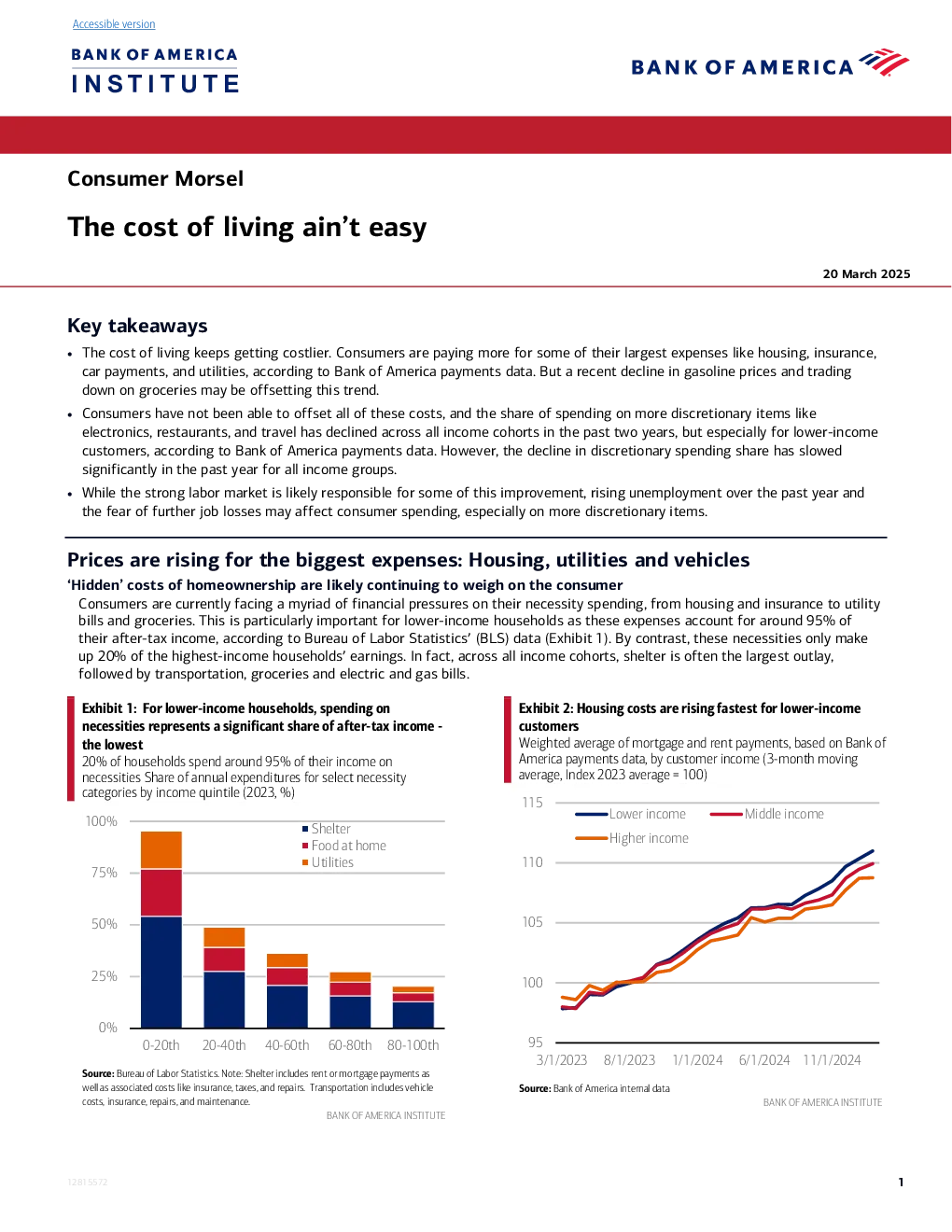
The cost of living ain’t easy Key takeaways •The cost of living keeps getting costlier. Consumers are paying more for some of their largest expenses like housing, insurance,car payments, and utilities, according to Bank of America payments data. But a recent decline in gasoline prices and tradingdown on groceries may be offsetting this trend. •Consumers have not been able to offset all of these costs, and the share of spending on more discretionary items likeelectronics, restaurants, and travel has declined across all income cohorts in the past two years, but especially for lower-incomecustomers, according to Bank of America payments data. However, the decline in discretionary spending share has slowedsignificantly in the past year for all income groups. •While the strong labor market is likely responsible for some of this improvement, rising unemployment over the past year andthe fear of further job losses may affect consumer spending, especially on more discretionary items. Prices are rising for the biggest expenses: Housing, utilities and vehicles ‘Hidden’ costs of homeownership are likely continuing to weigh on the consumerConsumers are currently facing a myriad of financial pressures on their necessity spending, from housing and insurance to utility bills and groceries. This is particularly important for lower-income households as these expenses account for around 95% oftheir after-tax income, according to Bureau of Labor Statistics’(BLS) data (Exhibit 1). By contrast, these necessities only makeup 20% of the highest-income households’earnings. In fact, across all income cohorts, shelter is often the largest outlay,followed by transportation, groceries and electric and gas bills. Exhibit2:Housing costs are rising fastest for lower-incomecustomersWeighted average of mortgage and rent payments, based on Bank of Exhibit1:For lower-income households, spending onnecessities represents a significant share of after-tax income -the lowest20% of households spend around 95% of their income on America payments data, by customer income (3-month movingaverage, Index 2023 average = 100) necessities Share of annual expenditures for select necessitycategories by income quintile (2023, %) Using a weighted average for mortgages and rents (see Methodology), we find that housing costs are continuing to increase forall income cohorts, but especially for lower-income customers. Their rent and mortgage payments was up 11% in Februarycompared to the 2023 average, according to Bank of America payments data. By contrast, higher-income customers have onlyseen a 9% average increase (Exhibit 2). It’s likely that lower-income consumers are getting hit harder as apartment rental increases spread to less expensive areas (seeMethodology andour recent analysis on rents by area). At the same time, those with higher incomes may be benefitting from arelatively smaller increase because homeownership tends to skew toward higher-income individuals, and monthly mortgage (e.g.,principal and interest) payments typically do not change over time. Those customers may have also locked in lower paymentsduring the historic decline in mortgages rates seen during the pandemic. Yet those who earn more haven’t entirely been protected from bigger bills. In fact, they have been pinched by the‘hidden’costsof homeownership including rising insurance or property tax payments often added into monthly mortgage payments (read moreabout this inour previous analysis on the hidden cost of housing). Rising utility and vehicle costs are also a pressure pointThere is other evidence that consumers are continuing to see higher insurance costs as well. Insurance payments of all types ticked up for all income levels last month. Consumers’direct payments to insurance providers were up over 6% year-over-year(YoY), with payments for middle- or higher-income customers growing slightly faster, according to Bank of America paymentsdata. By contrast, motor vehicle insurance premiums were up significantly more at 11% YoY, according to Consumer Price Index(CPI) inflation data from the BLS, although both price growth and payment growth has nearly halved in the past year (Exhibit 3). Exhibit3: Insurance payments rose over 6% YoY in Februaryacross all income cohorts, while motor vehicle insurance prices were Exhibit4: Utility payments rose faster thanenergyprices inFebruaryAverage utility payments per customer by income, based on Bank of up 11% YoYInsurance payment amounts per customer by income, based on America payments data (3-month moving average, YoY%) andenergy services inflation rates, based on BLS data (monthly, YoY%) Bank of America payments data (3-month moving average, YoY%)and motor vehicle insurance inflation rates, based on BLS data(monthly, YoY%) And it’s not just insurance. Bank of America internal data suggests that utility payments increased faster YoY than BLS inflationrates in February across all income cohorts (Exhibit 4). Consumers likely c