2014年阿拉伯政府服务展望
 AI智能总结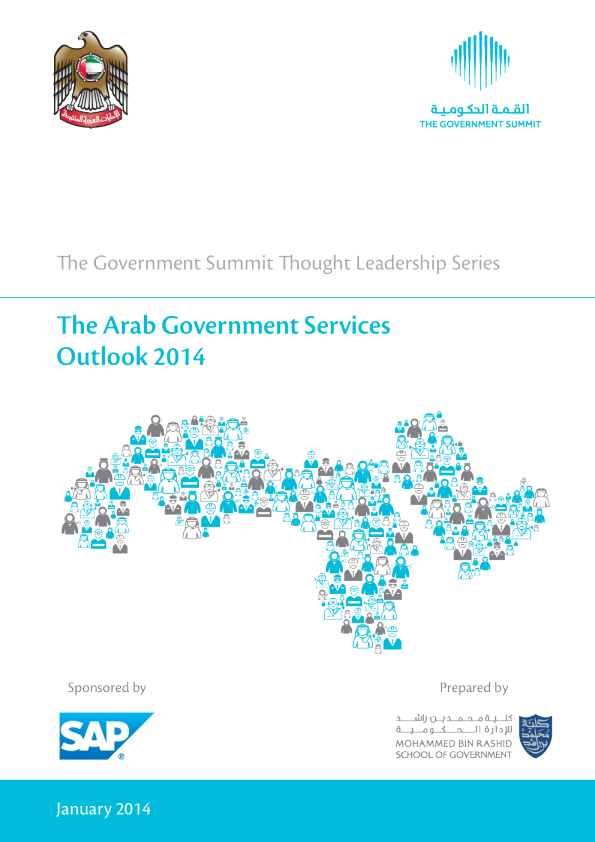
⅓e Arab Government Services Outlook 2014INDEX IntroductionWhat Arab Governments Need to KnowAbout Government ServicesBibliographyWhat Government Told Us aboutGovernment ServicesWhat Customers told us aboutGovernment ServicesAcknowledgementsAnnex I: Research Methodology: Citizensand Government SurveysAnnex II: Demographic Breakdowns5632710242630 1World Bank classifications were used because they are one of the most frequently cited income-based classifications in development studies, scholarly circles and international organizations. Moreinformation on World Bank classifications available at: http://data.worldbank.org/about/country-classifications2Low income countries in the Arab world (Comoros, Djibouti, Somalia) were not included in this study due to a low response rate to the survey.* Additionally, a showcase of selected practices on innovations in government service design and delivery in the form of case studies from around the Arab world is published as complementarypublications. See: “Innovations from Across the Arab World: Making Government “Smarter”, Cutting Red-tape, and Creating Value Partnerships”. (Eds.) Fadi Salem with Racha Mourtada and SarahAlshaer, The 2nd Government Summit 2014. Dubai: Governance and Innovation Program, MBR School of Government.IntroductionRising citizen expectations have made efficient, relevant, qualitypublic sector services the key government ‘products’ requestedby public service ‘customers’. In the Arab world, enhancing thequality, efficiency and accessibility of public sector servicesrequires government institutions to apply creative approachesto service design and delivery processes. Fostering a citizen-centric culture in the design and delivery of public services inthe Arab region can potentially create new and locally-fittingsolutions to public services challenges, as well as improvingquality of services related to education, unemployment, andsocial affairs among others.Despite the wide acceptance of the need for enhanced servicesin the Arab World, efforts to understand the intricaciesof public service development are limited, especially on aregional level. For this reason, the Governance and InnovationProgram at the Mohammed bin Rashid School of Governmentconducted regional research examining the state of publicservices in the Arab world. This report aims to improveunderstanding of public service delivery in the Arab regionby providing a broad view of service delivery environments,outputs and enablers; as well as regional challenges andstrengths, and the overall quality of public services in the Arabworld.This report is comprised of two main components*:•The results of a survey of key official Arab governmententities which focused on internal service delivery activities ofgovernment organizations.•The results of an Arab regional ‘customer’ satisfaction surveywhich focused on customer experience and satisfaction withpublic services. ⅓e Arab Government Services Outlook 2014WhileArab countries share many traits,challenges andopportunities in terms of service delivery, there is clear diversityin many environmental contexts affecting the public sector.Factors such as wealth, population sizes, geography, and socialconditions affect service delivery in each of these countriesdifferently. As such, the analysis of the regional findings wassupplanted with an analysis of survey findings across threegroups -using Gross National Product (GNP) classificationsused by the World Bank1-2:•Lower-middle income: Egypt, Mauritania, Morocco, Palestine,Sudan, Syria, Yemen•Upper-Middle income: Algeria, Iraq, Jordan, Lebanon, Libya,Tunisia•High income: Bahrain, Kuwait, Oman, Qatar, Saudi Arabia,UAE ⅓e Arab Government Services Outlook 2014What Arab Governments Need to KnowAbout Government Services1. Services that are designed usingcustomer input and feedback are seen asmore relevant and of better qualityRespondents to the public survey indicated higher levels ofsatisfaction with services on which their feedback and inputwas elicited. Despite the strong co-relation between servicesatisfaction and customer input, the survey showed a gap ingovernment needs assessment initiatives. Less than 25% ofpublic services customers in high income countries reportedbeing asked for their input when designing or deliveringservices, this percentage drops to below 15% in middle incomecountries. However, amongst those who were being asked fortheir feedback and input into the service design and deliveryprocess, satisfaction with services was noticeably higher.2.The adoption of electronic servicesacross the Arab world has positivelyimpacted service accessibility, efficiencyand quality. Most Arab governments,however, are yet to transition tom-services and have as a result, notreaped the benefitsArab governments are integrating ICT into service deliveryat different rates. While all countries in the Arab world haveprovided at least a baseline of e-government services, theprovision of mobile applications and soci