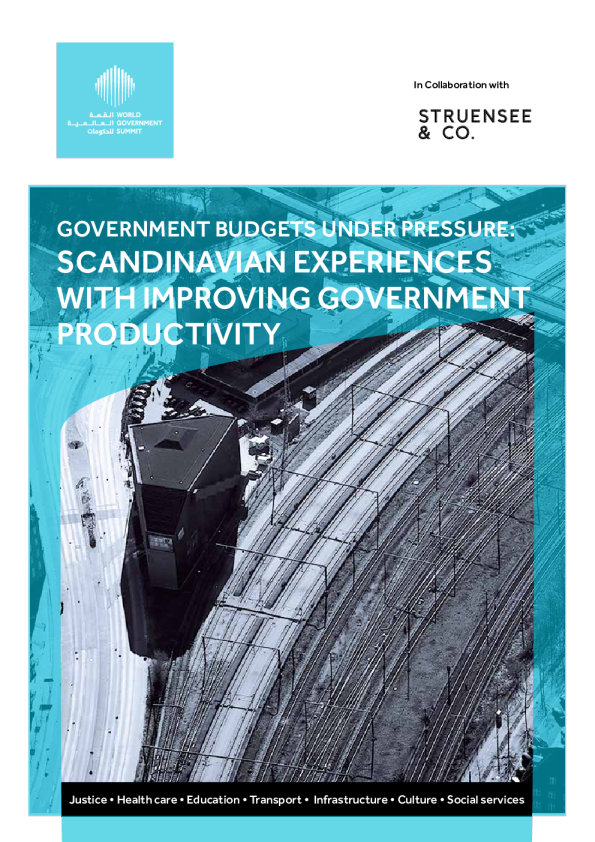
政府预算面临压力:斯堪的纳维亚提高政府生产力的经验
PRODUCTIVITY CONTENT03INTRODUCTIONScandinavian experienceswith improving governmentproductivityLevers to improve publicsector productivity06SPENDING REVIEWS:A JOURNEY FORIMPROVING GOVERNMENTPRODUCTIVITYCase: Spending reviews ofScandinavian universitiesCase: A spending review ofa Scandinavian police force12SHARED SERVICECENTERS – A LEVER TOINCREASE PRODUCTIVITYAND QUALITY OFSUPPORT FUNCTIONSCase: Establishment ofstate-wide administrativeservice centersCase: Establishing sharedservice center for payrolland accounts14IMPROVING CORESERVICES THROUGHTIME ANALYSISCase: Time use in nursingservicesCase: Analysis of time useas a lever to identify bestpractice in investigation DECREASINGPROCUREMENT SPENDINGWHILE MAINTAINING ORINCREASING QUALITYAND QUANTITYCase: Procurement projectfor a national broadcastingagencyPUBLIC INVESTMENTMANAGEMENT – A LEVERTO OPTIMIZE CAPITALEXPENDITURECase: Achieving costreductions and timelydelivery of a multibillionrailway projectCAPACITY UTILIZATIONANALYSIS – A LEVER TOINCREASE UTILITY OFPUBLIC SECTOR ASSETSCase: Capacity utilizationat a Scandinavian universityCase: Increasing useof existing capacity fornational broadcasterCase: Redesigningprocesses to increasecapacity utilization in thehealth care sectorABOUT THE AUTHORS 16182022 INTRODUCTIONGovernments across the globe are facing increasing pressures on public expenditure due to a plurality of factors.On one hand, the increasing expectations of citizens regarding private consumption is paralleled by increasingdemands on government services. At the same time, revenue streams are drying up due to modest growth scenarios,falling oil prices and hurtful consequences of taxes and fees. The expansionary efforts to steer economies back onthe right track following the crisis have also in many cases led to substantial fiscal deficits and rising debt levels.Governments are thus looking at ways to reduce spending and make ends meet. To a large degree, governmentslook to initiatives such as raising taxes and fees, reducing social benefits and entitlements as well as cutting backon services.This report posits, that there is an alternative approach, which has received less attention than it deserves:Governments can improve public finances and performance by increasing productivity rather than reducing publicsector output.Improving public sector productivity raises a need to increase transparency about governments’ service deliverymodel and the link between output and resource use. With this kind of transparency, there are many opportunitiesfor identifying and accomplishing improvements to public sector productivity in order to get as much as possibleout of scarce resources.This report looks closer at the Scandinavian experience with increasing public sector productivity, e.g. throughspending reviews, which typically result in budget improvements of 10–20%. The report can thus be seen as aninspirational catalogue for governments facing the same challenges.Lessons learned from Scandinavia~20 years ago, the Scandinavian countries were plagued by mounting fiscal deficits and oppressive public debt.In many ways, they faced a fiscal situation that is similar to the current situation in GCC countries today.The Scandinavian countries, Sweden and Denmark in particular, addressed this challenge through a continuous focuson increasing public sector productivity. It involved a number of different initiatives. Some of the larger structuralreforms involved restructuring the labor market model, strengthening the educational system and reforming thetax system. These reforms resulted in decreasing debt over the coming years along with a significant improvementin public deficit.Along with structural reforms, the Scandinavian countries focused on increasing the transparency in the linkbetween government spending and productivity through analyses. This has strengthened public sector performance,resulting in wealthier people, job creation and improved government performance.The global financial crisis starting in 2007 has since challenged these positive developments, but still leaves theScandinavian countries in good shape. Exhibit 1: The Scandinavian countries are characterized by large public sectors,which contribute considerably to GDPSCANDINAVIAN EXPERIENCES WITH IMPROVINGGOVERNMENT PRODUCTIVITYThe Scandinavian experience thus consists of +20 yearsof refinement of the tools for improving productivity.Thisis pivotal as the Scandinavian countries allhave large public sectors, as illustrated in exhibit 1.This makes ongoing productivity improvements inthe public sector an important part of the overallcompetitiveness of the countries.As an example, Denmark is conducting spendingreviews on an on-going basis, targeting all majorparts of the public sector at least every fifth year. Thereviews cover core sectors such as defense, police,transport, infrastructure and utilities. Denmark alsoconducts cross-sectoral spending reviews focusingon administrative shared service cen